


Introduction
Let’s imagine a growing business.
At the beginning, everything is manageable. Sales are tracked in spreadsheets, inventory is updated manually, and finance teams rely on accounting software. Reports are prepared at the end of the month, and decisions are mostly based on experience.
For a while, this system works.
But as the company grows, things begin to change quickly.
More customers come in. Orders increase. Inventory becomes harder to track. Finance teams spend more time preparing reports. Different departments start using different tools to manage their work.
Soon the business realizes something important: growth has created operational complexity.
At this stage, many companies begin looking for a solution that can connect their entire business. This is where ERP systems like SAP Business One enter the picture.
However, adopting ERP software alone is not enough. Businesses also need the right guidance, implementation expertise, and long-term support.
That is why choosing a trusted SAP Business One ERP vendor or working with one of the best SAP solution providers in Oman becomes one of the most important decisions in a company’s digital transformation journey.
Why Digital Transformation Has Become a Business Priority
Over the last decade, the way businesses operate has changed dramatically.
Customers expect faster service. Markets move quickly. Competition is stronger than ever. Companies need accurate information to make decisions quickly.
In this environment, manual processes and disconnected systems create serious limitations.
For example:
A sales team may not know the exact inventory availability when confirming orders.
Finance teams may take days to prepare reports.
Management may struggle to access real-time insights about the business.
Digital transformation helps businesses solve these challenges by using integrated technologies that connect data, processes, and teams.
Instead of managing separate tools for each department, companies use centralized systems that streamline operations. Many organizations today actively search for SAP digital transformation services near me to accelerate their modernization journey.
ERP platforms like SAP Business One are designed specifically for this purpose.
What Makes SAP Business One Ideal for Growing Companies
Many ERP systems are built for large enterprises and require complex infrastructure.
SAP Business One is different.
It is designed specifically for small and medium-sized businesses that want enterprise-level capabilities without unnecessary complexity.
With SAP Business One, organizations can manage multiple operations from a single platform, including:
- Finance and accounting
- Sales management
- Customer data
- Purchasing operations
- Inventory and warehouse management
- Production processes
- Business reporting
The system provides real-time data across departments, helping businesses improve efficiency and make smarter decisions.
Companies working with a best SAP Business One consulting company often customize the system based on their specific operational needs, including services like SAP Business One customization Dubai for regional deployments.
But for this system to work effectively, it must be implemented correctly. That is where the role of an experienced ERP vendor becomes essential.
The Strategic Role of an SAP Business One ERP Vendor
When companies hear the term “ERP vendor,” they sometimes assume the vendor’s job is simply to install the software.
In reality, the role of a trusted SAP Business One ERP vendor goes far beyond technical deployment.
A good ERP vendor becomes a strategic partner who helps the business rethink its processes and build a stronger operational foundation.
Their role typically includes:
- understanding the company’s operational challenges
- recommending the right ERP structure
- configuring SAP Business One modules
- migrating business data safely
- training employees to use the system
- providing long-term technical support
Many organizations also rely on ERP vendors for SAP support and maintenance services, SAP AMS services, and SAP application management services to ensure the system runs smoothly after implementation.
Evaluating the Business Before Implementation
Every business operates differently.
Even companies within the same industry often have unique processes and operational structures.
Because of this, ERP implementation always begins with a business evaluation phase.
During this stage, the ERP vendor studies how the organization currently works.
They examine how orders are processed, how inventory is managed, how financial transactions are recorded, and how management reports are generated.
This analysis helps identify inefficiencies such as:
- duplicate data entry
- delays in reporting
- lack of communication between departments
- manual processes that slow down operations
Organizations planning global expansion may also evaluate requirements for SAP multi company rollout or choose a reliable SAP global rollout partner to support deployments across multiple locations.
Designing an ERP System That Matches Business Needs
After understanding the organization’s operations, the next step is designing the ERP environment.
This phase focuses on translating business processes into digital workflows.
For example, a company may want automated approval systems for purchases. Another business may require detailed inventory tracking across multiple warehouses.
The ERP vendor configures SAP Business One to support these requirements.
This design stage also defines:
- user roles and permissions
- financial reporting structures
- product and inventory categorization
- approval workflows
- operational dashboards
In many cases, businesses also require SAP system integration services near me to ensure SAP Business One connects with CRM platforms, logistics tools, or eCommerce systems.
Preparing Business Data for the ERP System
One of the biggest challenges during digital transformation is dealing with existing data.
Businesses often have years of information stored across spreadsheets, accounting tools, and legacy software.
Moving this information into a new ERP system requires careful preparation.
Before migration begins, the ERP vendor reviews and cleans the data.
They ensure that customer records are accurate, product data is consistent, and financial information is structured properly.
Once the data is prepared, it is transferred into SAP Business One.
Accurate data migration is critical because the ERP system will rely on this information for reporting and decision-making.
Connecting ERP With Other Business Tools
Modern organizations often use multiple digital tools alongside ERP systems.
For example, a business might use CRM software to manage customer relationships or an eCommerce platform to handle online orders.
A trusted ERP vendor ensures that SAP Business One integrates smoothly with these tools.
Integration allows systems to share information automatically.
For instance:
Sales orders from an online store can automatically update inventory.
Customer information from CRM systems can sync with accounting data.
Financial transactions can update reporting dashboards in real time.
Many businesses today work with a SAP managed services provider near me to maintain integrations and system performance across their digital ecosystem.
Preparing Employees for the New System
Technology alone cannot transform a business.
Employees must be comfortable using the new system in their daily work.
This is why training plays a crucial role in ERP implementation.
The ERP vendor organizes training sessions for different teams within the company.
Finance teams learn how to generate reports and manage accounting workflows.
Sales teams learn how to create orders and track customers.
Operations teams learn how to manage inventory and purchasing activities.
Companies working with experienced vendors such as a SAP partner in Qatar, SAP consulting partner Qatar, or a SAP B1 partner in Saudi Arabia often benefit from structured training and support frameworks.
Launching the ERP System
Once the system configuration, data migration, and training are complete, the company is ready to launch SAP Business One.
This stage is often referred to as the go-live phase.
During this period, the ERP vendor monitors system performance closely to ensure everything works smoothly.
They verify that transactions are processed correctly, reports generate accurate information, and users can access the system without issues.
Quick troubleshooting during this stage helps prevent disruptions to business operations.
Continuous Support After Implementation
Digital transformation does not end once the ERP system is launched.
Businesses continue evolving, and their systems must evolve as well.
A trusted SAP Business One ERP vendor provides long-term support that includes:
- system updates and maintenance
- performance monitoring
- troubleshooting technical issues
- adding new modules as the business grows
- providing additional user training
Many organizations rely on SAP managed services in Chennai, SAP application management services Dubai, or global service teams to maintain system performance and ensure operational continuity.
The Long-Term Impact of ERP on Business Growth
When implemented correctly, SAP Business One can transform how a company operates.
Instead of relying on manual processes, businesses gain automated workflows.
Instead of waiting days for reports, management can access real-time dashboards.
Instead of managing disconnected tools, organizations operate through a single integrated system.
This transformation leads to:
- faster decision-making
- improved operational efficiency
- better financial control
- enhanced customer service
- stronger scalability for future growth
For many organizations, ERP becomes the foundation that supports long-term digital transformation.
Choosing the Right ERP Partner
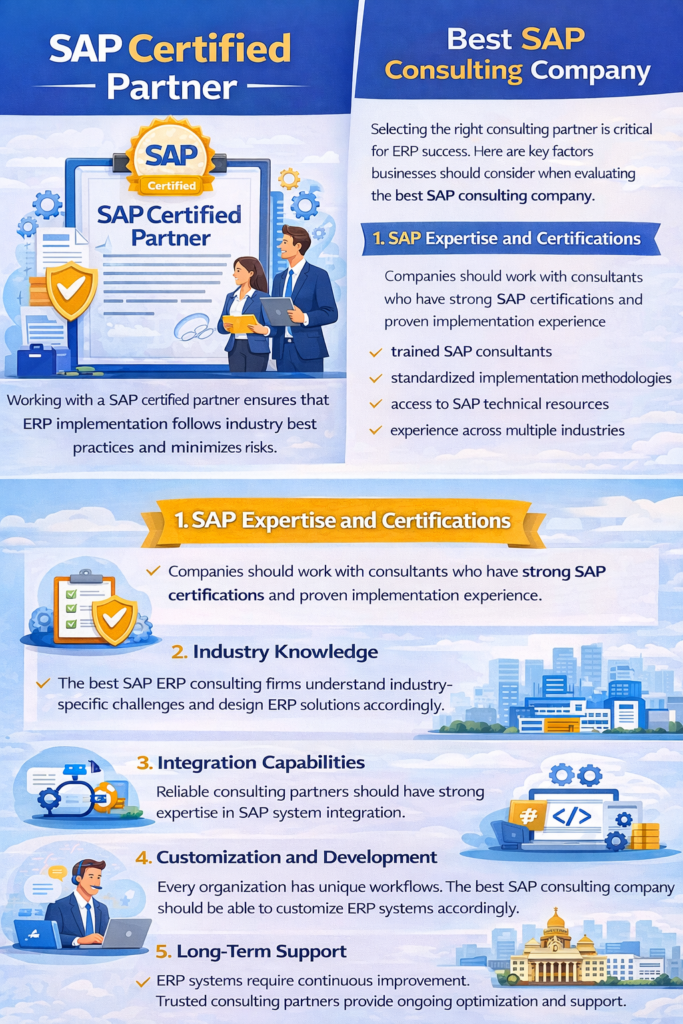
Selecting the right SAP Business One vendor requires careful evaluation.
Businesses should consider factors such as:
- experience with SAP Business One implementations
- industry expertise
- certified consultants
- implementation methodology
- post-implementation support services
Some companies may also evaluate vendors offering specialized services such as SAP Ariba implementation services in Bangalore or global rollout expertise when expanding their digital operations.
A strong ERP vendor does more than install software. They help businesses rethink their processes and adopt smarter ways of working.
Conclusion
Digital transformation is no longer just a trend—it has become a necessity for businesses that want to remain competitive in a rapidly changing market.
ERP systems like SAP Business One play a critical role in helping organizations modernize their operations and improve decision-making.
However, technology alone cannot drive transformation.
The expertise of a trusted SAP Business One ERP vendor ensures that the system is implemented correctly, employees adopt it successfully, and the organization gains long-term value from its investment.
With the right ERP partner and the support of experienced consultants and best SAP solution providers in Oman, businesses can move beyond manual processes and build a connected, data-driven organization ready for the future.
