


Introduction
Companies today rely heavily on technology to run their daily operations. Finance teams need accurate reporting. Sales teams need visibility into customer orders. Inventory teams need real-time stock data. Management teams need reliable insights to make faster decisions.
When these systems are disconnected, businesses start facing problems.
Orders may not reflect accurate inventory. Financial reports may take days to prepare. Teams often depend on manual processes or multiple tools that do not communicate with each other.
This is exactly why many organizations adopt enterprise systems like SAP ERP.
SAP ERP platforms bring different business processes together into a single connected environment. Finance, sales, procurement, inventory, and operations can all work within the same system.
But implementing an ERP platform is not just about installing software.
It requires planning, system integration, data migration, and long-term support. This is where working with an SAP official partner or an experienced SAP consulting services provider becomes extremely important.
A trusted SAP business solutions provider helps businesses implement ERP correctly, integrate it with other business systems, and maintain the platform as operations grow. Organizations searching online for SAP services near me, SAP consultants near me, or SAP company near me often look for certified partners who can guide them through ERP implementation and support.
For organizations implementing solutions like SAP Business One, choosing the #1 SAP official partner for SAP ERP integration and support can make a significant difference in the success of their digital transformation journey.
Many businesses also work with specialized partners offering SAP ERP services, SAP rollout services, SAP migration services, and SAP upgrade services as part of their ERP transformation strategy.
Why Businesses Choose SAP ERP Platforms

Organizations today generate large volumes of operational data every day.
Sales transactions, purchase orders, financial entries, inventory movements, and customer records all need to be managed efficiently.
When companies rely on multiple disconnected systems, managing this data becomes complicated.
ERP platforms solve this problem by centralizing business information.
With SAP ERP systems, companies can manage:
• Financial accounting
• Sales and customer management
• Purchasing and procurement
• Inventory and warehouse operations
• Production planning
• Business reporting and analytics
Instead of switching between different tools, teams can access information from a single system.
This improves operational efficiency and helps management make faster decisions based on real-time data.
Many organizations implementing ERP system implementation in Bangalore or End-to-end ERP solutions in Bangalore are choosing SAP because it provides a scalable foundation for long-term digital operations.
However, for ERP systems to deliver these benefits, they must be implemented and integrated correctly.
That responsibility usually falls on experienced SAP consulting services teams and certified SAP partners.
What Does an SAP Official Partner Do?
Many businesses assume that an ERP vendor simply installs the software and leaves.
In reality, the role of an SAP official partner is much broader.
These partners guide organizations through the entire ERP journey — from planning and implementation to system optimization and ongoing support.
Their responsibilities often include:
• Understanding the company’s business processes
• Designing the ERP system architecture
• Implementing SAP modules
• Integrating ERP with existing systems
• Migrating historical data
• Training employees
• Providing technical support and maintenance
Many organizations also rely on partners providing SAP application management services, SAP managed services in Chennai, and SAP AMC services in Chennai to ensure their ERP environment runs smoothly after implementation.
An experienced SAP partner acts as a long-term technology advisor for the organization.
Instead of simply deploying software, they help companies build a stable digital foundation that supports future growth.
Understanding SAP ERP Integration
One of the most important aspects of ERP implementation is system integration.
Most organizations already use several business tools before implementing ERP.
For example, companies may use:
• CRM systems for customer management
• eCommerce platforms for online sales
• HR systems for employee data
• logistics platforms for supply chain management
If these systems remain isolated, employees must manually transfer data between them.
This increases the risk of errors and slows down operations.
SAP ERP integration solves this issue by connecting different systems together.
When integration is done correctly:
• Sales orders automatically update inventory
• Customer information syncs with finance systems
• Procurement updates financial records
• Reports generate automatically from real-time data
Businesses searching for SAP solutions near me, SAP provider near me, or SAP support near me often need partners who specialize in these types of integrations.
A skilled SAP partner ensures that all these systems communicate seamlessly.
The Role of SAP Partners in ERP Implementation
ERP implementation is a complex process that usually happens in several stages.
An experienced SAP official partner or SAP digital transformation partner manages each of these stages carefully to ensure a smooth transition.
The typical ERP implementation process includes:
Business Process Assessment
Before implementation begins, the SAP partner studies how the company currently operates.
They analyze how sales orders are processed, how procurement works, how inventory is tracked, and how financial reporting is handled.
This helps identify operational gaps and areas where ERP can improve efficiency.
System Design
After understanding the business requirements, the SAP partner designs the ERP environment.
This includes defining workflows, configuring modules, and setting up user roles and permissions.
The goal is to ensure that the ERP system reflects the company’s real operational structure.
Data Migration
Businesses often have years of data stored across spreadsheets and legacy systems.
Moving this information into SAP ERP requires careful preparation.
The SAP partner performs SAP migration services to clean, organize, and transfer data to ensure accuracy and consistency.
System Integration
ERP platforms must connect with other business tools.
SAP partners handle these integrations to ensure seamless data flow between systems.
User Training
Employees must learn how to use the new system effectively.
SAP partners conduct training sessions for different departments to ensure smooth adoption.
Go-Live and Support
Once everything is ready, the system goes live.
During this phase, SAP partners monitor performance and quickly resolve any technical issues.
Organizations across regions often rely on partners such as a SAP partner in KSA, SAP partner Ras Al Khaimah, or SAP support services in Qatar to provide localized implementation expertise.
Why Integration and Support Matter After Implementation
Many companies believe ERP projects end once the system goes live.
In reality, that is just the beginning.
Businesses continue evolving. New departments are added. Operations expand to new regions. Additional software tools may be introduced.
ERP systems must adapt to these changes.
This is why ongoing integration and technical support are essential.
A reliable SAP official partner provides continuous services such as:
• system monitoring
• technical troubleshooting
• performance optimization
• system upgrades
• integration with new business tools
Organizations across the GCC often work with partners providing SAP support services in UAE, SAP support services in Qatar, and regional ERP support teams.
Benefits of Working With the #1 SAP Official Partner
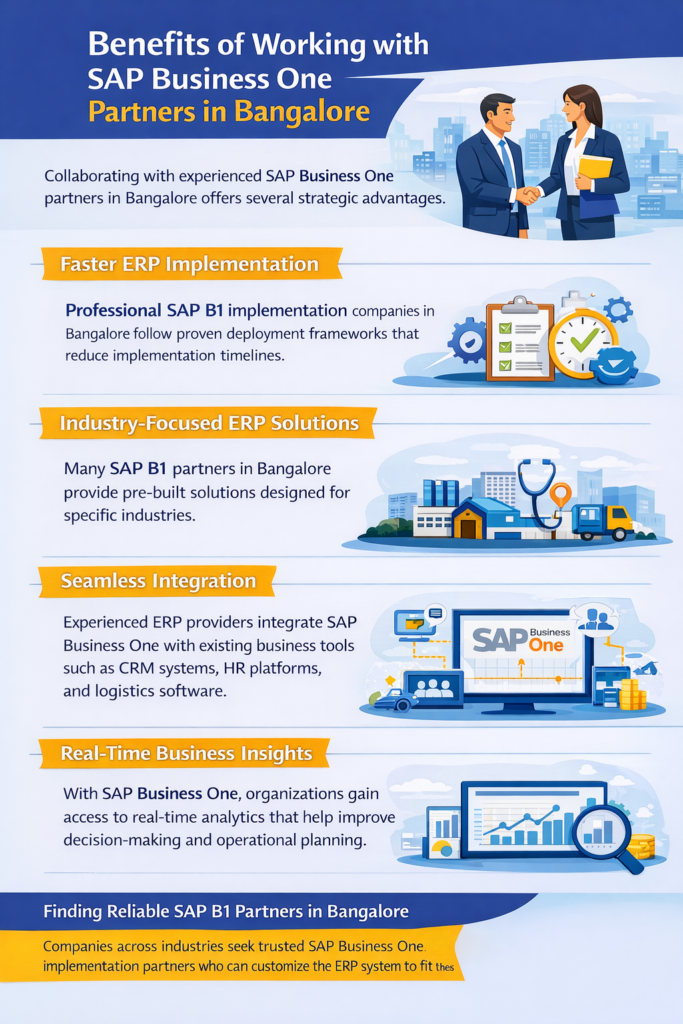
Choosing an experienced SAP partner can significantly improve the success of ERP implementation.
Organizations working with trusted SAP consulting services providers often experience several benefits.
Faster Implementation
Experienced consultants follow proven methodologies that reduce implementation time.
Reduced Operational Risk
ERP projects involve complex technical processes. Skilled partners help minimize errors during deployment.
Better System Integration
Professional partners ensure that ERP connects smoothly with other business systems.
Stronger User Adoption
Training and support help employees adapt quickly to the new platform.
Long-Term System Reliability
Continuous support ensures the ERP environment remains stable and secure.
Companies across the Middle East often partner with specialists such as:
• best SAP B1 partner in Oman
• top SAP B1 partners in Kuwait
• SAP B1 partner Sharjah
• top SAP B1 partners in Bahrain
These partners provide regional ERP expertise and local business understanding.
How to Identify the Right SAP Official Partner
Choosing the right SAP partner is a critical decision.
Businesses should evaluate several factors before selecting an implementation partner.
Important considerations include:
• SAP certification and partnership status
• experience with ERP implementation projects
• industry expertise
• integration capabilities
• long-term support services
• customer success track record
Companies looking for custom ERP solutions Abu Dhabi or SAP support services in UAE should always verify the partner’s SAP certifications and implementation experience.
A strong SAP partner focuses not just on software implementation but on helping businesses achieve real operational improvements.
The Future of ERP Integration
ERP systems are continuing to evolve as organizations adopt new technologies.
Modern ERP platforms are increasingly connected with tools such as:
• cloud applications
• AI-driven analytics
• supply chain automation platforms
• customer experience systems
This makes ERP integration even more important.
Businesses that invest in strong ERP foundations today will be better positioned to adopt advanced technologies in the future.
An experienced SAP digital transformation partner helps organizations integrate these new technologies with their ERP environment.
Conclusion
Enterprise systems have become essential for organizations that want to operate efficiently and scale their operations.
Platforms like SAP ERP and SAP Business One help businesses connect departments, automate workflows, and gain real-time insights into their operations.
However, the success of an ERP system depends heavily on proper implementation, system integration, and long-term support.
This is why working with the #1 SAP official partner for SAP ERP integration and support is so important.
An experienced SAP business one ERP partner, SAP B1 partner, or SAP business one official partner ensures that businesses not only implement ERP successfully but also continue to optimize their systems as their operations grow.
With the right partner and the right strategy, organizations can build a connected, data-driven business environment that supports long-term digital transformation.
FAQ’s
1. What is an SAP Official Partner?
An SAP Official Partner is a certified company authorized to implement, customize, and support SAP solutions. These partners have trained consultants who help businesses deploy ERP systems, integrate processes, and manage ongoing SAP operations.
2. Why should businesses work with an SAP Official Partner?
Working with an SAP partner ensures proper ERP implementation, system integration, and long-term technical support. Certified partners follow SAP best practices, which helps businesses reduce risks and improve operational efficiency.
3. What services does an SAP Official Partner provide?
SAP partners typically offer services such as ERP implementation, system integration, customization, data migration, employee training, and post-implementation support to keep the system running smoothly.
4. How does SAP ERP integration help businesses?
ERP integration connects different business functions like finance, sales, procurement, and inventory in one system. This improves data accuracy, reduces manual work, and provides real-time insights for better decision-making.
5. What is the difference between SAP ERP and SAP Business One?
SAP ERP is designed for medium and large enterprises with complex operations, while SAP Business One is built for small and mid-sized businesses that need a simplified but powerful ERP platform.
