


As the UAE e-invoicing mandate evolves, businesses must ensure their ERP systems are technically aligned with the national e-invoice exchange framework. A compliant implementation is not just about generating invoices; it requires a robust integration architecture that supports validation, clearance, reporting, and long-term compliance.
This blog explains the SAP and ERP e-invoicing integration architecture in the UAE, covering API models, middleware layers, security controls, and compliance automation aligned with the PINT AE framework.
Why ERP Integration Architecture Matters for UAE E-Invoicing?
UAE e-invoicing operates on a clearance-based, API-driven model. ERP systems must exchange structured invoice data securely with Accredited Service Providers (ASP) in real time.
A well-designed architecture ensures:
- Regulatory compliance
- High availability and performance
- Secure data transmission
- Scalability for future mandates
- Audit-ready reporting and archiving
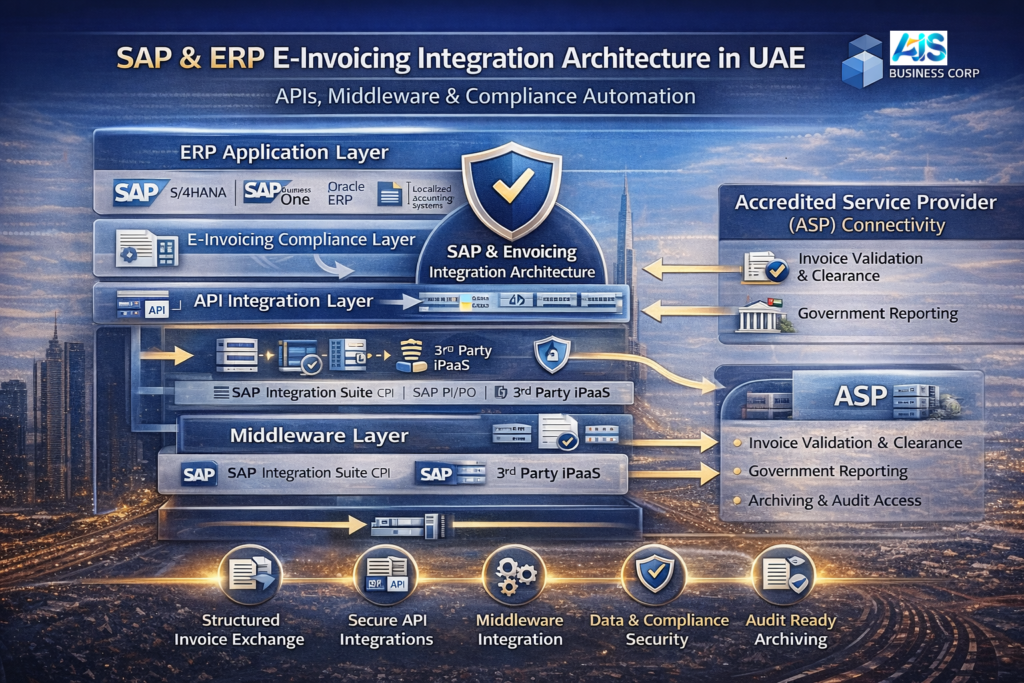
Core Components of UAE E-Invoicing Integration Architecture
A compliant architecture typically consists of the following layers:
1. ERP Application Layer (SAP & Non-SAP)
This is where invoices are created and managed.
Supported platforms include:
The ERP must support UAE VAT localization and structured invoice data generation.
2. E-Invoicing Compliance Layer
This layer handles:
- Invoice data mapping to PINT AE standards
- Business rule validation
- Tax calculation verification
- Multi-language invoice handling (English / Arabic)
It acts as a buffer between ERP and external systems.
3. API Integration Layer
The API layer enables secure, real-time communication between ERP and the ASP.
Key characteristics:
- REST or SOAP APIs
- Encrypted data exchange
- Token-based authentication
- Real-time status updates
This layer is essential for submission, clearance, and reporting workflows.
4. Middleware & Integration Platform
Middleware plays a critical role in:
- Message transformation
- Error handling and retries
- Load balancing
- System decoupling
Common middleware options include:
- SAP Integration Suite (CPI)
- SAP PI/PO
- Third-party iPaaS platforms
5. Accredited Service Provider (ASP) Connectivity
The ASP performs:
- Invoice validation and clearance
- Regulatory reporting
- Invoice exchange with trading partners
- Secure archiving
The ERP architecture must align with ASP technical and compliance requirements.
6. Security & Compliance Controls
Security is a core requirement in UAE e-invoicing architecture.
Key controls include:
- Digital signatures
- Encryption in transit and at rest
- Role-based access
- Audit trails and logs
- Data integrity validation
7. Monitoring, Logging & Error Management
A compliant system includes:
- Real-time monitoring dashboards
- Error alerts and notifications
- Failed invoice reprocessing
- SLA and performance tracking
This ensures operational continuity and regulatory confidence.
8. Archiving & Long-Term Storage Layer
Cleared invoices must be archived according to UAE regulations.
Archiving systems should provide:
- Tamper-proof storage
- Fast retrieval
- Retention policy enforcement
- Audit-ready access
SAP-Specific Considerations for UAE E-Invoicing
For SAP environments:
- SAP Business One requires add-ons or middleware connectors
- SAP S/4HANA supports advanced API and event-based integration
- Custom enhancements may be needed for PINT AE mapping
- Ongoing SAP compliance maintenance is critical
Benefits of a Well-Designed ERP E-Invoicing Architecture
- End-to-end compliance automation
- Reduced invoice rejection rates
- Improved processing speed
- Scalable for future regulatory changes
- Lower operational risk
How AIS Business Corp Supports ERP E-Invoicing Architecture?
AIS Business Corp provides:
- SAP and ERP integration architecture design
- API and middleware implementation
- ASP connectivity and onboarding support
- Compliance automation and monitoring
- AMC and managed services for UAE e-invoicing
Frequently Asked Questions (FAQs)
What is ERP e-invoicing integration architecture?
It defines how ERP systems connect with ASPs using APIs, middleware, and compliance layers to support UAE e-invoicing.
Is middleware mandatory for UAE e-invoicing?
Middleware is not mandatory but strongly recommended for scalability, error handling, and system decoupling.
Can SAP Business One support UAE e-invoicing?
Yes. SAP Business One can support UAE e-invoicing through add-ons or middleware-based integration.
What APIs are used in UAE e-invoicing?
Secure REST or SOAP APIs are used for invoice submission, validation, clearance, and reporting.
What is the role of PINT AE in integration?
PINT AE defines the standardized invoice data structure required for compliance.
How is data security ensured in e-invoicing integration?
Through encryption, authentication, digital signatures, and audit logging.
Can multiple ERP systems connect to one ASP?
Yes. Middleware allows multiple ERP systems to integrate with a single ASP.
How are invoice errors handled?
Errors are logged, notified, and reprocessed through monitoring and retry mechanisms.
Does the architecture support future UAE compliance changes?
Yes. A modular architecture ensures adaptability to regulatory updates.
Who should manage ERP e-invoicing integration?
Certified ERP and compliance partners like AIS Business Corp should manage implementation and support.
Looking to build or optimize your SAP or ERP e-invoicing integration in the UAE?
Partner with AIS Business Corp for secure architecture design, ASP connectivity, and long-term compliance automation.

