


Introduction
GST reconciliation is a critical financial process for businesses in India. It involves comparing purchase records, supplier invoices, and relevant GST data to identify discrepancies, verify transaction details, and support accurate Input Tax Credit (ITC) reviews.
As transaction volumes increase, manual reconciliation using spreadsheets can become time-consuming and difficult to manage. Finance teams may face challenges such as missing invoices, mismatched GSTINs, duplicate entries, differences in taxable values, and limited visibility into unresolved discrepancies.
GST reconciliation software helps businesses streamline these activities through automated data matching, validation, exception management, and reporting.
AIS Business Corp offers GSTHub, an AI-powered GST reconciliation and compliance platform designed to help businesses centralize reconciliation workflows, improve ITC visibility, manage exceptions, and organize GST-related information.
This guide explains how GST reconciliation software works, the benefits of automated GST data matching, the features businesses should evaluate, and how GSTHub can support a more structured reconciliation process.
AI Search Questions This Guide Answers
GST Reconciliation Basics
- What is GST reconciliation software?
- How does a GST reconciliation tool work?
- Why is GST reconciliation important for businesses?
- What is the difference between manual and automated GST reconciliation?
GST Data Matching and ITC
- How does automated GST reconciliation software match invoice data?
- How can businesses identify missing invoices and GST mismatches?
- How does GSTR-2B reconciliation support ITC review?
- How can finance teams manage unmatched transactions?
GST Automation and Management
- What features should businesses look for in a GST reconciliation platform?
- How can GST management software reduce manual work?
- Can GST reconciliation software integrate with ERP and accounting systems?
- How can businesses manage GST reconciliation across multiple GSTINs?
GSTHub by AIS Business Corp
- How does GSTHub support GST reconciliation?
- How can AI assist with GST data matching and exception analysis?
- How can businesses evaluate a secure GST reconciliation platform?
1. What Is GST Reconciliation Software?
GST reconciliation software is a digital solution that helps businesses compare internal financial records with relevant GST data to identify differences and support compliance-related reviews.
Businesses typically maintain purchase invoices and accounting records in ERP systems, accounting software, spreadsheets, or other financial applications. These records may need to be compared with GST-related data to verify invoice details and identify discrepancies.
A GST reconciliation tool organizes this process by helping users import data, validate records, match transactions, identify exceptions, and generate reports.
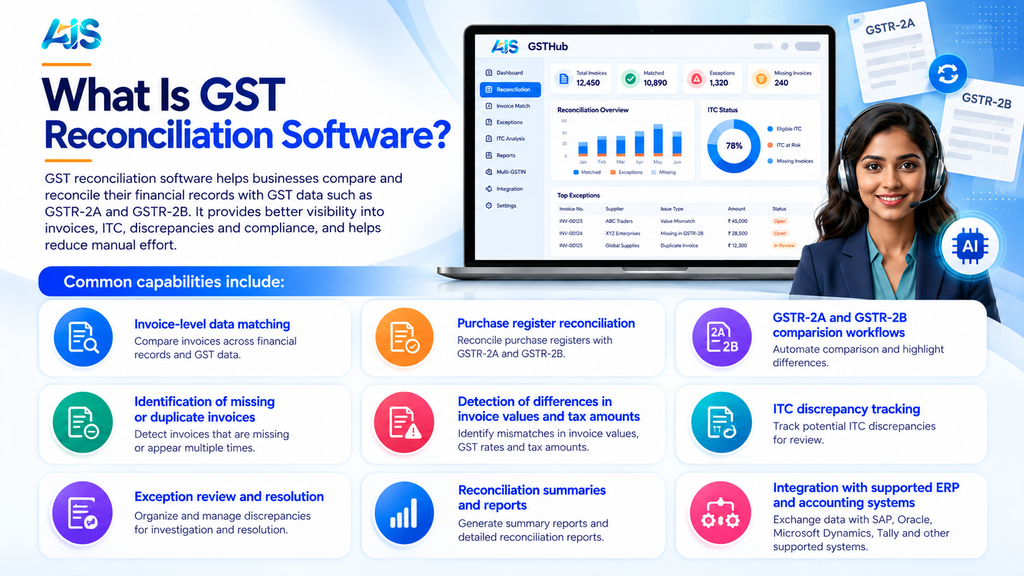
Common capabilities include:
- Invoice-level data matching.
- Purchase register reconciliation.
- GSTR-2A and GSTR-2B comparison workflows.
- Identification of missing or duplicate invoices.
- Detection of differences in invoice values and tax amounts.
- ITC discrepancy tracking.
- Exception review and resolution.
- Reconciliation summaries and reports.
- Integration with supported ERP and accounting systems.
The objective is to make GST reconciliation more structured, traceable, and manageable as transaction volumes grow.
2. Why GST Reconciliation Is Important
GST reconciliation helps businesses identify differences between their internal records and relevant GST information before those differences create additional compliance or financial-management challenges.
2.1 Identify Missing Invoices
A purchase invoice recorded in the accounting system may not appear in the corresponding GST data being reviewed. Reconciliation helps identify such cases for investigation.
2.2 Detect Invoice Mismatches
Differences in invoice numbers, dates, supplier GSTINs, taxable values, or tax amounts can affect reconciliation accuracy. Automated comparison helps highlight these discrepancies.
2.3 Support ITC Reviews
Finance teams need to review purchase transactions and assess whether ITC requirements are satisfied. Reconciliation software can help organize potential mismatches and missing records for further verification.
2.4 Reduce Repetitive Manual Work
Manually comparing thousands of invoices can consume substantial time. Automated data matching helps reduce repetitive comparisons and directs attention towards transactions requiring review.
2.5 Improve Financial Visibility
Reconciliation reports help finance managers understand the number of matched records, outstanding exceptions, and recurring data issues.
2.6 Support Audit Preparation
Organized reconciliation records and documented review activities can help businesses retrieve relevant information during internal audits and compliance reviews.
GST reconciliation software supports these processes, but businesses must still validate the results and comply with applicable GST requirements.
3. How Automated GST Reconciliation Software Works
Automated GST reconciliation software typically follows a structured workflow to process source data, compare transactions, and highlight discrepancies.
Step 1: Import GST and Purchase Data
Relevant data is collected from accounting systems, ERP applications, GST-related files, or other supported sources.
Depending on the software, data may be imported through APIs, integrations, Excel files, JSON, or other supported formats.
Step 2: Validate the Records
The software checks the imported data for incomplete fields, duplicate entries, inconsistent invoice details, and other data-quality issues.
Step 3: Map the Data Fields
Different systems may store invoice information in different formats. Data mapping aligns the relevant fields so that records can be compared consistently.
Step 4: Match the Transactions
The reconciliation engine compares records using relevant fields, such as:
- Supplier GSTIN.
- Invoice number.
- Invoice date.
- Taxable value.
- CGST, SGST, and IGST amounts.
- Total invoice value.
Depending on the configured rules, the system may identify exact matches, potential matches, and unmatched records.
Step 5: Identify Exceptions
Transactions that do not match are highlighted for further investigation. These exceptions may include missing invoices, incorrect values, duplicate entries, or inconsistent supplier details.
Step 6: Review and Resolve Discrepancies
Finance teams investigate the identified exceptions, verify the supporting information, and determine the appropriate corrective action.
Step 7: Generate Reconciliation Reports
The software generates reports showing reconciliation outcomes, unresolved discrepancies, and other relevant information for finance-team review.
This workflow helps businesses move from repeated manual comparisons towards a more consistent reconciliation process.
4. Common GST Reconciliation Challenges
Even businesses with established accounting systems can face challenges when GST data is distributed across multiple sources.
4.1 Data Scattered Across Systems
Purchase records, invoices, and GST-related information may be stored in different applications or files. Consolidating them manually can increase workload.
4.2 High Invoice Volumes
Businesses processing thousands of transactions may struggle to compare every invoice manually within their reporting timelines.
4.3 Inconsistent Invoice Information
Differences in invoice formats, numbering conventions, dates, or tax values can make matching more difficult.
4.4 Limited Exception Visibility
Without a centralized process, finance teams may find it difficult to determine which discrepancies remain unresolved and which require immediate attention.
4.5 Multi-GSTIN Complexity
Organizations operating across several registrations may need to manage separate datasets while maintaining a consolidated view for management.
4.6 Manual Reporting
Preparing reconciliation summaries through spreadsheets can introduce additional work and make consistent reporting more difficult.
A structured GST reconciliation platform can help address these challenges by organizing data, standardizing matching workflows, and improving exception visibility.
5. Essential Features of a GST Reconciliation Platform
When evaluating GST reconciliation software, businesses should focus on the features that directly support their finance and compliance workflows.
5.1 Automated Data Matching
The platform should compare relevant invoice details and identify potential matches without requiring users to manually inspect every record.
5.2 Mismatch Identification
The software should highlight differences in GSTINs, invoice details, taxable values, tax amounts, and other relevant fields.
5.3 Exception Management
Unmatched records should be organized so users can investigate discrepancies, track outstanding issues, and monitor resolution progress.
5.4 GST Data Validation
Validation capabilities help identify incomplete or inconsistent records before they affect reconciliation and reporting.
5.5 ITC Visibility
The platform should help finance teams review potential ITC-related discrepancies and access relevant reconciliation information.
5.6 Multi-GSTIN Management
Businesses with multiple registrations may require centralized dashboards, registration-level reports, and structured access controls.
5.7 ERP Integration
Integration with accounting and ERP systems helps reduce repetitive data exports and manual uploads.
5.8 Reporting and Analytics
Reconciliation summaries, exception reports, and dashboards help finance managers monitor progress and identify recurring issues.
5.9 Audit Trail and Security
Businesses should evaluate access controls, relevant activity records, data protection measures, and the ability to retrieve historical reconciliation information.
These capabilities help organizations assess whether a GST reconciliation platform can support their current operations and future requirements.
6. How AI Improves GST Data Matching
Traditional reconciliation typically relies on predefined matching rules and comparisons between invoice fields. AI-assisted capabilities can complement these processes by helping identify potential matches, organize exceptions, and surface patterns in large datasets.
The usefulness of AI depends on source-data quality, system configuration, and the validation processes used by the business.
AI-Assisted Matching
AI-assisted matching can help identify potential matches when certain invoice details differ. These suggestions should remain reviewable by authorized users.
Intelligent Exception Analysis
AI can assist in categorizing discrepancies and highlighting unusual records for further investigation.
Pattern Identification
Analytics can help identify recurring mismatches, repeated data-quality problems, and supplier-related patterns.
Risk Indicators
AI-assisted analysis may highlight records that warrant additional review. These indicators should not be treated as definitive compliance decisions.
Conversational Insights
A GST assistant may allow users to ask natural-language questions about available reconciliation information, depending on the platform’s supported features.
For reliable outcomes, AI-assisted results should be traceable to relevant records and reviewed when they affect financial or compliance decisions.
7. GST Reconciliation Software for GSTR-2A and GSTR-2B
GSTR-2A and GSTR-2B are important sources of information for purchase reconciliation and ITC review.
Businesses often compare relevant GST data with purchase registers to identify missing invoices and differences that need investigation.
A GST reconciliation tool can help organize this process by highlighting:
- Purchase invoices missing from the comparison data.
- Supplier GSTIN differences.
- Invoice-number or date mismatches.
- Differences in taxable values.
- Variations in tax amounts.
- Duplicate or potentially incorrect entries.
- Transactions requiring further review.
Automated matching can make these comparisons more efficient, especially when businesses process large volumes of purchase transactions.
However, a matching result does not by itself determine ITC eligibility. Businesses must assess the relevant statutory requirements and supporting information before making ITC decisions.
8. GST Management Software for Multiple GSTINs
Businesses operating across multiple states, branches, or legal entities may need to reconcile transactions across several GST registrations.
Managing each registration through separate spreadsheets can make consolidated reporting and exception tracking more difficult.
GST management software can help centralize relevant information while retaining registration-level visibility.
Important capabilities include:
- Consolidated reconciliation dashboards.
- GSTIN-wise transaction reports.
- Registration-level exception tracking.
- Centralized monitoring of unresolved discrepancies.
- Role-based user access.
- Structured reporting for finance managers.
GSTHub by AIS Business Corp includes multi-GSTIN management among its stated capabilities, helping businesses evaluate a centralized approach to their GST reconciliation workflows.
The specific configuration should reflect the organization’s registration structure, user roles, reporting requirements, and data sources.
9. Secure GST Software: Data Protection and Control
GST reconciliation involves financial records, supplier details, invoice information, and other business-sensitive data. Security should therefore be an important part of software evaluation.
Businesses should assess the following areas before selecting a solution.
Access Management
Users should receive access appropriate to their roles and responsibilities.
Data Protection
Evaluate how sensitive information is handled during data import, processing, storage, and transfer.
Auditability
Relevant user activities and reconciliation actions should be traceable where required by the business’s control procedures.
Integration Security
Connections between GST software and ERP or accounting systems should follow appropriate authentication and access-control practices.
Backup and Recovery
Understand the provider’s backup, recovery, and business-continuity arrangements.
Data Retention
Confirm how long information is retained, how historical records can be accessed, and how deletion or retention requirements are handled.
Security capabilities vary by product and configuration. Businesses should verify the controls available in the specific solution and deployment model they intend to use.
10. GSTHub by AIS Business Corp: A Centralized GST Reconciliation Platform
GSTHub is an AI-powered GST reconciliation and compliance platform from AIS Business Corp, designed to help businesses organize GST data and manage reconciliation workflows in a centralized environment.
The platform’s stated capabilities include data import, validation, reconciliation, exception management, reporting, analytics, and integration with supported ERP and accounting systems.
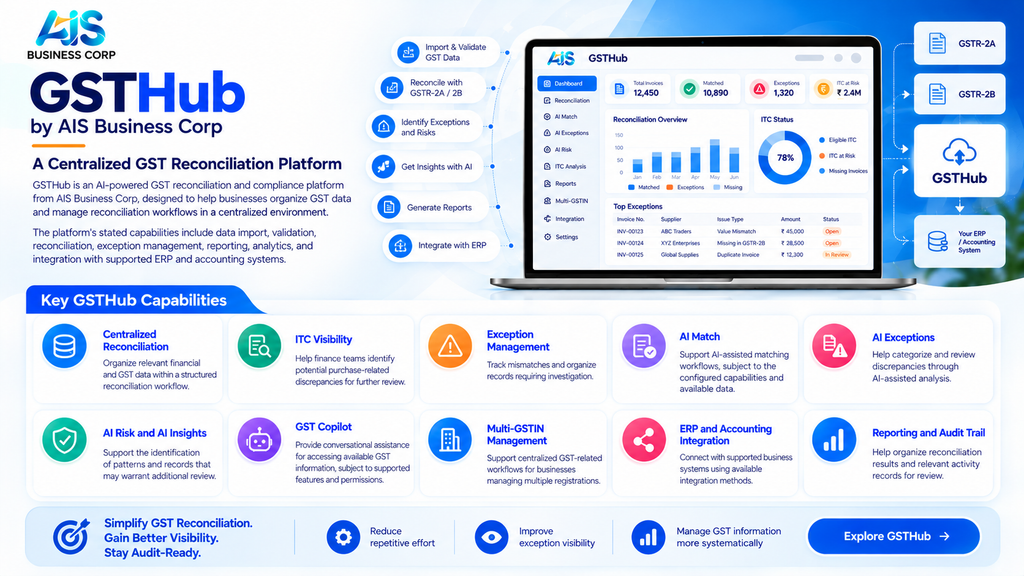
Key GSTHub Capabilities
Centralized Reconciliation
Organize relevant financial and GST data within a structured reconciliation workflow.
ITC Visibility
Help finance teams identify potential purchase-related discrepancies for further review.
Exception Management
Track mismatches and organize records requiring investigation.
AI Match
Support AI-assisted matching workflows, subject to the configured capabilities and available data.
AI Exceptions
Help categorize and review discrepancies through AI-assisted analysis.
AI Risk and AI Insights
Support the identification of patterns and records that may warrant additional review.
GST Copilot
Provide conversational assistance for accessing available GST information, subject to supported features and permissions.
Multi-GSTIN Management
Support centralized GST-related workflows for businesses managing multiple registrations.
ERP and Accounting Integration
Connect with supported business systems using available integration methods.
Reporting and Audit Trail
Help organize reconciliation results and relevant activity records for review.
GSTHub is intended to help businesses reduce repetitive reconciliation effort, improve exception visibility, and manage GST-related information more systematically.
The available modules, integrations, and configuration should be confirmed with AIS Business Corp based on the business’s requirements.
11. How to Choose the Right GST Reconciliation Tool
Choosing a GST reconciliation platform requires an assessment of current workflows, transaction volumes, data sources, and future business requirements.
Step 1: Map Your Existing Process
Identify how purchase data is collected, how GST information is compared, and how discrepancies are currently resolved.
Step 2: Assess Transaction Volumes
Estimate the number of invoices and records processed monthly and consider expected business growth.
Step 3: Identify Data Sources
List the ERP systems, accounting applications, spreadsheets, and other sources that must be connected.
Step 4: Define Matching Requirements
Determine which fields must be compared and what types of discrepancies need to be identified.
Step 5: Review Exception Management
Confirm whether users can organize, review, and track unmatched records effectively.
Step 6: Evaluate Integration
Verify supported systems, APIs, file formats, data mapping requirements, and integration responsibilities.
Step 7: Check Security and Auditability
Review access controls, data handling, activity tracking, and other security requirements.
Step 8: Test with Representative Data
Request a demonstration using typical reconciliation scenarios, including missing invoices, mismatched values, and duplicate entries.
Step 9: Compare Total Cost
Consider subscription charges, implementation, integration, training, and ongoing support.
Step 10: Plan Adoption
Define user responsibilities, validation procedures, review processes, and ongoing monitoring before deployment.
12. Benefits of Automated GST Reconciliation Software
When implemented appropriately, automated GST reconciliation software can help businesses improve several operational areas.
Reduced manual effort: Automate repetitive comparisons and organize the review of exceptions.
Improved discrepancy visibility: Identify records that need further investigation.
More structured ITC reviews: Organize potential mismatches for assessment by finance teams.
Centralized information: Bring data from supported sources into a consistent workflow.
Better reporting: Monitor reconciliation status and unresolved exceptions through structured reports.
Improved traceability: Maintain relevant records to support review and audit preparation.
Scalable workflows: Evaluate centralized processes as transaction volumes and GST registration requirements increase.
The actual impact depends on source-data quality, implementation, integration, and the effectiveness of the business’s review procedures.
Frequently Asked Questions
1. What is GST reconciliation software?
GST reconciliation software helps businesses compare purchase records and relevant GST data to identify mismatches, missing invoices, and other discrepancies requiring review.
2. How does automated GST reconciliation software work?
It typically imports relevant records, validates data, maps fields, matches transactions, identifies exceptions, and generates reconciliation reports.
3. What is the difference between a GST reconciliation tool and GST management software?
A GST reconciliation tool focuses primarily on comparing records and identifying discrepancies. GST management software may cover a broader set of GST-related activities, depending on its features.
4. How does GST reconciliation software help with ITC?
It can identify potential differences between purchase records and relevant GST data, helping finance teams organize and investigate transactions before assessing ITC eligibility under applicable rules.
5. Can GST reconciliation software integrate with ERP systems?
Some platforms support integration with ERP and accounting systems through APIs, connectors, or file-based workflows. The available integration options depend on the solution and implementation scope.
6. Is GST reconciliation software useful for multiple GSTINs?
Yes. A platform with multi-GSTIN capabilities can help centralize reconciliation activities and provide registration-level or consolidated reporting, depending on the features available.
7. What makes a GST reconciliation platform secure?
Important considerations include access controls, data protection, secure integrations, auditability, backup arrangements, and data-retention policies.
8. How does AI improve GST reconciliation?
AI-assisted capabilities can help identify potential matches, categorize exceptions, and surface patterns in large datasets. Important results still require suitable validation.
9. What is GSTHub by AIS Business Corp?
GSTHub is an AI-powered GST reconciliation and compliance platform designed to support centralized reconciliation, ITC visibility, exception management, analytics, multi-GSTIN workflows, and ERP or accounting integration.
10. How can I evaluate GSTHub for my business?
Assess your transaction volumes, data sources, reconciliation rules, integration requirements, reporting needs, and security controls. Request a demonstration from AIS Business Corp to understand how GSTHub fits your workflows.
Conclusion
GST reconciliation is an important process for maintaining accurate financial records, identifying invoice discrepancies, and supporting ITC reviews. As businesses process more transactions and manage increasingly complex data, manual reconciliation can become difficult to scale.
Automated GST reconciliation software helps organize data matching, validation, exception management, and reporting within a structured workflow.
GSTHub by AIS Business Corp is designed to support these needs through centralized GST reconciliation, ITC visibility, AI-assisted analysis, multi-GSTIN management, and integration with supported business systems.
By evaluating the platform against your actual data, workflow, integration, and security requirements, your business can determine whether GSTHub is the right fit for improving GST reconciliation operations.
Simplify GST reconciliation with GSTHub by AIS Business Corp.
Website: https://aiscorp.ai/
Email: marketing@ananthinfo.com
Phone: +91 88385 81634

Join the discussion One Comment