


The UAE’s e-invoicing mandate is not just a regulatory change; it is a digital and AI-driven transformation of how businesses create, validate, exchange, and report invoices. As enforcement approaches, companies are seeking both clarity on UAE e-invoicing regulations and reliable UAE e-invoicing implementation services to ensure compliance without operational disruption.
This guide combines UAE e-invoicing requirements, implementation timelines, AI-enabled processes, and professional implementation services, making it a complete resource for businesses preparing for UAE e-invoicing in 2026 and beyond.
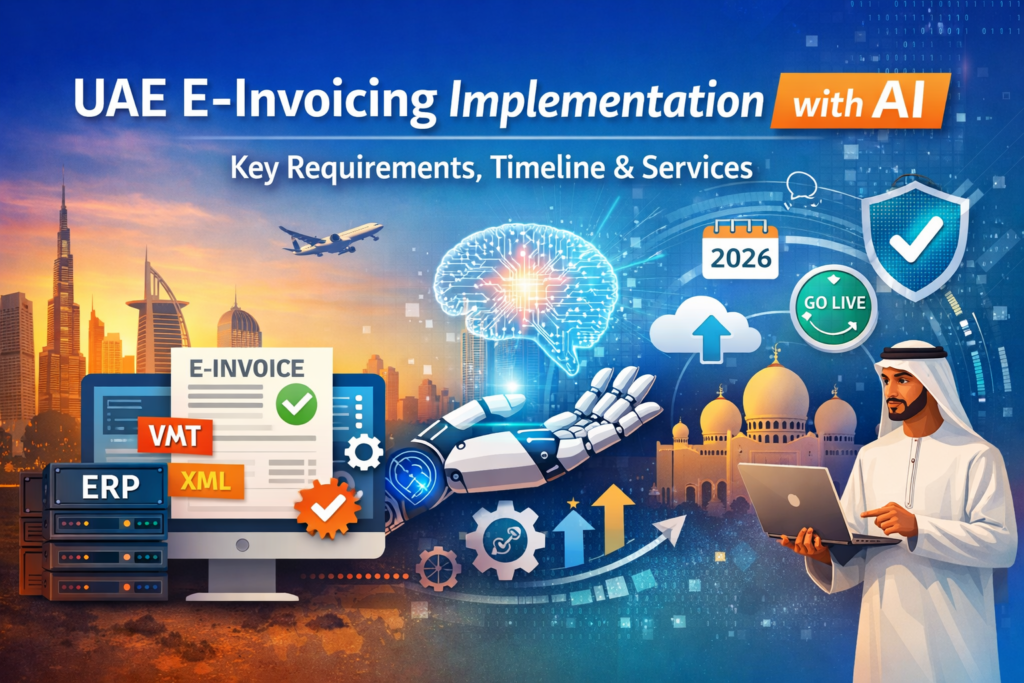
What is E-Invoicing in the UAE?
UAE e-invoicing refers to the issuance and exchange of invoices in a structured digital format that enables automated validation, reporting, and audit readiness through the Federal Tax Authority (FTA).
Unlike traditional PDFs or paper invoices, UAE e-invoices are:
- Machine-readable (XML / UBL formats)
- Validated using rule-based and AI-assisted checks
- Exchanged electronically through approved platforms
- Stored securely for compliance and audits
The UAE e-invoicing framework leverages automation and AI-enabled validation to reduce tax errors, improve transparency, and support real-time tax monitoring.
UAE E-Invoicing Key Requirements
To comply with UAE e-invoicing regulations, businesses must meet the following requirements:
- Structured invoice formats (XML / UBL-based)
- Mandatory invoice data fields
- Real-time or near real-time invoice transmission
- Integration with approved e-invoicing platforms
- Secure, audit-ready invoice storage
- VAT and cross-border transaction compliance
Modern UAE e-invoicing implementation increasingly uses AI-powered validation engines to detect data inconsistencies, missing fields, and VAT mismatches before invoices are transmitted.
UAE E-Invoicing Implementation Timeline
The UAE follows a phased e-invoicing implementation approach:
- 2024–2025: Legal framework and technical standards
- 2026: Mandatory onboarding for large taxpayers
- 2027 onwards: Expansion to all VAT-registered businesses
Early adoption allows businesses to use AI-driven automation to streamline invoice processing and avoid last-minute compliance risks.
Why UAE Businesses Need E-Invoicing Implementation Services?
UAE e-invoicing is not just a system upgrade; it is a process, compliance, and technology transformation.
Common challenges include:
- Legacy ERP limitations
- Manual invoice validation
- Complex VAT rules
- Free zone vs mainland compliance differences
- High transaction volumes
A professional UAE e-invoicing implementation company helps businesses combine automation, AI, and regulatory expertise to achieve seamless compliance.
What Do UAE E-Invoicing Implementation Services Include?
End-to-end UAE e-invoicing implementation services typically cover:
1️⃣ Compliance & Readiness Assessment
- Business and VAT analysis
- ERP and billing system review
- Risk identification using AI-based data profiling
2️⃣ Solution Architecture & Design
- Selection of compliant e-invoicing models
- Data mapping and validation rules
- AI-assisted error detection and exception handling
3️⃣ System & ERP Integration
- Integration with SAP, Oracle, Microsoft, and custom ERPs
- API or middleware configuration
- Automated and AI-enabled invoice validation
4️⃣ Testing & Go-Live
- Sandbox testing
- FTA validation checks
- Controlled rollout with monitoring dashboards
5️⃣ Ongoing Support & Optimization
- Regulatory updates
- AI-based compliance monitoring
- Audit and reporting support
AI-Driven UAE E-Invoicing Implementation
AI plays a growing role in UAE e-invoicing implementation by enabling:
- Automated invoice validation
- Real-time anomaly detection
- VAT rule interpretation
- Error prediction before submission
- Faster reconciliation and audit readiness
By combining AI with structured e-invoicing, businesses reduce manual effort, improve accuracy, and ensure long-term compliance.
UAE E-Invoicing Implementation for ERP Systems
ERP-centric implementation is critical for scalable compliance.
UAE e-invoicing implementation services support:
AI-enabled integrations help automate invoice checks without forcing ERP migration or process disruption.
Free Zone & Mainland UAE E-Invoicing Implementation
UAE e-invoicing applies to:
- Mainland businesses
- Free zone entities
- VAT-registered branches
Businesses operating in Dubai, Abu Dhabi, Sharjah, Ajman, Ras Al Khaimah, Fujairah, Umm Al Quwain, and UAE free zones must ensure invoice compliance regardless of location.
AI-based compliance engines help manage:
- VAT applicability
- Cross-border invoicing
- Multi-entity audit trails
Why Choose a UAE E-Invoicing Implementation Company?
A specialized UAE e-invoicing implementation company provides:
- Deep regulatory understanding
- ERP and system integration expertise
- AI-driven validation and automation
- Faster go-live timelines
- Reduced compliance risk
This is especially important for enterprises with complex operations and high invoice volumes.
Penalties for Non-Compliance
Failure to comply with UAE e-invoicing regulations may result in:
- Financial penalties
- Audit exposure
- Operational disruption
- Reputational damage
Early implementation using AI-enabled e-invoicing solutions significantly reduces compliance risk
UAE Regions Covered
UAE e-invoicing implementation services are available across:
FAQs – UAE E-Invoicing & AI-Enabled Implementation
What is UAE e-invoicing?
UAE e-invoicing is a structured digital invoicing system mandated by the Federal Tax Authority.
Is e-invoicing mandatory in the UAE?
Yes, it will be mandatory in phases starting from 2026.
How does AI help in UAE e-invoicing?
AI automates validation, detects errors, and improves compliance accuracy.
Who needs UAE e-invoicing implementation services?
All VAT-registered businesses, including free zone companies.
Can existing ERP systems be used?
Yes, with proper integration and AI-enabled validation layers.
How long does UAE e-invoicing implementation take?
Typically 4–8 weeks, depending on complexity.
Are free zone companies included?
Yes, free zone entities must comply.
What formats are used for UAE e-invoicing?
Structured XML / UBL formats are required.
What happens if implementation is delayed?
Businesses risk penalties and compliance issues.
What does a UAE e-invoicing implementation company do?
It manages compliance, integration, AI-based validation, and ongoing support.
Book FREE consultation with AIS Business Corp to implement UAE E-Invoicing with AI for your registered business.
