


The Shift from Manual Finance to Smart Business Systems
In today’s competitive business environment, managing finance, operations, and growth manually is no longer practical. Businesses dealing with spreadsheets, disconnected tools, or outdated systems often face issues like data errors, lack of visibility, and slow decision-making.
This is where accounting software and business management software become essential. These systems are designed to centralize operations, automate workflows, and provide real-time insights into financial and operational performance.
Whether you are a startup, small business, or enterprise, investing in the right business software solution helps streamline processes, reduce manual work, and enable scalable growth.
What is Accounting Software?
Accounting software is a digital tool that helps businesses manage financial transactions, billing, invoicing, taxation, and reporting in a structured and automated way.
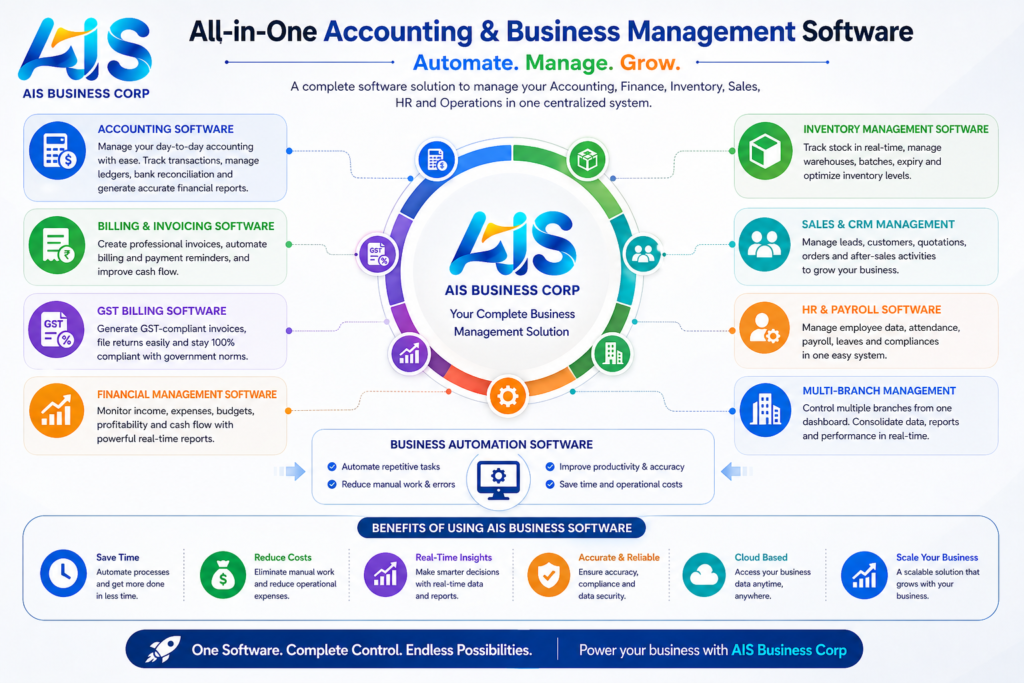
A modern financial management software includes:
- Billing software for creating invoices
- Invoicing software for tracking payments
- GST billing software for tax compliance
- Expense and revenue tracking
- Financial reporting and analytics
It functions as a reliable company accounting system, ensuring accuracy and transparency in financial data.
Evolution of Business Software: From Accounting to Integrated Systems
Earlier, businesses relied on separate tools for accounting, inventory, and sales. This created inefficiencies and data silos.
Today, companies prefer accounting and inventory software that integrates:
- Finance
- Inventory
- Sales
- Customer management
This evolution has led to the rise of integrated business software and enterprise software, enabling organizations to manage everything from a single platform.
Why Businesses Need Accounting and Inventory Software?
Managing finance alone is not enough. Businesses need a system that connects finance with operations.
Here’s why accounting and inventory software is critical:
1. Real-Time Financial Visibility
Track income, expenses, and profitability instantly.
2. Accurate Inventory Tracking
Monitor stock levels and avoid shortages or overstocking.
3. Automated Billing and Invoicing
Reduce manual errors and improve billing efficiency.
4. Better Decision-Making
Use real-time reports to make informed business decisions.
5. Improved Operational Efficiency
Eliminate duplicate data entry and streamline workflows.
How to Manage Inventory Efficiently Using Software?
Inventory management is one of the biggest challenges for businesses.
Common issues include:
- Stock shortages
- Overstocking
- Poor tracking
Using inventory-enabled business software, businesses can:
- Track stock in real-time
- Automate reorder levels
- Manage multiple warehouses
- Monitor product movement
This directly answers the question: how to manage inventory efficiently using modern tools.
How to Manage Multiple Branches with a Centralized System?
Businesses operating in multiple locations often struggle with data synchronization and control.
A centralized business software or enterprise management system allows:
- Managing all branches from a single dashboard
- Tracking sales and finance across locations
- Standardizing operations
- Accessing real-time reports
This makes it easier to manage multiple branches software effectively.
Business Automation Software: Transforming Operations
What is Business Automation Software?
Business automation software is designed to automate repetitive tasks and processes across departments.
How to Automate Business Processes?
Automation can be applied to:
- Billing and invoicing
- Payroll processing
- Inventory updates
- Sales tracking
Using business process automation software, companies can significantly reduce manual work.
Benefits of Business Automation
- Saves time
- Reduces human errors
- Improves productivity
- Enhances accuracy
Automation is a key driver of business growth.
Software to Manage Sales and Finance Together
One of the most important requirements for modern businesses is a system that integrates sales and finance.
A powerful software to manage sales and finance enables:
- Tracking sales transactions
- Managing invoices and payments
- Monitoring revenue and profitability
- Generating financial reports
This ensures better alignment between operations and finance.
Business Software for Different Business Sizes
1. Business System for Startups
Startups need:
- Simple, cloud-based solutions
- Basic accounting and billing
- Cost-effective tools
2. Software for Small Businesses
Small businesses require:
- Billing and invoicing software
- Inventory tracking
- Cloud software for small business
3. Business Software for Medium Companies
Growing businesses need:
- Multi-branch management
- Automation features
- Advanced reporting
4. Enterprise Business Software
Enterprises require:
- Full ERP systems
- Integrated business software
- Advanced analytics and automation
Key Features of the Best Accounting Software
The best accounting and inventory software should include:
- Billing and invoicing software
- GST billing software
- Inventory management system
- Sales tracking software
- Financial reporting tools
- CRM integration
These features ensure complete control over business operations.
Cloud Software for Modern Businesses
Cloud-based solutions are becoming the standard.
Benefits of Cloud Software
- Access from anywhere
- Lower infrastructure cost
- Automatic updates
- Data security
This makes cloud software for small business highly popular.
Enterprise Accounting Software: Scaling Business Operations
For large organizations, enterprise accounting software provides:
- Advanced financial control
- Multi-location management
- Custom workflows
- Integration with other systems
It is essential for businesses looking to scale efficiently.
Industry Use Cases of Business Software
Retail
- Billing software
- Inventory tracking
- Customer management
Manufacturing
- Material management
- Production tracking
- Supply chain management
Real Estate
- Real estate management software
- Financial tracking
- Client management
HR & Payroll
- HR and payroll software
- Employee data management
- Salary processing
SAP-Based Business Software Advantage
SAP-based solutions like SAP Business One offer:
- End-to-end business integration
- Real-time analytics
- Scalability
- Industry-specific solutions
They are widely used as enterprise business software for growing companies.
How to Choose the Right Business Software?
Before selecting software, consider:
- Business size and needs
- Scalability
- Automation capabilities
- Integration options
- Cost and ROI
Choosing the right system ensures long-term success.
Future Trends in Business Software
- AI-powered automation
- Predictive analytics
- Cloud-first solutions
- Mobile-based systems
- Real-time data processing
Businesses adopting these trends will stay ahead.
In today’s digital world, using the right accounting software, billing software, and business management software is essential for success.
From managing financial operations to automating workflows and scaling growth, modern business software solutions provide everything companies need to stay competitive.
Whether you need a company accounting system, enterprise accounting software, or business automation software, investing in the right solution will transform your business.
FAQs
What is accounting software?
Accounting software helps businesses manage financial transactions, billing, invoicing, and reporting.
What is the best accounting software for small businesses?
Cloud-based accounting and inventory software is ideal for small businesses.
How to manage inventory efficiently?
Use inventory management software with real-time tracking and automation.
What is business automation software?
It automates repetitive tasks to improve efficiency and reduce manual work.
Can one software manage accounting and inventory?
Yes, integrated business software can handle both accounting and inventory.
What is GST billing software?
It helps businesses generate GST-compliant invoices and manage tax reporting.
How to manage multiple branches efficiently?
Use centralized business software with real-time data access.
What is enterprise accounting software?
It is designed for large businesses to manage complex financial operations.
What is cloud business software?
Cloud software allows access to business systems from anywhere via the internet.
Why is integrated business software important?
It connects all business functions, improving efficiency and decision-making.
