


Introduction
Every enterprise runs on processes. Purchase orders, invoice approvals, goods receipts, month-end close, employee onboarding – these workflows execute hundreds or thousands of times every month. And in most organizations, a significant portion of them still involve a human clicking through screens, copying data between systems, or waiting for an email approval that may or may not arrive on time.
The cost of this manual work is not just efficiency – it is accuracy, compliance, and competitive speed. A single miskeyed vendor invoice can trigger a payment dispute. A delayed approval can stall a production order. A missed exception can cause a compliance breach.
SAP S/4HANA Automation changes this equation entirely. By embedding intelligent automation – combining Robotic Process Automation (RPA), AI-driven decision making, and workflow orchestration – directly into the ERP environment, SAP enables organizations to run faster, leaner, and with far greater process reliability than was ever possible with legacy SAP ECC systems.
What is SAP S/4HANA Automation?
SAP S/4HANA Automation refers to the suite of capabilities within SAP’s ecosystem that enable the automated execution of business processes – with minimal or zero human intervention for routine tasks. It spans multiple technologies that work together inside and alongside SAP S/4HANA:
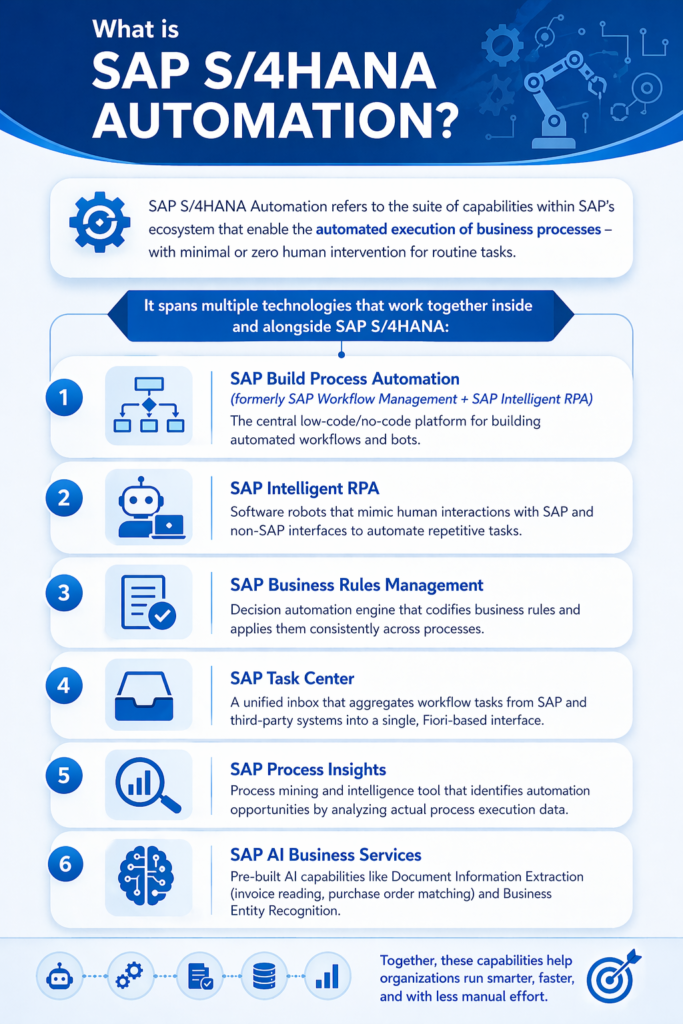
- SAP Build Process Automation (formerly SAP Workflow Management + SAP Intelligent RPA) – the central low-code/no-code platform for building automated workflows and bots
- SAP Intelligent RPA – software robots that mimic human interactions with SAP and non-SAP interfaces to automate repetitive tasks
- SAP Business Rules Management – decision automation engine that codifies business rules and applies them consistently across processes
- SAP Task Center – a unified inbox that aggregates workflow tasks from SAP and third-party systems into a single, Fiori-based interface
- SAP Process Insights – process mining and intelligence tool that identifies automation opportunities by analyzing actual process execution data
- SAP AI Business Services – pre-built AI capabilities like Document Information Extraction (invoice reading, purchase order matching) and Business Entity Recognition
Together, these tools create a layered automation architecture that handles everything from simple approval routing to complex, multi-system, AI-augmented process orchestration.
Key numbers:
- Up to 80% reduction in manual processing time for high-volume transactional processes
- 3-5× faster invoice processing with AI-powered document extraction
- 60%+ reduction in process exceptions when automation handles rule-based decisions
- Zero-touch processing achievable for standard, low-risk transactions
Why SAP Process Automation is a Business Priority in 2025
The pressure on enterprise operations has never been greater. Supply chain volatility, talent shortages, compliance complexity, and the demand for faster financial close cycles are forcing organizations to do more with less. Manual, human-dependent processes are the single biggest bottleneck standing in the way.
The Hidden Cost of Manual SAP Processes
Most organizations underestimate the true cost of manual process execution in their SAP environment. Consider a mid-sized manufacturer processing 5,000 vendor invoices per month. If each invoice requires 8-12 minutes of manual handling – matching to POs, checking tolerances, routing for approval, posting – that is 700-1,000 person-hours every month consumed by a process that could be fully automated.
Multiply this across accounts payable, procurement, order management, HR operations, and financial close – and the aggregate manual workload is staggering. SAP S/4HANA Automation directly attacks this hidden cost.
The Shift from ECC to S/4HANA Enables Automation at Scale
SAP ECC’s architecture limited automation possibilities. Workflow capabilities were rigid, RPA bots worked around the system rather than within it, and process visibility was poor. SAP S/4HANA’s modern architecture – built on HANA, exposed through OData APIs, and surfaced through SAP Fiori – creates a fundamentally more automatable system. APIs replace screen-scraping. Event-driven triggers replace scheduled batch jobs. AI services integrate natively instead of bolted on.
Regulatory and Compliance Pressure
Automated processes are inherently more compliant than manual ones. Every automated decision is logged, every rule is consistently applied, and every exception is tracked. For organizations subject to SOX, GDPR, GST/VAT compliance, or industry-specific regulations, SAP S/4HANA Automation is also a compliance and audit readiness tool – not just an efficiency play.
Core Automation Capabilities in SAP S/4HANA
SAP Build Process Automation
SAP Build Process Automation is the flagship low-code platform for designing, deploying, and managing automated business processes across SAP and non-SAP systems. It combines two previously separate products – SAP Workflow Management and SAP Intelligent RPA – into a unified, cloud-native automation studio.
Business analysts and process owners can use drag-and-drop tools to build approval workflows, decision logic, and robotic automation bots – without writing code. Pre-built automation packages for common SAP processes (invoice approval, purchase requisition, travel expense) are available in the SAP Store and can be deployed in days rather than weeks.
SAP Intelligent RPA (Robotic Process Automation)
SAP Intelligent RPA enables software robots – bots – to perform repetitive, rule-based tasks inside SAP S/4HANA and across connected systems. Bots can log into SAP, read data, perform validations, create documents, and trigger downstream processes – executing in seconds what a human would take minutes to complete, and doing so around the clock with zero errors.
Unlike generic RPA tools that use brittle screen-scraping methods, SAP Intelligent RPA integrates natively with S/4HANA through APIs and BAPI calls – making it far more reliable, upgrade-stable, and performant.
SAP Document Information Extraction (AI-Powered)
One of the most impactful AI automation capabilities in the SAP ecosystem is Document Information Extraction (DOX) – a pre-trained machine learning service that automatically reads and extracts data from invoices, purchase orders, and delivery notes. Instead of accounts payable staff manually keying invoice data into SAP, DOX reads the document, extracts the relevant fields, validates them against SAP master data, and posts the document – with human review only triggered for exceptions.
SAP Business Rules Management
Business Rules Management allows organizations to define and automate decision logic that previously required human judgment. Approval thresholds, tolerance checks, pricing rules, tax determinations, and compliance validations can all be codified as executable rules – applied consistently across every transaction, every time.
SAP Task Center
SAP Task Center provides a single, unified inbox for all workflow tasks – whether they originate from S/4HANA, SAP Ariba, SAP SuccessFactors, SAP Concur, or third-party systems. Instead of users logging into multiple systems to find and action their approvals, everything appears in one Fiori-based interface accessible from desktop or mobile.
High-Impact Automation Use Cases in SAP S/4HANA
Accounts Payable Automation: Invoice-to-Post
The accounts payable process is one of the highest-volume, highest-automation-ROI workflows in any SAP environment. A fully automated invoice-to-post workflow in S/4HANA looks like this: vendor sends invoice by email → DOX extracts invoice data → system matches to PO and goods receipt → tolerance rules validate amounts → compliant invoices post automatically → exceptions route to AP staff for review → payment runs execute on schedule.
The result is a 70-80% reduction in manual AP touchpoints, faster vendor payments, more early payment discounts captured, and a significant reduction in duplicate or fraudulent payment risk.
Purchase Requisition to Purchase Order Automation
Routine, low-value purchase requisitions that meet defined sourcing criteria – approved vendor, contracted price, within budget – can be automatically converted to purchase orders without any buyer intervention. Buyers are freed from processing routine transactions and can focus on strategic sourcing, supplier negotiations, and exception management.
Automated Three-Way Matching
Goods receipt verification and three-way matching (PO vs. GR vs. invoice) is one of the most time-consuming manual tasks in procurement operations. SAP S/4HANA automates the matching logic entirely – flagging only genuine discrepancies for human review, while processing clean matches automatically and immediately.
Financial Close Automation
Month-end and year-end close processes in SAP S/4HANA can be orchestrated through automated close cockpits that trigger accrual postings, run depreciation, execute allocation cycles, and generate financial statements in a defined, monitored sequence. Close task management tools ensure every step is completed, every dependency is respected, and every exception is escalated – turning a chaotic, email-driven close process into a managed, auditable workflow.
Employee Lifecycle Automation in SAP SuccessFactors + S/4HANA
HR processes that span SuccessFactors and S/4HANA – new hire onboarding, cost center assignments, payroll master data updates, offboarding – can be automated end-to-end using SAP Build Process Automation. A new hire approval in SuccessFactors automatically triggers IT provisioning, SAP user creation, payroll setup, and equipment requests – all without manual hand-offs between HR, IT, and finance.
Sales Order Processing and Credit Check Automation
Standard sales orders from known customers with clean master data, within credit limits, and with available stock can be automatically released, confirmed, and scheduled for delivery – with zero manual intervention from order management teams. Exception orders – credit holds, unusual quantities, new customers – are routed for review.
SAP Automation vs. Traditional SAP Workflow: Key Differences
| Capability | SAP S/4HANA Intelligent Automation | Traditional SAP ECC Workflow |
| Builder Experience | Low-code / no-code drag and drop | ABAP development required |
| AI & Machine Learning | Built-in (DOX, decision AI) | Not available |
| Cross-System Orchestration | Native (SAP + non-SAP) | Limited to SAP systems |
| Bot / RPA Integration | Native SAP Intelligent RPA | Third-party only |
| Process Visibility | Real-time monitoring dashboards | Limited logging |
| Deployment Speed | Days to weeks | Weeks to months |
| Business User Ownership | Yes – process owners can maintain | IT-dependent |
| Mobile Approvals | Native SAP Fiori / Task Center | Limited |
How to Build an SAP Automation Strategy
A successful SAP S/4HANA automation program is not built by automating random processes – it requires a strategic, prioritized approach.
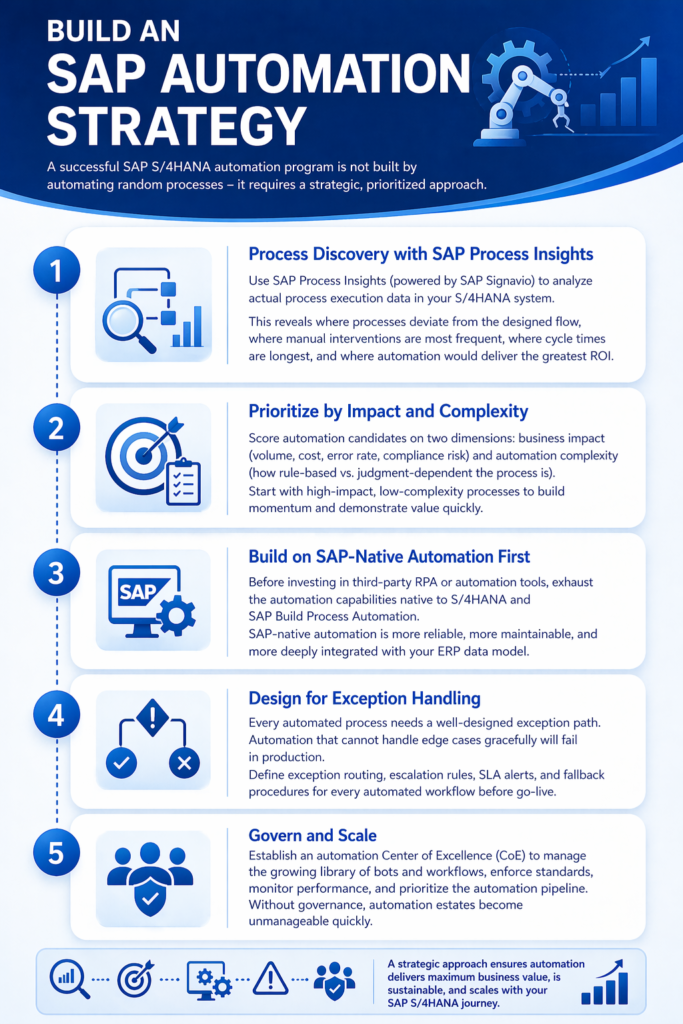
Step 1: Process Discovery with SAP Process Insights
Use SAP Process Insights (powered by SAP Signavio) to analyze actual process execution data in your S/4HANA system. This reveals where processes deviate from the designed flow, where manual interventions are most frequent, where cycle times are longest, and where automation would deliver the greatest ROI.
Step 2: Prioritize by Impact and Complexity
Score automation candidates on two dimensions: business impact (volume, cost, error rate, compliance risk) and automation complexity (how rule-based vs. judgment-dependent the process is). Start with high-impact, low-complexity processes to build momentum and demonstrate value quickly.
Step 3: Build on SAP-Native Automation First
Before investing in third-party RPA or automation tools, exhaust the automation capabilities native to S/4HANA and SAP Build Process Automation. SAP-native automation is more reliable, more maintainable, and more deeply integrated with your ERP data model.
Step 4: Design for Exception Handling
Every automated process needs a well-designed exception path. Automation that cannot handle edge cases gracefully will fail in production. Define exception routing, escalation rules, SLA alerts, and fallback procedures for every automated workflow before go-live.
Step 5: Govern and Scale
Establish an automation Center of Excellence (CoE) to manage the growing library of bots and workflows, enforce standards, monitor performance, and prioritize the automation pipeline. Without governance, automation estates become unmanageable quickly.
Frequently Asked Questions
What is the difference between SAP Workflow and SAP Intelligent RPA? SAP Workflow manages the routing and approval of business process steps – who needs to approve what, in what sequence, under what conditions. SAP Intelligent RPA uses software bots to perform actual system tasks – entering data, reading screens, posting documents. In a complete automation solution, workflow orchestrates the process while RPA bots handle the transactional execution steps.
Do we need SAP BTP (Business Technology Platform) to use SAP Build Process Automation? Yes. SAP Build Process Automation runs on SAP BTP and is consumed as a cloud service. However, it connects seamlessly to both cloud and on-premise S/4HANA systems. Organizations on S/4HANA on-premise can still leverage the full SAP Build Process Automation capability through BTP connectivity.
Can SAP Intelligent RPA automate non-SAP systems as well? Yes. SAP Intelligent RPA can automate interactions with any web-based application, desktop application, or API-enabled system – not just SAP. This makes it particularly valuable for cross-system processes that span SAP, legacy systems, supplier portals, and third-party platforms.
How quickly can we see ROI from SAP process automation? High-volume processes like invoice processing, PO automation, and three-way matching typically deliver measurable ROI within 3-6 months of go-live. The ROI calculation should include reduced processing time, error correction costs avoided, early payment discounts captured, and compliance risk reduction.
Is SAP automation suitable for small and mid-sized SAP customers? Absolutely. SAP Build Process Automation is available in flexible consumption models on BTP that scale with transaction volume – meaning smaller organizations are not paying for enterprise-scale infrastructure. Many mid-market S/4HANA customers see the fastest ROI from automation because their processes are less fragmented and easier to standardize.
Ready to Automate Your SAP S/4HANA Processes?
AIS Business Corp helps organizations design and implement intelligent automation strategies across their SAP S/4HANA landscape – from quick-win invoice automation to enterprise-wide process orchestration using SAP Build Process Automation and SAP Intelligent RPA.
Our SAP-certified consultants start with a free process automation assessment – identifying your highest-ROI automation opportunities and building a realistic business case before any development begins.
