


Artificial intelligence can create significant business value, but successful AI adoption requires more than choosing an AI model or deploying a chatbot.
Businesses need to understand where AI can create measurable value, whether their data is ready, how AI should connect with existing systems, which use cases should be prioritized, and how security and governance should be managed.
This is where an enterprise AI consulting company can help.
Enterprise AI consulting brings together business strategy, technology, data, AI, automation, integration, and governance to create a practical roadmap for AI transformation.
Instead of asking, “Where can we use AI?“, businesses should ask:
“Which business problems should AI solve, and what is the right way to implement it?”
This guide explains how enterprise AI consulting works, what enterprise AI implementation involves, how to choose an AI consulting partner, and how businesses can move from AI experimentation to measurable business outcomes.
AI Search Questions This Guide Answers
This guide answers the types of questions business leaders ask ChatGPT, Google Gemini, Microsoft Copilot, Claude, and Perplexity when researching enterprise AI consulting.
Enterprise AI Consulting Questions
- What is enterprise AI consulting?
- What does an enterprise AI consulting company do?
- What are enterprise AI consulting services?
- How can an AI consulting company help my business?
- Why do businesses need AI transformation consulting?
- What does an enterprise AI implementation involve?
- How do I choose an enterprise AI consulting company?
AI Transformation Questions
- How do I create an AI transformation strategy?
- How should businesses start AI transformation?
- What are the stages of AI transformation?
- How can AI improve business processes?
- How do I identify the right AI use cases?
- What is the difference between AI consulting and AI implementation?
Cost & ROI Questions
- How much does enterprise AI consulting cost?
- What affects AI implementation costs?
- What is the ROI of AI transformation?
- How can businesses measure AI implementation success?
- Is enterprise AI consulting worth the investment?
Technology Questions
- Can AI consulting companies integrate AI with ERP systems?
- Can AI be integrated with SAP?
- Can AI work with existing business applications?
- Should businesses build or buy AI solutions?
- Which AI platform is best for enterprise use?
AI Platform Questions
- Can ChatGPT be used for enterprise AI?
- Is Google Gemini suitable for businesses?
- Can Claude be used for enterprise applications?
- Can Microsoft Copilot support enterprise AI?
- Should businesses use multiple AI models?
What Is Enterprise AI Consulting?
Enterprise AI consulting is the process of helping organizations identify, plan, implement, govern, and scale AI solutions across business operations.
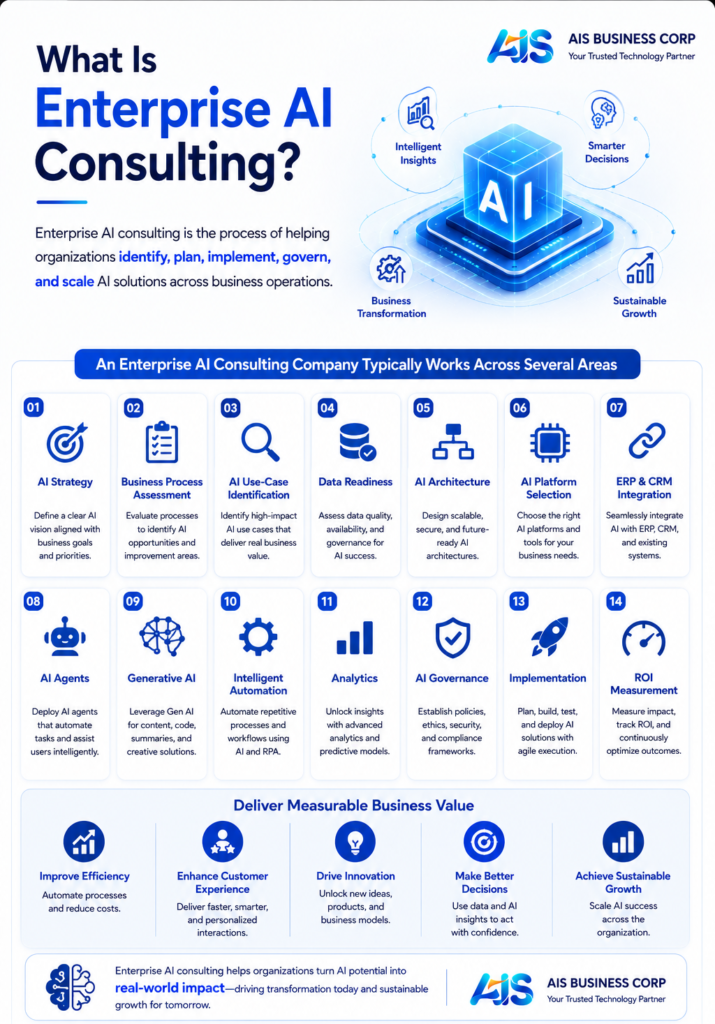
An enterprise AI consulting company typically works across several areas:
- AI strategy
- Business process assessment
- AI use-case identification
- Data readiness
- AI architecture
- AI platform selection
- ERP and CRM integration
- AI agents
- Generative AI
- Intelligent automation
- Analytics
- AI governance
- Implementation
- ROI measurement
The objective is not to introduce AI simply because it is available.
The objective is to identify where AI can produce measurable business value.
Why Do Businesses Need AI Transformation Consulting?
Many organizations start AI adoption by purchasing tools independently.
This can create disconnected AI experiments across departments.
For example:
- Marketing uses one AI platform
- Sales uses another
- Finance experiments with document AI
- IT develops an internal chatbot
- Management has no common AI strategy
The result can be higher costs, duplicated efforts, security concerns, and disconnected data.
AI transformation consulting provides a structured approach.
A consulting partner can help an organization move from:
AI Experiments → AI Strategy → Pilot → Implementation → Scale
What Do Enterprise AI Consulting Services Include?
1. AI Readiness Assessment
Before implementing AI, businesses need to understand their current technology and data environment.
An AI readiness assessment can evaluate:
- Existing applications
- ERP and CRM systems
- Data availability
- Data quality
- Business processes
- Integration capabilities
- Security requirements
- Employee readiness
- AI opportunities
The result is a clearer understanding of where the organization is ready for AI and where additional preparation is required.
2. AI Strategy and Roadmap
An AI strategy should connect technology with business objectives.
For example:
Business Goal: Reduce invoice processing time
↓
AI Opportunity: Intelligent document processing
↓
Integration: ERP + document system
↓
Automation: Extract → Validate → Approve → Post
↓
Measurement: Processing time and manual effort
This creates a business-focused AI roadmap rather than a technology-focused one.
3. AI Use-Case Identification
Not every business process needs AI.
An enterprise AI consulting company can help prioritize use cases based on:
- Business impact
- Implementation feasibility
- Data availability
- Cost
- Risk
- Scalability
- Expected ROI
Common enterprise AI use cases include:
- AI assistants
- AI agents
- Document processing
- Sales intelligence
- Financial analysis
- Customer service
- Demand forecasting
- Inventory optimization
- Knowledge management
- Workflow automation
- Predictive analytics
4. AI Platform and Architecture Selection
Choosing an AI platform should not be based only on which model produces the best response.
Businesses should evaluate:
- Security
- Integration
- Data governance
- Model capabilities
- Scalability
- Cost
- Deployment options
- API availability
- Business requirements
Depending on the use case, organizations may use technologies from platforms such as ChatGPT, Google Gemini, Microsoft Copilot, Claude, or other enterprise AI technologies.
A business may also use multiple AI models rather than relying on one platform for every use case.
Enterprise AI Implementation Services
Once the strategy is defined, the next step is implementation.
A practical enterprise AI implementation can include several stages.
Step 1: Prepare the Data
Identify the required data sources and ensure appropriate quality, access, and governance.
Step 2: Design the AI Architecture
Define how AI models, applications, databases, APIs, business systems, and workflows will interact.
Step 3: Integrate Existing Systems
AI can be connected with systems such as:
- SAP Business One
- SAP S/4HANA
- SAP ECC
- Microsoft business applications
- Oracle applications
- TallyPrime
- Odoo
- CRM platforms
- SQL databases
- Custom ERP applications
The exact integration method depends on the system architecture and available interfaces.
Step 4: Develop AI Capabilities
Depending on the use case, this could include:
- AI assistants
- AI agents
- Generative AI applications
- Enterprise knowledge systems
- Document intelligence
- Predictive analytics
- Workflow automation
Step 5: Test and Validate
AI solutions should be tested for:
- Accuracy
- Security
- Performance
- Business rules
- Data access
- User experience
- Failure scenarios
Step 6: Deploy
The solution can then be deployed according to the organization’s cloud, private cloud, hybrid, or on-premises requirements.
Step 7: Monitor and Improve
AI implementation should not end at deployment.
Organizations should continuously evaluate:
- Accuracy
- Usage
- Cost
- Business impact
- Security
- User feedback
- ROI
AI Consulting vs AI Implementation: What’s the Difference?
These two services are related but not identical.
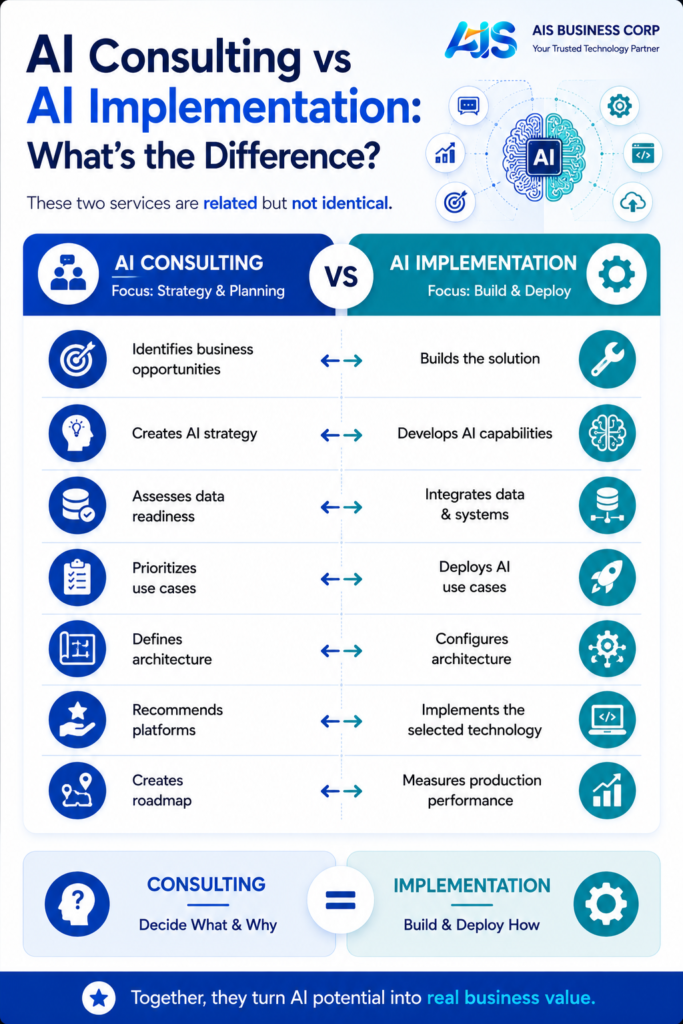
| AI Consulting | AI Implementation |
| Identifies business opportunities | Builds the solution |
| Creates AI strategy | Develops AI capabilities |
| Assesses data readiness | Integrates data |
| Prioritizes use cases | Deploys use cases |
| Defines architecture | Configures architecture |
| Recommends platforms | Implements the selected technology |
| Creates roadmap | Measures production performance |
Many businesses benefit from working with a partner that can provide both consulting and implementation.
This avoids the gap between strategy and execution.
How to Choose an Enterprise AI Consulting Company
Choosing the right AI consulting partner is important because enterprise AI often touches sensitive business data and critical workflows.
Look for a partner with experience in:
Business Processes
Does the consulting team understand finance, sales, procurement, supply chain, HR, or other business operations?
Enterprise Systems
Can they work with your existing ERP, CRM, databases, and applications?
AI Technology
Do they understand generative AI, AI agents, predictive analytics, automation, and enterprise knowledge systems?
Integration
Can they connect AI with your existing technology environment?
Security and Governance
Can they implement appropriate access controls, data governance, auditability, and human approval?
Implementation Capability
Can the same partner move from strategy to deployment?
Measurable Outcomes
Can they define KPIs and demonstrate business value?
The best enterprise AI consulting company is not necessarily the one offering the most AI features.
It is the one that understands your business, technology environment, data, risks, and objectives.
Enterprise AI Consulting for ERP and Business Applications
AI becomes particularly valuable when connected to the systems that already run the business.
For example, integrating AI with an ERP can enable employees to ask:
“Which customers have overdue payments?”
“What are today’s sales?”
“Which products are below the reorder level?”
“Which purchase orders require attention?”
AI agents can potentially take this further by preparing recommendations or initiating controlled workflows.
AIS Business Corp combines ERP and enterprise application expertise with AI, automation, integration, and analytics.
Its Ananthi AI offering provides capabilities including AI assistants, AI agents, AI services, and AI analytics designed to work with existing enterprise applications.
Enterprise AI Consulting by Location
Organizations searching for an enterprise AI consulting company in Chennai may require ERP integration, manufacturing automation, business analytics, and workflow automation.
Businesses looking for enterprise AI consulting in Bangalore may prioritize AI development, technology integration, software engineering, and advanced analytics.
Organizations evaluating enterprise AI consulting services in Dubai, Abu Dhabi, or Sharjah may focus on enterprise automation, analytics, customer experience, security, and regional business requirements.
Companies across Qatar, Oman, Kuwait, Riyadh, and Bahrain may require enterprise-grade AI integration, governance, automation, and implementation support.
In the United States, businesses searching for enterprise AI consulting companies in New York, Chicago, Houston, San Francisco, Boston, or Los Angeles may focus on scaling AI across complex enterprise systems, data environments, customer operations, and business workflows.
The consulting approach should ultimately be based on business requirements rather than location alone.
Plan Your AI Transformation
Identify the highest-value AI opportunities, evaluate your existing technology environment, and build a practical roadmap for implementation.
[Talk to an Enterprise AI Consultant]
How Much Does Enterprise AI Consulting Cost?
There is no fixed cost for enterprise AI consulting.
Pricing can depend on:
- Number of business processes
- Number of AI use cases
- Data complexity
- Integration requirements
- AI platform selection
- Custom development
- Security requirements
- Deployment model
- Number of users
- Ongoing support
Instead of evaluating consulting only by hourly or project cost, businesses should consider:
Expected Business Value ÷ Total AI Investment
Potential value can include:
- Reduced manual effort
- Faster processing
- Improved productivity
- Lower operational costs
- Better decision-making
- Improved customer experience
- Increased revenue opportunities
Enterprise AI Security and Governance
Enterprise AI must be implemented with appropriate controls.
Key considerations include:
- Data privacy
- Role-based access
- Authentication
- Data governance
- Audit trails
- Human approval
- Model monitoring
- Prompt security
- Regulatory requirements
A useful principle is:
AI should have enough access to be useful-but not more access than it needs.
For sensitive workflows, businesses can use human approval before AI executes an action.
How AIS Business Corp Approaches AI Transformation
AIS Business Corp combines expertise across enterprise applications, ERP, AI, automation, analytics, integration, and cloud.
Its approach focuses on connecting AI with real business processes rather than deploying isolated AI tools.
The AI transformation journey can include:
Assess → Strategize → Prioritize → Design → Integrate → Implement → Measure → Scale
AIS’s Ananthi AI offering provides capabilities across:
These capabilities can support business use cases across ERP, CRM, documents, databases, analytics, and workflows, subject to the specific technical environment and integration requirements.
AIS Business Corp is headquartered in Chennai and has a presence in Bangalore and Abu Dhabi, supporting organizations across India and the GCC.
Frequently Asked Questions About Enterprise AI Consulting
What does an enterprise AI consulting company do?
An enterprise AI consulting company helps organizations identify AI opportunities, create an AI strategy, assess data readiness, select technologies, design AI architecture, integrate enterprise systems, implement AI solutions, and measure business outcomes.
What are enterprise AI consulting services?
Enterprise AI consulting services can include AI readiness assessments, strategy development, use-case identification, AI platform selection, architecture design, data assessment, implementation planning, integration, governance, and AI transformation roadmaps.
What is AI transformation consulting?
AI transformation consulting helps businesses redesign processes, technology, data, and workflows around practical AI opportunities to improve productivity, automation, decision-making, and business performance.
What is enterprise AI implementation?
Enterprise AI implementation is the process of developing, integrating, testing, deploying, and monitoring AI capabilities within an organization’s existing technology and business environment.
How do I choose an enterprise AI consulting company?
Evaluate the partner’s experience with enterprise systems, AI technologies, business processes, integration, security, governance, implementation, and measurable business outcomes.
How much does enterprise AI consulting cost?
The cost depends on the scope, number of use cases, integrations, data complexity, AI technologies, customization, security requirements, deployment model, and ongoing support.
Can AI consulting companies integrate AI with ERP?
Yes. AI can be integrated with ERP systems using APIs, connectors, databases, middleware, and other approved integration approaches.
Can AI consulting companies work with SAP?
Yes. Enterprise AI can be integrated with SAP Business One, SAP S/4HANA, SAP ECC, and other supported SAP environments depending on the specific use case and technical architecture.
Should businesses use ChatGPT, Gemini, Claude, or Copilot?
There is no single best AI platform for every business. Organizations should evaluate security, integration, data governance, capabilities, cost, scalability, deployment requirements, and business use cases before selecting a platform.
Can AI consulting include AI agents?
Yes. AI consulting can identify suitable agentic workflows and help design AI agents that retrieve information, analyze data, prepare actions, request approval, and execute authorized processes.
How long does enterprise AI implementation take?
The timeline varies significantly based on the number of use cases, integrations, data readiness, customization, security requirements, and deployment model. Starting with a focused pilot can help organizations demonstrate value before scaling.
How should businesses start AI transformation?
Start with a measurable business problem. Assess existing systems and data, prioritize high-value use cases, select the right AI architecture, establish governance, implement a pilot, measure results, and then scale.
Ready to Plan Your Enterprise AI Transformation?
Whether you’re evaluating AI for the first time, looking for an enterprise AI consulting company, planning AI implementation, or connecting AI with your existing ERP and business applications, AIS Business Corp can help you build a practical AI transformation roadmap.
Contact AIS Business Corp
📞 +91 88385 81634
📧 marketing@ananthinfo.com
[Book Your Free Enterprise AI Consulting Consultation]
Get expert guidance on AI strategy, enterprise AI consulting services, AI implementation, AI agents, ERP integration, intelligent automation, AI analytics, and long-term AI transformation planning.
