


The UAE e-invoicing mandate is not just a regulatory shift. For the construction sector, it is a structural transformation.
From project-based billing and milestone invoicing to subcontractor VAT reconciliation and retention payments, construction companies face the most complex invoicing ecosystem in the UAE.
With UAE e-invoicing 2026 approaching, contractors, developers, subcontractors, and suppliers must prepare for FTA-compliant structured e-invoice transmission across Dubai, Abu Dhabi, Sharjah, Ajman, Ras Al Khaimah, Fujairah, Umm Al Quwain, and UAE Freezones.
This page is built specifically for:
- Construction companies
- EPC contractors
- Infrastructure developers
- MEP firms
- Real estate developers
- Project-based service providers
If you operate in construction, compliance is not optional. It’s mandatory.
What is UAE E-Invoicing for Construction?
UAE e-invoicing is a regulated digital invoicing framework under the Federal Tax Authority (FTA) that requires businesses to:
- Issue structured electronic invoices
- Digitally validate them
- Transmit them via secure API connectors
- Receive authority confirmation
- Store them securely for audit
For construction companies, this includes:
- Progress billing invoices
- Retention invoices
- Advance payment invoices
- Variation order billing
- Subcontractor tax invoices
- Final project settlement invoices
Unlike simple retail billing, construction invoicing includes staged payments, VAT adjustments, and multi-party reconciliation, making UAE e-invoicing construction compliance significantly more technical.
UAE E-Invoicing 2026: Timeline & Regulatory Scope
The UAE e-invoice regulation rollout is expected to follow a phased model beginning 2026, requiring:
- Structured XML/JSON invoice schema
- Digital signatures
- Real-time or near-real-time validation
- ERP system integration
- Certified adaptor or connector usage
Construction businesses in:
- Dubai
- Abu Dhabi
- Sharjah
- Ajman
- Ras Al Khaimah
- Fujairah
- Umm Al Quwain
- UAE Freezones
will be required to comply if registered for VAT.
Why Construction Companies Face Higher Compliance Risk?
Construction invoicing involves:
- Multi-phase billing cycles
- Advance + retention percentages
- VAT on progress payments
- Inter-emirate transactions
- Freezone and mainland VAT scenarios
- Subcontractor reconciliation
Without structured e-invoice automation:
❌ VAT mismatches increase
❌ Payment delays occur
❌ Audit exposure rises
❌ Manual invoice errors multiply
❌ Cash flow disruptions intensify
This is why UAE e-invoicing for construction companies requires specialized ERP integration, not generic software.
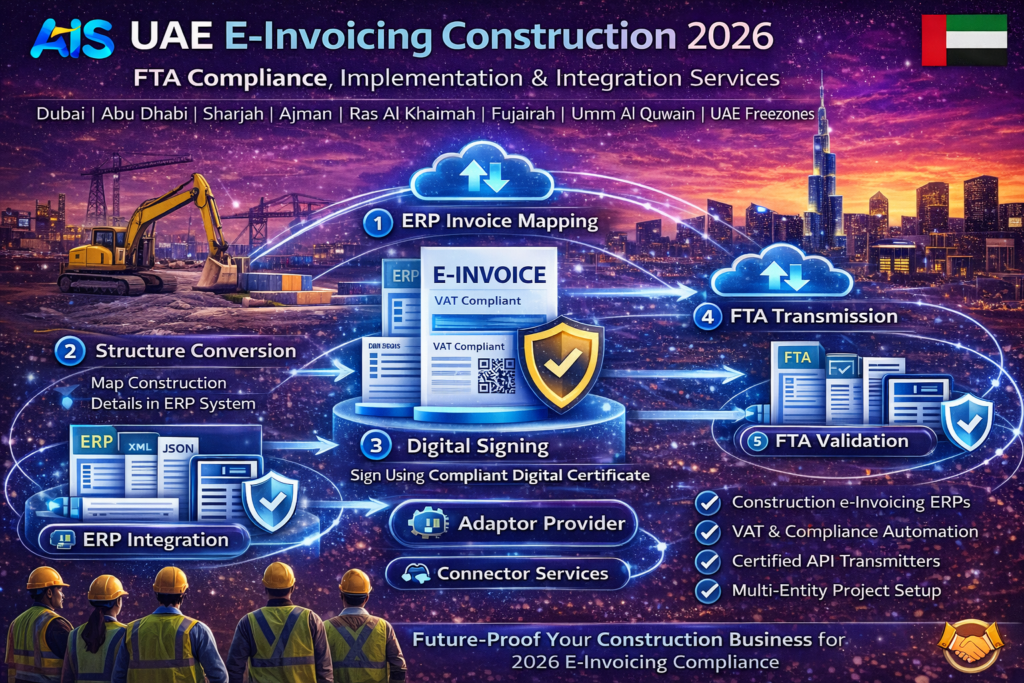
UAE E-Invoicing Construction: Technical Architecture
Step 1: ERP Invoice Mapping
Convert construction invoice data into a structured schema format.
- BOQ mapping
- Milestone tagging
- Retention logic configuration
- VAT code structuring
Step 2: Digital Signing
Apply compliant digital certificate validation.
Step 3: API Transmission
Transmit invoice securely via certified connector services.
Step 4: FTA Validation
Receive approval or rejection in real-time.
Step 5: Secure Archival
Store validated invoices for audit traceability.
Construction E-Invoicing Across UAE Emirates
Construction E-Invoicing Dubai
Dubai-based contractors managing large-scale real estate and infrastructure projects must ensure ERP readiness before 2026.
Construction E-Invoicing Abu Dhabi
Oil & gas, infrastructure, and government contracts demand higher compliance accuracy.
Construction E-Invoicing Sharjah
Industrial and commercial construction firms require integrated VAT reporting systems.
Construction E-Invoicing Ajman
SME contractors need structured integration without operational disruption.
Construction E-Invoicing Ras Al Khaimah
Manufacturing-linked construction projects require VAT-compliant invoice exchange.
Construction E-Invoicing Fujairah
Port, logistics, and marine construction companies must adopt API-enabled invoice submission.
Construction E-Invoicing Umm Al Quwain
Growing SME builders must implement early to avoid compliance penalties.
Construction E-Invoicing UAE Freezones
Freezone developers and contractors must ensure dual compliance (VAT + regulatory reporting).
High-Intent Commercial Services for the Construction Sector
AISCorp.ai provides:
- UAE e-invoicing implementation service company for construction
- UAE e-invoice integration services
- UAE e-invoicing adaptor provider
- UAE e-invoice connector services
- ERP e-invoice integration for construction companies
- FTA-compliant e-invoice system setup
- VAT automation for project-based billing
- Real-time invoice validation integration
UAE E-Invoicing for EPC & Infrastructure Projects
Engineering Procurement Construction (EPC) companies face unique invoicing complexity:
- Cross-border suppliers
- Multiple subcontractor layers
- Partial billing cycles
- Performance guarantees
- VAT reverse charge cases
Structured UAE e-invoice automation reduces reconciliation time and audit risk.
How Aiscorp.ai helps Construction Companies Prepare?
We deliver:
✔ ERP readiness assessment
✔ Schema mapping configuration
✔ API connector deployment
✔ Adaptor implementation
✔ Digital certificate integration
✔ UAT testing & validation
✔ Phased rollout before 2026
✔ Multi-entity project compliance setup
Our systems integrate with:
- Microsoft Dynamics
- SAP
- Oracle
- Custom construction ERPs
What Happens if Construction Firms Delay Implementation?
Waiting until 2026 may result in:
- System overload
- Integration bottlenecks
- Vendor delays
- Compliance penalties
- Project billing disruptions
Early implementation ensures:
- Smooth migration
- Cost control
- Audit preparedness
- Cash flow stability
Informational Section: UAE E-Invoicing Regulation Explained
What is UAE E-Invoicing?
A structured digital invoicing framework regulated by the Federal Tax Authority requiring compliant electronic invoice exchange.
When will UAE E-invoicing start?
Phased rollout beginning in 2026.
Who must comply?
VAT-registered businesses, including construction companies, contractors, developers, and subcontractors.
Is E-invoicing mandatory?
Yes, once rollout begins for applicable business categories.
Why AISCorp.ai Is Positioned to Lead Construction E-Invoicing?
Unlike generic tax platforms, we specialize in:
- Industry-specific ERP mapping
- Construction billing logic
- Retention handling
- Milestone-based VAT compliance
- Multi-branch operations
We are not just consultants; we are integration architects.
FAQs
What is UAE e-invoicing for construction companies?
It is the structured digital invoicing system mandated by the FTA for VAT-registered construction businesses.
When will UAE e-invoicing become mandatory for construction?
The phased rollout is expected to begin in 2026.
Do subcontractors need to comply?
Yes, if VAT registered.
Does e-invoicing apply to progress billing?
Yes, all VAT-relevant invoices, including progress and retention billing.
Is API integration required?
Yes, secure transmission via certified connectors is required.
What format must invoices follow?
Structured XML or JSON schema format as defined by the regulatory framework.
Does this apply in Dubai and Abu Dhabi?
Yes, across all Emirates, including Freezones.
Can construction ERPs integrate with UAE e-invoice systems?
Yes, through adaptors and connector services.
What happens if invoices are rejected?
They must be corrected and resubmitted for validation.
How can construction companies prepare now?
By conducting ERP readiness assessments and beginning phased implementation before 2026.
Future-Proof Your Construction Business for 2026
The UAE e-invoicing mandate is approaching fast.
Construction billing is complex. Compliance is critical. Delays are costly.
Whether you operate in:
Dubai | Abu Dhabi | Sharjah | Ajman | Ras Al Khaimah | Fujairah | Umm Al Quwain | UAE Freezones
Aiscorp.ai delivers:
✔ UAE E-Invoicing Implementation for Construction
✔ ERP Integration & API Connector Deployment
✔ FTA-Compliant Structured Invoice Setup
✔ Adaptor & Connector Services
✔ End-to-End 2026 Readiness
📞 Book Your Free Construction E-Invoicing Readiness Assessment Today
📩 Contact AISCorp.ai to secure compliance before the 2026 mandate

