


As e-invoicing regulations expand across the UAE and the wider Arab region, language compliance has become a critical requirement. Beyond technical integration, businesses must ensure their ERP systems support Arabic and multi-language e-invoicing, while maintaining tax accuracy, regulatory compliance, and seamless invoice exchange.
This blog explains how organizations can achieve Arabic-compliant and multi-language ERP e-invoicing, covering UAE requirements, ERP configuration, data standards, and best practices for regional operations.
Why Language Compliance Matters in E-Invoicing?
In the UAE and many Arab countries, Arabic is a regulatory and legal requirement for official business documents. While English is widely used operationally, tax authorities and audit processes often require Arabic-readable invoice data.
Language compliance ensures:
- Regulatory acceptance
- Clear communication with authorities
- Audit readiness
- Reduced rejection and dispute risk
- Regional scalability
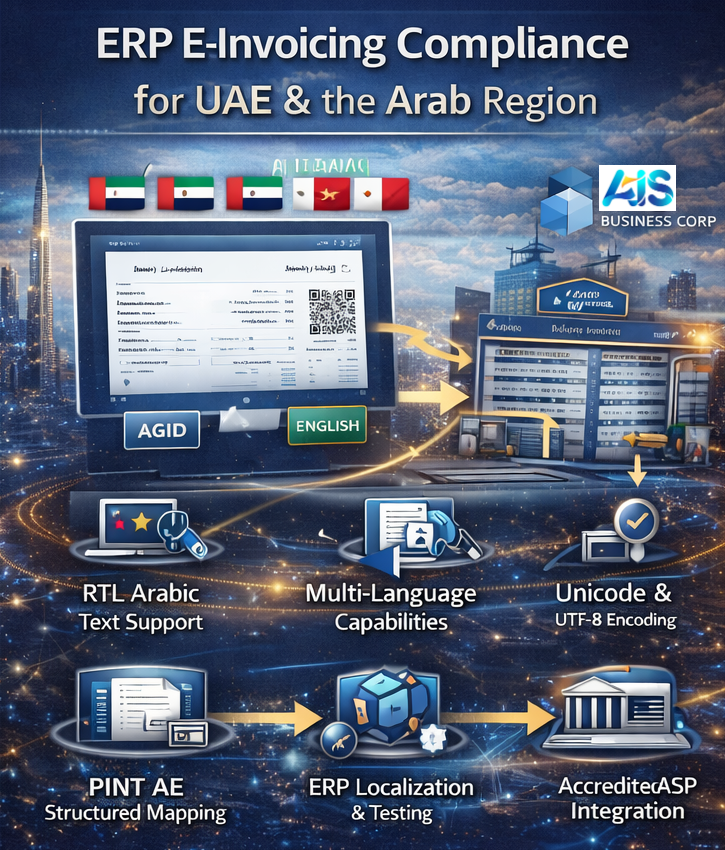
Arabic Language Requirements in UAE E-Invoicing
Under the UAE e-invoicing framework:
- Invoice data must support Arabic text fields
- Buyer and supplier details should be readable in Arabic
- Tax descriptions and references must be accurately mapped
- Structured data must align with PINT AE standards
ERP systems must support Arabic without affecting structured invoice integrity.
Multi-Language Challenges in ERP E-Invoicing
Organizations operating across the Arab region often face:
- Mixed Arabic and English invoice fields
- Inconsistent translations
- ERP character encoding limitations
- Data mapping issues between ERP, middleware, and ASPs
Addressing these challenges requires proper ERP configuration and integration design.
ERP Configuration for Arabic & Multi-Language Support
ERP systems must be configured to:
- Enable Unicode and UTF-8 encoding
- Support right-to-left (RTL) Arabic text
- Map Arabic fields correctly to structured invoice formats
- Maintain English fields for internal and cross-border reporting
SAP and modern ERP platforms provide native multi-language capabilities when correctly configured.
SAP Considerations for Arabic E-Invoicing
For SAP environments:
- SAP S/4HANA supports Arabic localization
- SAP Business One supports Arabic with proper add-ons
- PINT AE mapping must include Arabic data elements
- Output formats must preserve Arabic characters during API transmission
Testing is critical to avoid data truncation or misalignment.
Multi-Language Invoice Data Exchange with ASPs
Accredited Service Providers (ASPs) must be able to:
- Accept Arabic and bilingual invoice data
- Validate language-specific fields
- Transmit compliant data to authorities
- Exchange invoices with trading partners accurately
ERP-ASP compatibility is essential for end-to-end compliance.
Regional Scalability Across the Arab Market
A well-designed multi-language e-invoicing solution allows:
- Expansion across GCC countries
- Support for local language mandates
- Centralized ERP management
- Consistent compliance architecture
This future-proofs ERP investments.
Best Practices for Arabic & Multi-Language Compliance
- Standardize Arabic translations centrally
- Avoid manual language overrides
- Validate Unicode handling across systems
- Test invoice exchange in bilingual scenarios
- Maintain compliance documentation
How AIS Business Corp Supports Multi-Language E-Invoicing?
AIS Business Corp helps organizations:
- Configure ERP systems for Arabic compliance
- Implement PINT AE-aligned invoice structures
- Integrate SAP and ERP with ASPs
- Validate bilingual invoice workflows
- Support regional e-invoicing expansion
Frequently Asked Questions (FAQs)
Is Arabic mandatory for UAE e-invoicing?
Arabic support is required for regulatory readability, even if English is used operationally.
Can invoices be bilingual in UAE?
Yes. Invoices can contain both Arabic and English fields.
Does SAP support Arabic e-invoicing?
Yes. SAP S/4HANA and SAP Business One support Arabic when properly configured.
What is PINT AE’s role in language compliance?
PINT AE defines structured fields that can carry Arabic and English data.
Can Arabic text cause invoice rejection?
Yes, if encoding or mapping is incorrect.
Do ASPs support Arabic invoices?
Accredited ASPs must support Arabic and multi-language invoice data.
How are right-to-left issues handled?
Through ERP localization and output formatting controls.
Is translation required for tax fields?
Yes. Tax descriptions must be readable and accurate.
Can one ERP support multiple Arab countries?
Yes, with proper localization and compliance configuration.
Who should manage Arabic e-invoicing compliance?
ERP and compliance specialists like AIS Business Corp.
Need Arabic-compliant, multi-language ERP e-invoicing for UAE or the Arab region?
Partner with AIS Business Corp for secure configuration, regional compliance, and scalable ERP integration.
