

Complete Implementation Guide for Dubai, Abu Dhabi & All Emirates
UAE e-invoicing is no longer optional. It is becoming a regulatory mandate that will directly impact every organization operating in Dubai, Abu Dhabi, Sharjah, Ajman, Ras Al Khaimah, Fujairah, Umm Al Quwain, and all UAE Free Zones.
If your business runs on Microsoft Dynamics 365, Dynamics F&O, Business Central, or legacy Dynamics NAV, you must prepare now.
Many ERP users believe they are ready.
Most are not.
This comprehensive guide explains:
- UAE e-invoicing for Microsoft Dynamics 365
- UAE e-invoice integration for Dynamics F&O
- UAE e-invoicing for Microsoft Dynamics Business Central
- UAE e-invoicing implementation services
- City-specific compliance considerations
- AI-ready e-invoicing strategy for 2026
Why UAE E-Invoicing Matters in 2026?
The UAE government is introducing a structured electronic invoicing framework aligned with global digital tax transformation initiatives.
Businesses operating in:
- Dubai
- Abu Dhabi
- Sharjah
- Ajman
- Ras Al Khaimah
- Fujairah
- Umm Al Quwain
- Free Zones
must ensure their ERP system supports:
- Structured XML invoice generation
- Real-time or near real-time reporting
- Digital signatures
- Secure invoice validation
- Tax authority integration
- VAT compliance automation
If your Microsoft Dynamics system only generates PDFs, you are not compliant.
What Is UAE E-Invoicing for Microsoft Dynamics?
UAE e-invoicing Microsoft Dynamics 365 refers to enabling Dynamics ERP systems to:
- Generate structured electronic invoices
- Transmit invoices digitally
- Integrate with UAE tax infrastructure
- Maintain audit-ready compliance logs
This applies to:
- Dynamics 365 Finance & Operations
- Dynamics 365 Business Central
- Microsoft Dynamics NAV
- Dynamics AX (legacy)
Microsoft Dynamics Systems Affected
UAE E-Invoicing for Microsoft Dynamics 365 Finance & Operations
For large enterprises in Dubai, Abu Dhabi, and Free Zones, Dynamics 365 F&O requires:
- Peppol or approved network integration
- Real-time invoice validation
- API-based submission workflow
- Automated VAT handling
- AI-driven exception management
Key Requirements:
- Structured XML mapping
- Tax schema compliance
- Digital certificate configuration
- Secure transmission protocol
UAE E-Invoicing for Microsoft Dynamics 365 Business Central
SMEs in Sharjah, Ajman, Fujairah, and Ras Al Khaimah commonly use Business Central.
They need:
- Lightweight e-invoice connectors
- VAT automation modules
- Cloud-ready compliance updates
- Real-time invoice status tracking
Business Central must be configured to:
- Convert invoice data to structured format
- Connect with approved e-invoicing gateways
- Maintain compliance audit trails
UAE E-Invoicing for Microsoft Dynamics NAV
Companies still using NAV must:
- Upgrade modules
- Add middleware integration
- Implement API connectors
- Ensure compliance logging
Legacy systems require special handling to avoid disruption.
UAE E-Invoicing Microsoft Dynamics – Core Compliance Elements
Your ERP must support:
✔ Structured Invoice Format
No more PDF-only invoices.
✔ Digital Authentication
Certificate-based signing.
✔ Real-Time Validation
Instant rejection/approval workflow.
✔ VAT Compliance Automation
Zero manual VAT adjustments.
✔ Secure Data Archiving
Long-term digital storage.
UAE Microsoft Dynamics E-Invoicing by City
Although the regulation is federal, implementation readiness differs by region.
Dubai
High transaction volume businesses must prioritize scalable integration architecture.
Abu Dhabi
Energy, oil & government suppliers need enterprise-grade automation.
Sharjah
SMEs must adopt cost-effective e-invoice connectors.
Ajman
Manufacturing and trading companies require VAT automation support.
Ras Al Khaimah
Export-oriented firms need cross-border compliance.
Fujairah
Logistics companies must ensure real-time invoice processing.
Umm Al Quwain
Growing SMEs need simplified integration.
UAE Free Zones
Cross-jurisdiction compliance adds complexity.
Why Many Microsoft Dynamics Users Think They’re Ready (But Aren’t)?
Common myths:
❌ “We already generate VAT invoices.”
❌ “We have digital PDFs.”
❌ “Our ERP is cloud-based, so we’re compliant.”
Reality:
- PDF ≠ Structured e-invoice
- VAT calculation ≠ Real-time submission
- Cloud ERP ≠ Regulatory integration
UAE E-Invoicing Implementation Service Company – What to Look For
Choosing the right partner determines compliance success.
You need a company that provides:
- Microsoft Dynamics e-invoicing implementation
- UAE regulatory expertise
- Secure API integration
- Performance testing
- Ongoing compliance monitoring
- AI-based anomaly detection
Technical Architecture for UAE E-Invoicing in Dynamics 365
Step 1: ERP Invoice Mapping
Convert invoice data to structured schema.
Step 2: Digital Signing
Apply digital certificate.
Step 3: API Transmission
Send invoice securely.
Step 4: Authority Validation
Receive confirmation or rejection.
Step 5: Archival & Audit
Store validated invoice securely.
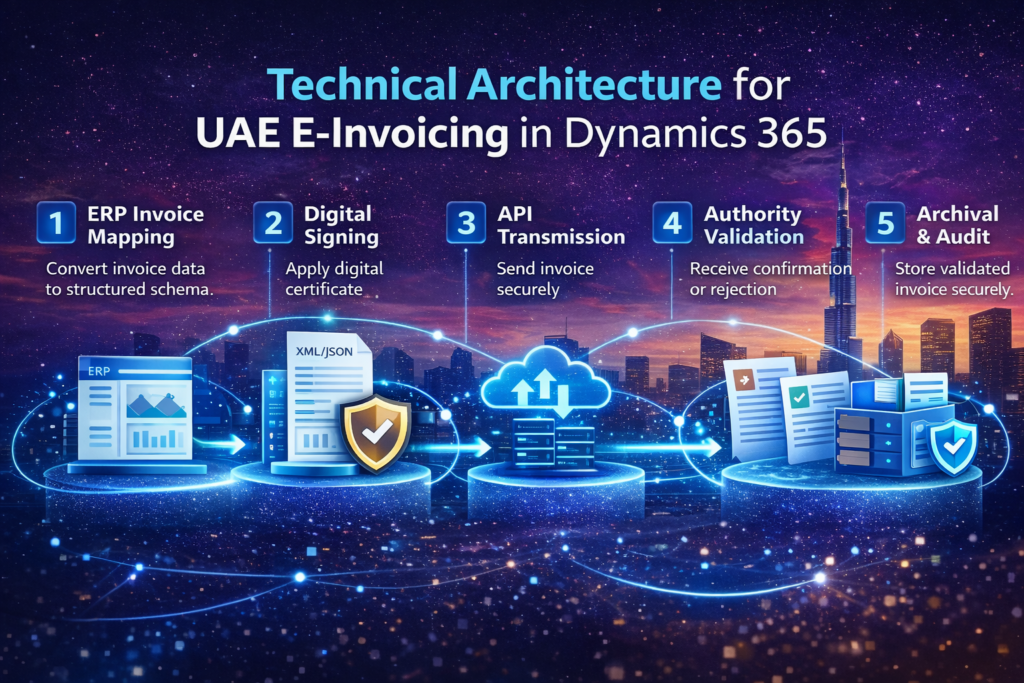
ographic showing five-step process: ERP invoice mapping, digital signing, API transmission, authority validation, and secure archival & audit workflow.
UAE E-Invoice Microsoft Dynamics – Implementation Phases
Phase 1: Assessment
- Current ERP gap analysis
- VAT process review
- Integration audit
Phase 2: Design
- Data mapping
- API framework design
- Security model configuration
Phase 3: Development
- Connector deployment
- Sandbox testing
- Integration trials
Phase 4: Go-Live
- Real-time activation
- Monitoring
- Compliance validation
Phase 5: Continuous Optimization
- AI reporting
- Error reduction
- Performance tuning
Benefits of Early UAE E-Invoicing Adoption
✔ Avoid penalties
✔ Faster invoice approvals
✔ Improved cash flow
✔ Automated VAT compliance
✔ Reduced manual errors
✔ AI-ready financial data
AI & UAE E-Invoicing – The Future
Forward-thinking companies use AI to:
- Detect duplicate invoices
- Predict compliance risks
- Monitor VAT anomalies
- Automate reconciliation
- Generate financial insights
E-invoicing is not just compliance. It’s digital finance transformation.
Why AISCorp.ai Is Positioned for UAE Microsoft Dynamics E-Invoicing?
AISCorp.ai combines:
- Microsoft Dynamics expertise
- UAE regulatory alignment
- AI-powered compliance automation
- Secure API frameworks
- Multi-emirate implementation capability
We support:
- Microsoft Dynamics e-invoicing Dubai
- Microsoft Dynamics e-invoicing Abu Dhabi
- Microsoft Dynamics e-invoicing Sharjah
- Microsoft Dynamics e-invoicing Ajman
- Microsoft Dynamics e-invoicing Ras Al Khaimah
- Microsoft Dynamics e-invoicing Fujairah
- Microsoft Dynamics e-invoicing Umm Al Quwain
- Free Zone ERP compliance
Frequently Asked Questions
What is UAE e-invoicing for Microsoft Dynamics 365?
It is the integration of structured electronic invoice generation and submission within Dynamics ERP to comply with UAE regulations.
Is PDF invoice sufficient for UAE compliance?
No. Structured digital format is required.
Does Microsoft Dynamics 365 support UAE e-invoicing?
Yes, with proper configuration and integration modules.
Do SMEs in Dubai need e-invoicing?
Yes, SMEs across all Emirates must prepare.
Is UAE e-invoicing mandatory in Free Zones?
Yes, compliance applies across jurisdictions.
Can Dynamics NAV handle UAE e-invoice?
Yes, with upgrades and middleware integration.
What is the benefit of early implementation?
Reduced risk, improved efficiency, and better financial insights.
How long does implementation take?
Typically 6–12 weeks depending on ERP complexity.
Is API integration required?
Yes, secure API transmission is mandatory.
How to choose UAE e-invoicing implementation service company?
Select a provider with Microsoft Dynamics expertise and regulatory knowledge.
UAE e-invoicing Microsoft Dynamics implementation is not a minor upgrade.
It is a strategic transformation.
Whether you operate in Dubai, Abu Dhabi, Sharjah, Ajman, Ras Al Khaimah, Fujairah, Umm Al Quwain, or any Free Zone, your Microsoft Dynamics ERP must evolve.
The businesses that act now will lead in compliance, automation, and AI-driven finance.
