


The introduction of UAE Corporate Tax for SMEs represents one of the most significant regulatory developments in the country’s business environment. For decades, the UAE was recognized as a low-tax jurisdiction, attracting startups, family businesses, consultancies, trading firms, and technology companies. With the implementation of corporate tax, small and medium-sized enterprises (SMEs) must now adopt structured tax governance, maintain compliant financial records, and align their operations with new reporting standards.
At the same time, the UAE’s upcoming e-invoicing framework is reshaping how transactions are documented, validated, and reported. The convergence of corporate tax and e-invoicing is not coincidental both initiatives aim to increase transparency, reduce tax leakage, and modernize the country’s digital tax ecosystem.
This complete guide explains:
- Corporate tax rules for SMEs in the UAE
- Registration and filing requirements
- Free zone considerations
- Exemptions and small business relief
- Penalties and compliance risks
- How e-invoicing impacts tax reporting?
- Practical compliance strategies for SMEs
If you are a business owner, finance manager, or startup founder, this guide will help you stay compliant and future-ready.
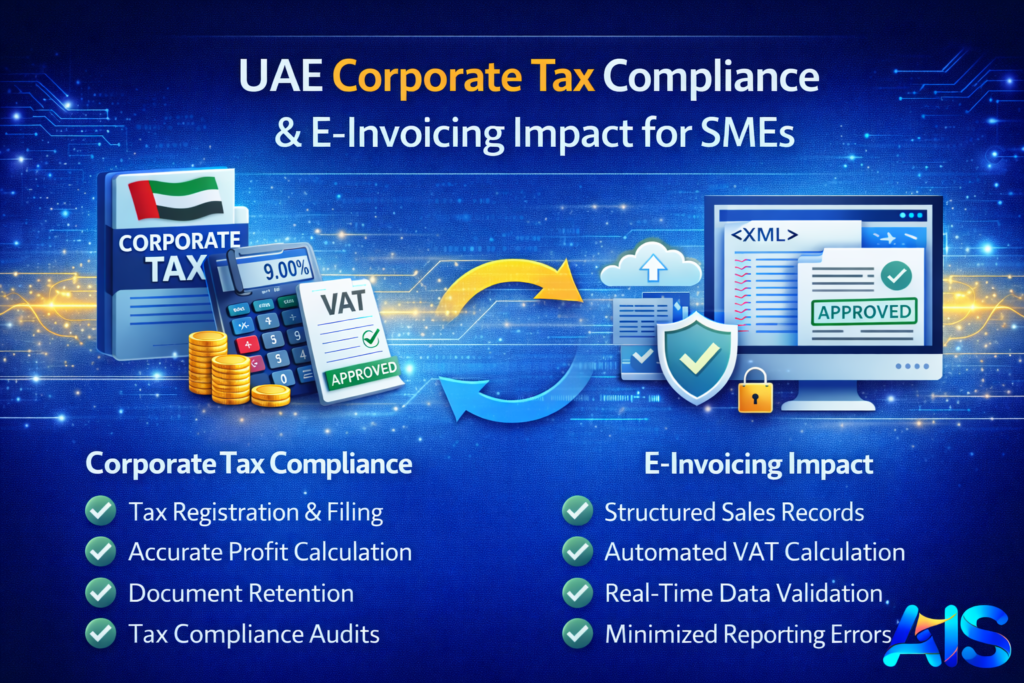
Understanding UAE Corporate Tax for SMEs
Corporate tax in the UAE applies to business profits exceeding the specified threshold. SMEs must understand whether they fall within the scope of taxation and what their obligations include.
Who Must Register for Corporate Tax?
SMEs operating in the UAE must register if they:
- Conduct business activities in the UAE
- Earn taxable income
- Operate as mainland or free zone entities
- Hold a valid trade license
Even businesses expecting minimal profits are required to assess whether registration is mandatory. Failure to register can result in penalties.
Corporate Tax Rates Applicable to SMEs
The UAE corporate tax system is structured to support small businesses while ensuring fairness.
- 0% tax rate on taxable income up to the prescribed threshold
- 9% tax rate on income exceeding the threshold
- Higher rates may apply to specific multinational entities under global tax rules
For most SMEs, the 0% band provides initial relief. However, accurate profit calculation is critical.
Small Business Relief Explained
To reduce compliance burdens, the UAE offers small business relief mechanisms. Eligible SMEs may be able to:
- Simplify tax return requirements
- Benefit from reduced documentation thresholds
- Use simplified accounting methods
However, eligibility criteria must be reviewed carefully. Businesses must maintain records even if they qualify for relief.
Corporate Tax Registration Process for SMEs
The registration process typically includes:
- Creating a tax account through the official tax portal
- Submitting trade license and ownership details
- Providing financial year information
- Receiving a Tax Registration Number (TRN)
SMEs should ensure accuracy during registration to avoid delays or compliance issues.
Filing Requirements and Deadlines
Corporate tax returns must be filed annually. Key requirements include:
- Preparation of financial statements
- Calculation of taxable income
- Adjustment for deductible and non-deductible expenses
- Submission of return within the specified deadline
Late filing may result in administrative penalties.
Record-Keeping Obligations
SMEs must maintain:
- Invoices and receipts
- Bank statements
- Expense documentation
- Payroll records
- Contracts and agreements
Proper documentation ensures smooth audits and reduces compliance risk.
The Impact of E-Invoicing on Corporate Tax Compliance
E-invoicing is transforming tax reporting. For SMEs, it directly affects corporate tax calculations because profits are derived from recorded sales and expenses.
What Is E-Invoicing?
E-invoicing refers to the structured electronic generation, transmission, and storage of invoices in a standardized format (typically XML). It enables automated validation and reporting to tax authorities.
Why E-Invoicing Matters for SMEs?
E-invoicing impacts corporate tax compliance in several ways:
1. Accurate Revenue Reporting
Structured invoices reduce manipulation and errors in revenue recognition.
2. Automated Expense Validation
Digital invoice matching ensures only legitimate expenses are recorded.
3. Real-Time Transparency
Authorities can verify transaction data faster.
4. Reduced Audit Risk
Standardized data improves reporting consistency.
Integration Between Accounting Systems and E-Invoicing
SMEs should ensure their accounting software supports:
- Structured invoice generation
- VAT calculations
- Data export for tax reporting
- Secure digital storage
Cloud-based accounting platforms are increasingly preferred because they simplify integration.
Compliance Risks SMEs Must Avoid
SMEs may face risks such as:
- Underreporting income
- Incorrect expense deductions
- Missing documentation
- Filing delays
- Software incompatibility
Proactive compliance reduces financial penalties and reputational damage.
Corporate Tax and Free Zone SMEs
Free zone businesses may benefit from special tax treatment if they meet qualifying conditions.
However, they must:
- Maintain separate accounting records
- Avoid disqualifying activities
- Comply with transfer pricing rules
Non-compliance can result in the loss of tax benefits.
Tax Planning Strategies for SMEs
Strategic tax planning ensures compliance while optimizing profitability.
Key strategies include:
- Maintaining clean bookkeeping
- Monitoring deductible expenses
- Reviewing intercompany transactions
- Conducting periodic compliance reviews
- Leveraging automation tools
Early preparation minimizes stress during filing season.
How SMEs Should Prepare for the Combined Impact?
The overlap between corporate tax and e-invoicing means SMEs should modernize operations.
Step 1: Upgrade Accounting Systems
Ensure compatibility with structured invoicing standards.
Step 2: Train Finance Teams
Staff must understand tax rules and digital compliance requirements.
Step 3: Conduct Compliance Audits
Internal reviews help identify weaknesses.
Step 4: Consult Tax Professionals
Expert advice reduces regulatory uncertainty.
Benefits of Early Compliance
SMEs that act early can:
- Avoid penalties
- Improve financial transparency
- Strengthen investor confidence
- Enhance operational efficiency
- Reduce long-term compliance costs
Digital transformation is not just a regulatory necessity; it is a business advantage.
Penalties for Non-Compliance
Non-compliance may result in:
- Financial penalties
- Suspension of trade licenses
- Audit investigations
- Loss of free zone benefits
Preventive compliance is always less costly than corrective action.
The Future of SME Taxation in the UAE
The UAE is moving toward a fully digitized tax ecosystem. SMEs must embrace:
- Automated reporting
- Real-time data validation
- Transparent financial disclosures
- Integrated ERP systems
Businesses that adapt early will remain competitive in the evolving regulatory landscape.
FAQs
Is corporate tax mandatory for SMEs in the UAE?
Yes, SMEs must register and comply if they meet taxable income thresholds, even if their tax liability is minimal.
What is the corporate tax rate for small businesses in the UAE?
Income up to the specified threshold is taxed at 0%, while income exceeding it is taxed at 9%.
Do free zone SMEs need to pay corporate tax?
Free zone SMEs may qualify for preferential treatment if they meet regulatory conditions.
How does e-invoicing affect corporate tax reporting?
E-invoicing improves revenue tracking, reduces reporting errors, and strengthens compliance accuracy.
Do SMEs need special software for compliance?
Yes, accounting systems should support structured invoicing and accurate tax reporting.
What happens if an SME fails to register?
Failure to register may result in administrative penalties and legal consequences.
Are startups required to file corporate tax returns?
Yes, if registered and operating, startups must assess filing obligations annually.
How often must SMEs file corporate tax returns?
Corporate tax returns are typically filed annually.
What records must SMEs maintain?
Invoices, financial statements, contracts, payroll records, and expense documentation.
Can SMEs reduce compliance risk?
Yes, through automation, proper bookkeeping, regular audits, and professional tax consultation.
UAE Corporate Tax for SMEs, combined with the national e-invoicing initiative, marks a significant transformation in the country’s business environment. SMEs must understand registration requirements, maintain accurate records, integrate structured invoicing systems, and adopt proactive compliance strategies.
Those who invest in digital tools, staff training, and professional guidance will not only meet regulatory obligations but also strengthen financial resilience. Compliance is no longer optional; it is a strategic necessity for sustainable growth in the UAE.
