

The UAE is rapidly advancing toward mandatory digital tax reporting through structured electronic invoicing. For businesses running SAP ERP systems, integration with the UAE’s e-invoicing framework is no longer optional; it is a strategic compliance requirement.
Whether you use SAP ECC or SAP S/4HANA, aligning your ERP with the UAE’s digital invoicing ecosystem ensures regulatory compliance, operational efficiency, and real-time tax validation. This comprehensive guide explains the architecture, technical workflow, compliance checkpoints, and step-by-step integration strategy to help organizations prepare for UAE e-invoicing implementation.
Understanding UAE E-Invoicing Framework
The UAE is implementing a structured e-invoicing model aligned with international standards, including:
- XML-based invoice structure
- Real-time or near real-time validation
- Government reporting integration
- Peppol-based interoperability framework
- Centralized or decentralized reporting model (as finalized by FTA)
Key Objectives of UAE E-Invoicing
- Improve tax transparency
- Reduce VAT fraud
- Enable automated reporting
- Standardize invoice exchange
- Enhance audit readiness
Businesses must ensure that their ERP systems can generate structured electronic invoices compliant with UAE technical and legal requirements.
Why SAP ERP Integration is Critical?
SAP ERP is widely used across enterprises in the UAE for finance, procurement, and sales. However, standard SAP invoice output formats (PDF, print, IDoc) do not meet structured XML e-invoicing requirements.
Integration ensures:
- Automatic XML invoice generation
- Real-time validation
- Digital signature embedding
- Secure transmission to the e-invoicing platform
- Automated response handling (approval/rejection)
Without integration, companies risk:
- Compliance penalties
- Reporting delays
- Manual intervention costs
- VAT reporting errors
SAP Systems Covered Under This Guide
This integration framework applies to:
- SAP ECC 6.0
- SAP S/4HANA (On-Premise)
- SAP S/4HANA Cloud
- SAP Business One
Each system requires a slightly different technical configuration approach.
UAE E-Invoicing Technical Architecture Overview
The standard integration architecture includes:
- SAP ERP (Source System)
- Middleware / Integration Layer
- E-Invoicing Service Provider (Accredited)
- Government Platform (FTA Integration Node)
Data Flow Process
SAP → XML Conversion → Validation → Digital Signature → Transmission → Government Approval → Status Return to SAP
This process must be automated and secure.
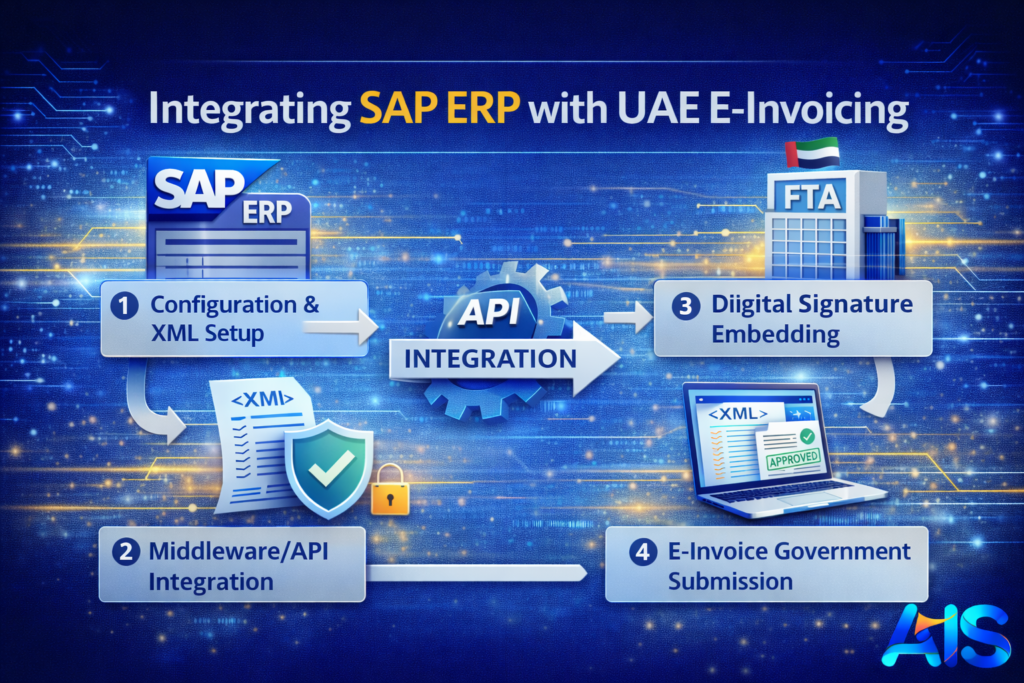
Step-by-Step SAP ERP Integration with UAE E-Invoicing
Step 1: Gap Assessment & Readiness Analysis
Before implementation:
- Review current SAP invoice output
- Identify mandatory UAE XML fields
- Map VAT configuration
- Analyze master data completeness
- Evaluate digital signature readiness
Conducting a readiness assessment reduces integration failures.
Step 2: Configure SAP for Structured Invoice Data
In SAP:
- Enable XML output format
- Activate required VAT codes
- Configure tax procedure (UAE VAT)
- Ensure customer and supplier master data accuracy
- Include TRN (Tax Registration Number)
- Configure invoice numbering compliance
For S/4HANA, Advanced Compliance Reporting (ACR) may be used.
Step 3: Choose Integration Approach
There are three main integration methods:
Option 1: Direct API Integration
SAP connects directly to e-invoicing platform APIs.
Pros:
- Real-time validation
- Full automation
Cons:
- Higher development complexity
Option 2: Middleware-Based Integration
Use SAP CPI, SAP PI/PO, or third-party middleware.
Pros:
- Centralized integration control
- Easier error handling
- Scalable
Most recommended approach for enterprises.
Option 3: Accredited E-Invoicing Service Provider
Connect SAP to an approved provider who handles:
- XML formatting
- Digital signatures
- Government submission
- Compliance updates
Ideal for SMEs or mid-size companies.
Step 4: XML Mapping & UBL Compliance
Invoices must follow:
- Structured XML format
- UBL (Universal Business Language) schema
- Mandatory tax fields
- Buyer & seller identification details
- VAT breakdown
- Invoice reference numbers
Incorrect XML structure leads to rejection.
Step 5: Implement Digital Signature & Security
Security requirements include:
- Public Key Infrastructure (PKI)
- Digital certificate installation
- Encryption standards
- Secure transmission protocol (HTTPS)
Invoices must be digitally signed before submission.
Step 6: API & Endpoint Configuration
Configure:
- Authentication tokens
- API keys
- Government endpoint URLs
- Error response mapping
- Retry mechanism
Test in sandbox environment before production go-live.
Step 7: Real-Time Validation & Response Handling
Once transmitted:
- Invoice receives validation status
- Approved invoices receive a clearance ID
- Rejected invoices must be corrected and resubmitted
SAP must capture the response status automatically.
Step 8: Testing & Simulation
Testing phases include:
- Unit testing
- Integration testing
- User acceptance testing (UAT)
- Compliance validation
- Edge case scenarios
Ensure complete testing before mandatory rollout.
Step 9: Go-Live Strategy
Best practices:
- Parallel run
- Monitor rejection rate
- Dedicated support team
- Automated alerts
Step 10: Ongoing Compliance Monitoring
Post-go-live:
- Monitor API updates
- Review regulatory changes
- Maintain digital certificates
- Conduct periodic audit checks
Compliance is continuous, not one-time.
SAP S/4HANA Specific Considerations
S/4HANA offers:
- Embedded compliance reporting
- Real-time analytics
- Advanced tax configuration
- Improved API connectivity
For S/4HANA Cloud, integration may require SAP BTP services.
Common Challenges & Solutions
| Challenge | Solution |
| Incorrect VAT mapping | Tax configuration audit |
| XML rejection | Schema validation tool |
| API timeout errors | Retry logic implementation |
| Missing master data | Data cleansing project |
| Certificate expiry | Automated monitoring |
Compliance Requirements Checklist
✔ Valid TRN
✔ Correct VAT breakdown
✔ Structured XML format
✔ Digital signature
✔ Secure transmission
✔ Real-time validation
✔ 5+ years record retention
Benefits of SAP E-Invoicing Integration
- Full regulatory compliance
- Reduced manual errors
- Faster invoice processing
- Real-time VAT reporting
- Audit readiness
- Automated reconciliation
- Improved cash flow
SAP E-Invoicing Implementation Timeline
| Phase | Duration |
| Assessment | 2–4 weeks |
| Design | 3–6 weeks |
| Development | 4–8 weeks |
| Testing | 3–5 weeks |
| Go-Live | 1–2 weeks |
Total timeline: 3-6 months, depending on complexity.
FAQs
Is UAE e-invoicing mandatory for SAP users?
Yes. If your company is subject to UAE VAT regulations, SAP-generated invoices must comply with structured e-invoicing standards once mandatory phases begin.
Can SAP ECC integrate with UAE e-invoicing?
Yes. SAP ECC can integrate via middleware or accredited service providers to generate structured XML invoices compliant with UAE requirements.
Does SAP S/4HANA support UAE e-invoicing natively?
S/4HANA supports advanced compliance reporting, but integration with UAE’s e-invoicing platform still requires configuration and API connectivity.
What format is required for UAE e-invoices?
Structured XML format compliant with UBL standards and UAE technical schema.
Is digital signature mandatory for UAE e-invoices?
Yes. Electronic invoices must be digitally signed using approved security certificates before submission.
What happens if an invoice is rejected?
The invoice must be corrected in SAP and resubmitted through the integration platform.
How long should UAE e-invoices be retained?
Businesses must retain electronic invoices and related records for at least 5 years as per VAT regulations.
Can SAP Business One integrate with UAE e-invoicing?
Yes. SAP Business One can integrate via add-ons or third-party service providers.
What are the penalties for non-compliance?
Penalties may include fines, VAT audit risks, and suspension of tax privileges.
How can Aiscorp.ai help with SAP e-invoicing integration?
Aiscorp.ai provides end-to-end implementation including readiness assessment, SAP configuration, XML mapping, API integration, compliance monitoring, and post-go-live support.
Integrating SAP ERP with UAE e-invoicing is a strategic compliance initiative that enhances operational efficiency and ensures regulatory alignment. Early preparation reduces risks, avoids penalties, and positions your business for seamless digital tax transformation.
If your organization uses SAP and needs expert guidance for UAE e-invoicing integration, a structured implementation roadmap and compliance-focused approach are essential.
Digital compliance is not just a requirement; it is a competitive advantage.
