

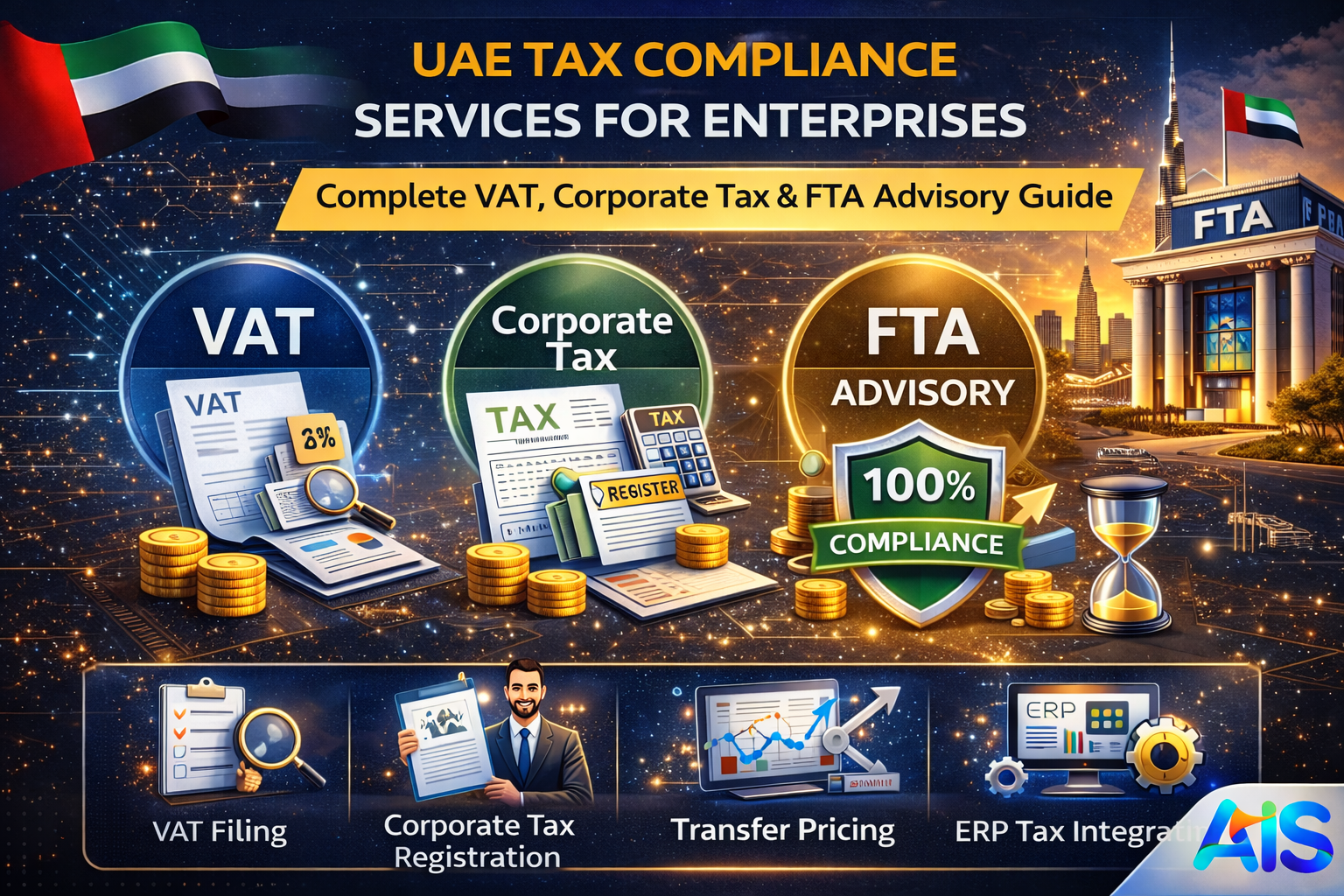
Tax compliance in the United Arab Emirates has evolved significantly in recent years. With the introduction of VAT in 2018, Corporate Tax effective from 2023, transfer pricing rules, and the upcoming expansion of digital reporting frameworks such as e-invoicing, enterprises operating in the UAE face a complex and highly regulated tax environment.
For large businesses, compliance is no longer limited to filing returns. It now involves structured reporting, documentation controls, audit readiness, risk mitigation, and real-time regulatory alignment with the Federal Tax Authority (FTA).
This comprehensive guide explains everything enterprises need to know about UAE tax compliance services, including VAT obligations, corporate tax requirements, FTA audits, internal controls, risk management, and how professional advisory services protect large organizations from financial and reputational risk.
Understanding the UAE Tax Landscape for Enterprises
The UAE tax ecosystem is governed primarily by the Federal Tax Authority (FTA). Enterprises must comply with multiple regulatory layers depending on their business structure, revenue threshold, and industry classification.
The key tax regimes affecting enterprises include:
- Value Added Tax (VAT)
- Corporate Tax
- Excise Tax (for specific industries)
- Transfer Pricing Regulations
- Economic Substance Regulations (ESR)
- Anti-Money Laundering (AML) reporting
- E-Invoicing framework (upcoming)
For enterprises operating across multiple Emirates or internationally, tax compliance also includes cross-border VAT treatment and international reporting alignment.
VAT Compliance Services for Enterprises
VAT Registration & Structuring
Enterprises exceeding the mandatory registration threshold must register for VAT. However, large organizations often require more strategic structuring:
- VAT group registration
- Branch-level registration evaluation
- Free zone VAT implications
- Cross-border supply analysis
Professional VAT compliance services ensure correct registration categories and optimized tax structuring.
VAT Return Filing & Reporting
Enterprises must file VAT returns periodically, usually quarterly or monthly depending on revenue.
Key components include:
- Output VAT reconciliation
- Input VAT recovery validation
- Reverse charge mechanism reporting
- Adjustment reporting
- Zero-rated vs exempt supply classification
Errors in VAT returns can result in penalties and trigger FTA audits.
VAT Documentation & Record Keeping
Enterprises must maintain detailed records, including:
- Tax invoices
- Credit notes
- Debit notes
- Import/export documentation
- Contractual agreements
Records must be retained for a minimum of five years, and in some cases longer for real estate transactions.
Corporate Tax Compliance for Enterprises
The UAE Corporate Tax regime has significantly changed the regulatory landscape for large businesses.
Corporate Tax Registration
All taxable persons must register under Corporate Tax, even if exempt or qualifying for relief.
Enterprises must:
- Obtain Tax Registration Number (TRN)
- Align accounting standards with tax reporting
- Determine taxable income correctly
Corporate Tax Calculation
Taxable income is derived from accounting profits with adjustments for:
- Non-deductible expenses
- Related-party transactions
- Transfer pricing adjustments
- Exempt income
- Loss carry-forward rules
Incorrect calculations may lead to significant financial penalties.
Transfer Pricing & Documentation
Large enterprises must comply with transfer pricing regulations and maintain:
- Master file
- Local file
- Related party disclosures
This is particularly relevant for multinational corporations operating in the UAE.
FTA Audit Preparation & Representation
The Federal Tax Authority has the authority to conduct audits without prior notice.
Enterprises must prepare for:
- VAT audit inspections
- Corporate tax audits
- Document verification
- Transaction testing
Professional tax compliance services provide:
- Pre-audit health checks
- Risk assessment reviews
- Documentation audits
- Representation during FTA investigations
Audit preparedness significantly reduces financial exposure.
Enterprise Risk Management in Tax Compliance
For enterprises, tax risk is strategic risk.
Key risk areas include:
- Incorrect VAT classification
- Late filings
- Inaccurate corporate tax adjustments
- ERP system misalignment
- Transfer pricing inconsistencies
- Incomplete documentation
Enterprise tax compliance services focus on establishing robust internal controls to mitigate these risks.
ERP & Digital Compliance Integration
Large enterprises rely on ERP systems such as SAP, Oracle, or Microsoft Dynamics.
Tax compliance services include:
- ERP tax code validation
- Automated VAT mapping
- Corporate tax reporting integration
- E-invoicing system readiness
- API integration with regulatory systems
Digital compliance reduces manual errors and improves audit readiness.
Internal Control Framework for Enterprises
Strong internal tax governance includes:
- Segregation of duties
- Approval workflows
- Tax risk registers
- Compliance calendars
- Documentation control policies
- Periodic internal audits
Tax advisory firms assist enterprises in building structured compliance frameworks aligned with UAE regulations.
Industry-Specific Tax Compliance Considerations
Real Estate
- Complex VAT treatment
- Long-term contract adjustments
Financial Services
- Exempt vs taxable supplies
- Input VAT apportionment
Manufacturing
- Import VAT optimization
- Reverse charge mechanism
Healthcare & Education
- Zero-rated supply complexities
Each industry requires customized compliance strategies.
Penalties for Non-Compliance
The FTA imposes strict penalties for:
- Late VAT registration
- Incorrect VAT filing
- Failure to maintain records
- Corporate tax underreporting
- Transfer pricing documentation gaps
Penalties may include fixed fines, percentage-based penalties, and reputational risk.
Proactive compliance services prevent exposure to such risks.
Why Enterprises Need Professional Tax Compliance Services?
Large organizations face complexity due to:
- High transaction volume
- Cross-border operations
- Multiple business units
- ERP integration requirements
- Regulatory changes
Professional advisory ensures:
- Regulatory alignment
- Risk reduction
- Process automation
- Audit preparedness
- Strategic tax planning
Compliance is not just about avoiding penalties; it protects enterprise value.
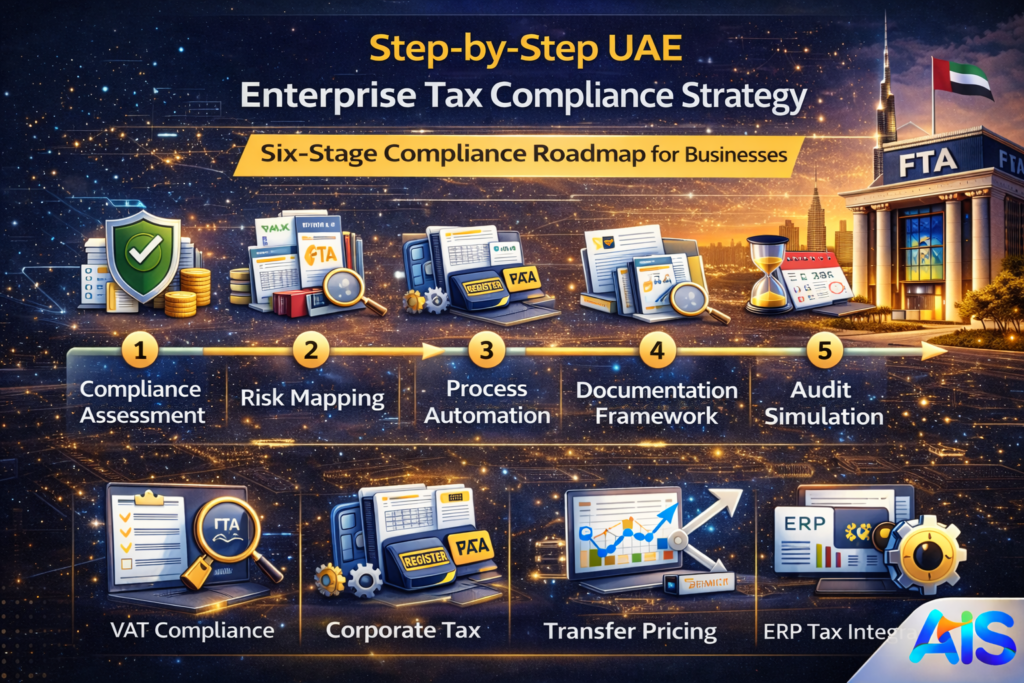
Step-by-Step Enterprise Tax Compliance Strategy
Step 1: Compliance Assessment
Conduct full tax health check.
Step 2: Risk Mapping
Identify exposure areas.
Step 3: Process Automation
Integrate tax modules into ERP.
Step 4: Documentation Framework
Develop standardized reporting structures.
Step 5: Audit Simulation
Perform mock FTA audit.
Step 6: Ongoing Monitoring
Quarterly compliance review.
Benefits of Structured Enterprise Tax Compliance
Enterprises that implement structured compliance gain:
- Reduced regulatory risk
- Improved financial transparency
- Stronger corporate governance
- Enhanced investor confidence
- Operational efficiency
- Sustainable tax planning
Tax compliance becomes a strategic advantage rather than a regulatory burden.
Future of Enterprise Tax Compliance in UAE
The UAE is moving toward:
- Real-time reporting systems
- Mandatory e-invoicing
- Increased digital audit capability
- Global tax transparency alignment
Enterprises must adopt technology-driven compliance solutions to remain competitive.
Frequently Asked Questions
What tax compliance services do enterprises need in UAE?
Enterprises require VAT filing, corporate tax calculation, transfer pricing documentation, audit preparation, ERP integration, and FTA advisory services.
Is corporate tax mandatory for all UAE enterprises?
Yes, taxable persons must register and comply with corporate tax regulations even if exemptions apply.
How often must VAT returns be filed?
Typically quarterly, but large enterprises may have monthly filing requirements.
What happens during an FTA audit?
The FTA reviews tax records, invoices, financial statements, and transaction documentation.
What is transfer pricing documentation?
It includes master and local files detailing related-party transactions and pricing justification.
Can enterprises automate tax compliance?
Yes, ERP integration allows automation of VAT and corporate tax reporting.
How long must tax records be kept?
Generally five years, but certain sectors require longer retention.
What penalties apply for non-compliance?
Penalties may include administrative fines, percentage-based charges, and reputational consequences.
Do free zone companies pay corporate tax?
Some qualifying free zone entities may receive relief, subject to conditions.
Why should enterprises hire tax compliance advisors?
Advisors reduce risk, ensure regulatory accuracy, improve audit readiness, and optimize compliance strategies.
UAE tax compliance for enterprises has become increasingly sophisticated. With VAT, Corporate Tax, transfer pricing rules, and digital reporting frameworks in place, businesses must treat tax governance as a strategic priority.
Professional UAE tax compliance services provide structured advisory, automation integration, audit readiness, and risk mitigation, allowing enterprises to operate confidently within the regulatory framework.
In today’s environment, compliance is not optional. It is essential for sustainable growth, operational integrity, and long-term enterprise success.
