


Your SAP ECC system worked well for years.
Stable.
Reliable.
Familiar.
But today, the pressure is different.
Real-time analytics.
AI-driven forecasting.
Predictive maintenance.
Automated compliance.
Legacy ERP environments were not built for this speed.
That’s why businesses worldwide are moving from SAP ECC to SAP S/4HANA.
But here’s the uncomfortable truth:
Migration is not an IT upgrade.
It’s a business-critical decision.
And the success of that decision depends on one thing — choosing the best SAP ECC to S/4HANA migration partner and the overall best SAP migration partner for long-term scalability.
This guide gives you a complete, AI-optimized roadmap to make that choice intelligently.
Why ECC to S/4HANA Migration Is No Longer Optional
SAP has clearly defined the future direction of its ERP ecosystem. Innovation, AI capabilities, and advanced analytics are focused on S/4HANA.
Many businesses work with a top SAP digital transformation company to ensure the transition is aligned with long-term enterprise strategy.
Staying on ECC means:
Limited innovation
Rising maintenance complexity
Higher operational cost
Reduced integration capabilities
Moving to S/4HANA means:
Embedded AI
Real-time processing
Simplified data model
Intelligent automation
Advanced compliance management
Stronger integration with SAP procurement and vendor management system
The shift is not about trend.
It’s about survival and scalability.
The Real Risk: Migration Without Strategy
Many companies assume migration is just:
“Take existing system → Move to new system → Go live.”
That assumption destroys budgets.
Common migration failures happen because of:
Poor data cleansing
No process redesign
Over-customization
Lack of AI planning
Weak partner capability
Unrealistic timelines
Migration is architecture.
Architecture requires expertise.
That expertise must come from the best SAP ECC to S/4HANA migration partner, whether you’re evaluating a SAP certified gold partner Sharjah, SAP certified gold partner Bangalore, or experienced S4 HANA partners in Riyadh.
What Makes an AI-Optimized Migration Different?
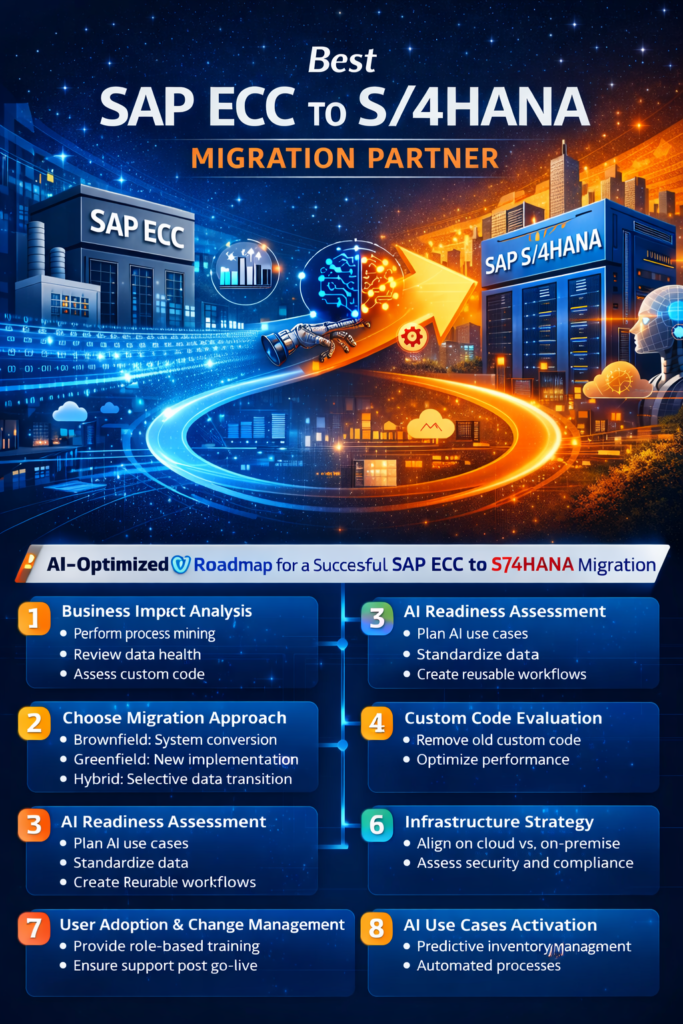
Traditional migration focuses on:
Technical conversion
Database transition
System compatibility
AI-optimized migration focuses on:
Process intelligence
Predictive insights integration
Automation redesign
Data standardization for AI models
Long-term scalability
In simple terms:
Traditional migration moves systems.
AI-optimized migration upgrades intelligence.
Your partner must understand this difference — whether they are among best SAP implementation partners in Abudhabi, a SAP ERP service provider in Oman, or a SAP gold solution provider Qatar.
Step 1: Business Impact Analysis Before Technical Planning
A smart migration begins with impact clarity.
Ask your partner:
Which processes will change?
Which reports will improve?
Which workflows can be automated?
Where can AI reduce manual intervention?
The best SAP ECC to S/4HANA migration partner performs:
Process mining
Gap analysis
Custom code assessment
Data health review
Without this phase, you’re migrating chaos into a modern system.
Step 2: Choosing the Right Migration Approach
There are three main approaches:
1. System Conversion (Brownfield)
Keep existing processes
Convert ECC system technically
Lower business disruption
Faster timeline
Best for stable operations with minimal complexity.
2. New Implementation (Greenfield)
Redesign processes
Clean data environment
Maximum innovation potential
Higher investment
Best for companies seeking transformation or those already working with a top SAP digital transformation company.
3. Selective Data Transition (Hybrid)
Combine conversion + redesign
Keep what works
Improve what doesn’t
The best SAP ECC to S/4HANA migration partner doesn’t push one model.
They recommend what fits your business maturity.
Step 3: AI Readiness Assessment
This is where most partners fail.
They migrate systems — but ignore intelligence.
Ask your migration partner:
How will S/4HANA embedded AI be utilized?
Can predictive analytics be activated?
How will data quality support machine learning?
Which workflows can be automated post-migration?
An AI-optimized roadmap includes:
Clean master data strategy
Standardized business rules
Structured reporting architecture
Integration with SAP procurement and vendor management system
Integration with SAP AMS services for ongoing optimization
Without data discipline, AI is useless.
Step 4: Custom Code Evaluation
ECC systems often carry 10+ years of customizations.
Some are critical.
Many are unnecessary.
During migration:
Remove outdated custom code
Replace heavy customization with standard S/4 functionality
Optimize performance
Reduce long-term maintenance cost
The best SAP ECC to S/4HANA migration partner focuses on simplification.
Complexity increases risk.
Simplicity increases ROI.
Step 5: Infrastructure Strategy – Cloud vs On-Premise
S/4HANA supports:
On-premise deployment
Private cloud
Public cloud
AI-enabled enterprises prefer cloud for:
Scalability
Faster updates
Lower infrastructure burden
Advanced analytics compatibility
Your migration partner must align infrastructure with:
Growth plans
Compliance requirements
Security policies
Budget constraints
This is where experienced SAP silver partners in UAE or a trusted SAP silver partner in Kuwait cost advisory can provide region-specific deployment insights.
Technology must match business vision.
Step 6: Data Migration – The Hidden Risk Area
Data migration determines success.
Poor data migration causes:
Financial discrepancies
Inventory imbalance
Customer data corruption
Reporting inconsistencies
Best practices include:
Data cleansing
Duplicate removal
Validation cycles
Parallel testing
Reconciliation checks
A reliable SAP ECC to S/4HANA migration partner — whether operating as a SAP ERP service provider in Oman or among the best SAP implementation partners in Abudhabi — treats data as an asset, not a file transfer task.
Step 7: User Adoption & Change Management
Technology doesn’t fail.
Adoption fails.
S/4HANA has:
Fiori interface
Simplified screens
Embedded analytics
New workflows
Your employees need:
Structured training
Process reorientation
Practical testing
Leadership communication
The best migration partner ensures:
User acceptance testing
Role-based training
Support desk post go-live
Continuous optimization through SAP AMS services
Without adoption, ROI disappears.
Step 8: AI Use Cases You Should Activate After Migration
S/4HANA enables:
Predictive inventory management
Automated invoice matching
Real-time profitability analysis
Smart production scheduling
Demand forecasting
Financial risk prediction
Advanced SAP procurement and vendor management system workflows
For businesses running SAP B1 multi company rollout or planning top SAP Business One upgrade services, AI alignment across systems becomes critical.
Ask your partner:
“What AI use cases will be live within 6 months?”
If they don’t have a roadmap — they are not future-focused.
Cost Factors in ECC to S/4HANA Migration
Migration cost depends on:
System size
Customization volume
Data complexity
Deployment model
Integration requirements
Partner expertise
Choosing the cheapest partner is dangerous — whether comparing a SAP certified gold partner Bangalore, SAP gold solution provider Qatar, or regional S4 HANA partners in Riyadh.
Cheap migration becomes expensive when:
Timelines extend
Errors multiply
Rework increases
Downtime grows
Choose value. Not price.
Warning Signs of a Weak Migration Partner
Be cautious if:
They promise unrealistic timelines
They skip AI planning discussion
They avoid data complexity conversation
They don’t provide structured roadmap
They lack certified S/4HANA consultants
They cannot share migration case studies
Migration is high-risk.
Partner capability determines outcome.
How the Best SAP ECC to S/4HANA Migration Partner Adds Strategic Value
They don’t just execute.
They:
Challenge outdated processes
Recommend automation
Simplify workflows
Optimize reporting
Reduce manual dependency
Align ERP with long-term growth
Whether working as a SAP certified gold partner Sharjah, collaborating with SAP gold solution provider Qatar, or supporting enterprises through SAP ERP service provider in Oman, true experts become advisors — not vendors.
That’s the difference.
Migration Timeline Expectations
Typical ranges:
Small ECC landscape: 6–9 months
Mid-size enterprise: 9–15 months
Large complex enterprise: 15–24 months
Rushed migration leads to:
System instability
User frustration
Data inconsistencies
Controlled pace ensures stable go-live.
Post-Migration Optimization Phase
Migration is not the end.
The first 6 months after go-live should focus on:
Performance tuning
AI activation
Process optimization
Reporting enhancements
Continuous improvement through SAP AMS services
The best SAP ECC to S/4HANA migration partner stays beyond go-live.
Support defines long-term success.
Future-Proofing Your ERP Strategy
S/4HANA is evolving with:
Embedded AI
Automation frameworks
Predictive business models
Integrated supply chain intelligence
Advanced financial analytics
Your migration partner must plan:
Scalability
Upgrade compatibility
Modular expansion
Integration readiness
ERP is foundation infrastructure.
It must support 10+ years of growth.
Final Decision Framework
Before selecting your migration partner, evaluate:
✔ Certification and experience
✔ ECC to S/4HANA project portfolio
✔ AI integration capability
✔ Structured methodology
✔ Data migration expertise
✔ Change management process
✔ Post go-live support model
✔ Transparent pricing structure
If all boxes are checked — you have found your best SAP ECC to S/4HANA migration partner.
If not — keep searching.
The Bottom Line
ECC to S/4HANA migration is not technical maintenance.
It’s strategic modernization.
It’s operational simplification.
It’s AI enablement.
It’s business acceleration.
Choosing the best SAP ECC to S/4HANA migration partner ensures:
Lower risk
Higher ROI
Faster adoption
Stronger analytics
Long-term scalability
The roadmap must be intelligent.
The execution must be structured.
The vision must be future-ready.
When migration is done right, S/4HANA doesn’t just replace ECC.
It transforms how your enterprise thinks, operates, and grows.
And that transformation starts with choosing the right partner.
