


The introduction of ERP integration for logistics e-invoicing UAE is transforming how logistics and freight companies manage billing, tax compliance, and financial workflows. As the UAE government accelerates digital transformation and prepares businesses for mandatory electronic invoicing, logistics companies must modernize their invoicing infrastructure to remain compliant with the Federal Tax Authority (FTA) and future digital reporting systems.
For logistics businesses operating across Dubai, Abu Dhabi, Sharjah, Ajman, Ras Al Khaimah, Fujairah, Umm Al Quwain, and UAE free zones, invoicing processes are often complex. Freight charges, customs fees, warehousing costs, and transportation services must all be accurately recorded and reported.
By implementing ERP integration for logistics e-invoicing UAE, companies can automate freight invoices, eliminate manual errors, ensure tax compliance, and streamline financial operations across their supply chain networks.
This article explores how ERP-based e-invoicing works for logistics companies in the UAE, the benefits of automation, implementation steps, and how businesses can prepare for upcoming digital tax compliance requirements.
Understanding ERP Integration for Logistics E-Invoicing in the UAE
ERP integration for logistics e-invoicing connects enterprise resource planning systems with digital invoicing platforms to automatically generate, validate, and transmit electronic invoices.
Instead of manually creating invoices, the system pulls operational data directly from logistics workflows such as shipment orders, delivery confirmations, warehouse operations, and freight management systems.
Once integrated, the ERP system can:
- Generate compliant electronic invoices
- Validate invoice data automatically
- Ensure tax calculations meet UAE regulations
- Send invoices digitally to customers
- Maintain digital audit trails
This automation significantly reduces administrative workload and ensures businesses comply with upcoming UAE e-invoicing frameworks.
Why Logistics Companies in the UAE Need ERP-Based E-Invoicing?
Logistics businesses deal with high volumes of transactions daily. Manual invoicing can create inefficiencies, delays, and compliance risks.
Key Challenges in Traditional Freight Invoicing
| Challenge | Impact on Logistics Companies |
| Manual invoice processing | Increased operational workload |
| Human errors in tax calculations | Compliance risks with FTA |
| Delayed invoice approvals | Cash flow disruptions |
| Fragmented systems | Lack of financial visibility |
| Paper-based records | Difficult auditing and reporting |
ERP integration solves these problems by enabling real-time digital invoicing automation.
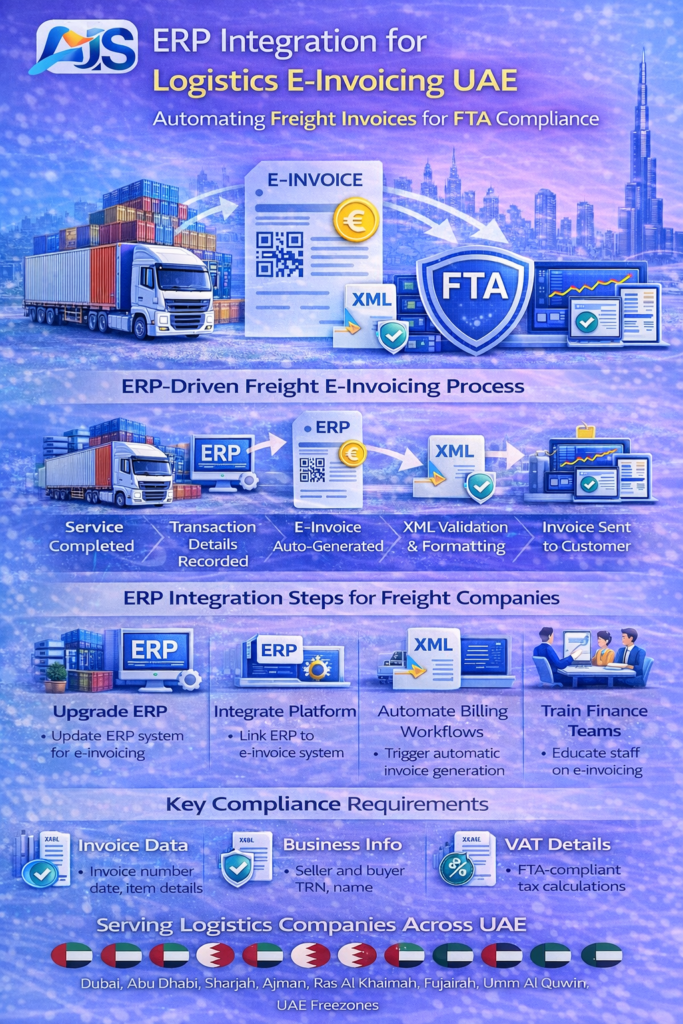
How ERP Integration Automates Logistics E-Invoicing?
ERP-driven e-invoicing systems automate the entire billing lifecycle.
Typical Workflow
| Step | Process |
| 1 | Shipment or freight service is completed |
| 2 | ERP records transaction details |
| 3 | System automatically generates e-invoice |
| 4 | Invoice is validated according to UAE tax rules |
| 5 | Invoice is transmitted digitally to customer |
| 6 | Records are stored for compliance and auditing |
This process ensures accuracy, speed, and regulatory compliance.
Key ERP Systems Used by Logistics Companies
Many logistics companies in the UAE rely on ERP platforms to manage finance and operations.
Common ERP Platforms
| ERP System | Usage in Logistics |
| SAP | Large enterprise logistics operations |
| Oracle NetSuite | Global supply chain management |
| Microsoft Dynamics | Mid-size logistics companies |
| Odoo | SMEs and startup logistics firms |
| Zoho ERP | Small logistics businesses |
Integrating these systems with e-invoicing platforms ensures seamless digital invoice generation and reporting.
UAE E-Invoicing Requirements for Logistics Businesses
The UAE is moving toward a structured electronic invoicing ecosystem that aligns with global digital tax reporting standards.
Logistics companies must prepare for:
- Standardized digital invoice formats
- Real-time invoice validation
- Secure electronic transmission
- Centralized tax reporting
- Digital audit trails
Key Compliance Requirements
| Requirement | Description |
| Digital invoices | Paper invoices replaced by electronic documents |
| Tax compliance | Correct VAT calculation |
| Data validation | Invoice data must meet the required structure |
| Secure transmission | Encrypted invoice exchange |
| Record retention | Digital records are maintained for audits |
ERP integration ensures logistics companies can meet these requirements automatically.
Benefits of ERP Integration for Logistics E-Invoicing UAE
Implementing automated e-invoicing provides significant operational advantages.
1. Faster Invoice Processing
Automation reduces the time required to generate freight invoices.
2. Improved Cash Flow
Digital invoicing speeds up customer payments.
3. Reduced Human Errors
ERP systems automatically calculate taxes and charges.
4. Real-Time Financial Visibility
Companies gain better insight into billing and revenue performance.
5. Regulatory Compliance
Automated systems ensure compliance with UAE tax regulations.
ERP Integration Architecture for Logistics E-Invoicing
A modern e-invoicing ecosystem integrates multiple systems.
Key Components
| Component | Function |
| ERP system | Generates invoice data |
| E-invoicing platform | Validates and formats invoice |
| Compliance engine | Applies tax rules |
| Transmission network | Sends invoices securely |
| Reporting system | Tracks invoice status |
Together, these systems create a fully automated invoicing environment.
Logistics Use Cases for ERP-Based E-Invoicing
Different logistics operations benefit from ERP integration.
Freight Forwarding
Automated billing for transportation services.
Warehousing
Digital invoices for storage and handling charges.
Customs Clearance
Electronic invoicing for documentation and service fees.
Last-Mile Delivery
Automated billing for delivery services.
Third-Party Logistics (3PL)
Integrated billing across supply chain partners.
Preparing Your Logistics Company for ERP E-Invoicing
Businesses should begin preparing now to ensure a smooth transition.
Preparation Checklist
| Step | Action |
| 1 | Review current invoicing workflows |
| 2 | Upgrade ERP systems |
| 3 | Integrate e-invoice platforms |
| 4 | Train finance teams |
| 5 | Implement automation tools |
Early adoption helps businesses avoid future compliance risks.
Cities Where Logistics E-Invoicing Adoption Is Growing
Logistics hubs across the UAE are rapidly adopting digital invoicing systems.
Major logistics markets include:
- Dubai
- Abu Dhabi
- Sharjah
- Ajman
- Ras Al Khaimah
- Fujairah
- Umm Al Quwain
- UAE Free Zones
Companies operating in these regions are increasingly implementing ERP-integrated invoicing systems to improve efficiency.
How AI and Automation Are Transforming Logistics Invoicing?
Advanced technologies are enhancing digital invoicing capabilities.
Key Innovations
- AI-driven invoice validation
- Automated tax calculations
- Smart invoice matching
- Predictive payment analytics
- Real-time compliance monitoring
These technologies reduce administrative workload and improve financial accuracy.
Future of ERP-Based Logistics E-Invoicing in the UAE
The UAE is rapidly becoming a global leader in digital finance and tax automation.
Future developments may include:
- Mandatory electronic invoicing
- Real-time tax reporting
- Integration with global e-invoice networks
- Blockchain-based invoice validation
- AI-driven financial compliance systems
Logistics companies that adopt ERP-based e-invoicing early will gain a competitive advantage.
The transition toward ERP integration for logistics e-invoicing UAE represents a major shift in how logistics companies manage financial operations and regulatory compliance.
By automating freight invoicing, businesses can improve efficiency, reduce errors, and maintain compliance with UAE tax regulations. As digital invoicing becomes the standard across industries, logistics companies must modernize their systems and prepare for future regulatory changes.
Organizations that implement ERP-integrated e-invoicing solutions today will be better positioned to scale operations, optimize billing processes, and thrive in the evolving digital economy.
Frequently Asked Questions (FAQs)
What is ERP integration for logistics e-invoicing in the UAE?
It connects ERP systems with digital invoicing platforms to automatically generate compliant electronic invoices for logistics services.
Why is e-invoicing important for logistics companies?
It improves invoice accuracy, speeds up payments, and ensures compliance with UAE tax regulations.
Is e-invoicing mandatory in the UAE?
The UAE government is introducing structured e-invoicing frameworks that businesses will need to adopt in the future.
Which ERP systems support logistics e-invoicing?
Popular systems include SAP, Oracle NetSuite, Microsoft Dynamics, Odoo, and Zoho ERP.
How does ERP automation improve freight invoicing?
ERP automation eliminates manual entry and generates invoices directly from logistics transaction data.
Can SMEs in logistics adopt ERP-based e-invoicing?
Yes, many cloud-based ERP platforms provide affordable e-invoicing solutions for small and medium logistics companies.
What compliance requirements must logistics invoices meet?
Invoices must follow UAE VAT regulations, include required tax details, and be stored digitally.
How long does ERP e-invoicing implementation take?
Implementation timelines vary depending on company size and system complexity.
What are the risks of not adopting e-invoicing?
Companies may face compliance issues, operational inefficiencies, and delayed payments.
How can logistics companies prepare for UAE e-invoicing?
They should upgrade ERP systems, automate invoicing workflows, and implement compliant digital invoicing platforms.
