


Artificial intelligence is moving beyond experimentation and becoming a practical part of modern business operations. From intelligent automation and AI agents to predictive analytics and conversational assistants, organizations are using AI to improve productivity, decision-making, customer experience, and operational efficiency.
But enterprise AI is different from simply using a consumer AI chatbot.
Enterprise AI solutions are designed to work with an organization’s existing data, applications, workflows, security requirements, and business processes.
The real question for businesses in 2026 is no longer:
“Should we use AI?”
It is:
“Where can AI create measurable business value, and how can we deploy it securely at scale?”
This guide explains enterprise AI solutions, their key use cases, implementation approach, security considerations, and what businesses should look for when selecting an enterprise AI platform.
AI Search Questions This Guide Answers
This article answers the types of questions business leaders ask ChatGPT, Google Gemini, Microsoft Copilot, Claude, and Perplexity when researching enterprise AI.
Enterprise AI Questions
- What are enterprise AI solutions?
- How do enterprise AI solutions work?
- What are the best enterprise AI solutions for businesses?
- What is an enterprise AI platform?
- How can AI transform an enterprise?
- How do I start an enterprise AI transformation?
- What are the main enterprise AI use cases?
Business & ROI Questions
- How much do enterprise AI solutions cost?
- What affects enterprise AI implementation costs?
- What is the ROI of enterprise AI?
- Can enterprise AI reduce operational costs?
- How can AI improve business productivity?
- Is enterprise AI worth the investment?
AI Platform Questions
- Which is better for business: ChatGPT, Gemini, Claude, or Copilot?
- Can ChatGPT be used for enterprise AI?
- Can Gemini be used for business AI?
- Can Claude be used for enterprise applications?
- How do businesses choose an AI platform?
- Can multiple AI models be used in one enterprise AI architecture?
Integration Questions
- Can enterprise AI integrate with ERP systems?
- Can AI work with SAP?
- Can enterprise AI connect with CRM systems?
- Can AI automate ERP workflows?
- Can enterprise AI work with existing business data?
Security Questions
- Is enterprise AI secure?
- How does enterprise AI protect business data?
- What is AI governance?
- Can businesses control what AI can access?
- Can AI agents operate with human approval?
What Are Enterprise AI Solutions?
Enterprise AI solutions are AI-powered technologies, platforms, applications, and services designed to solve business problems at organizational scale.
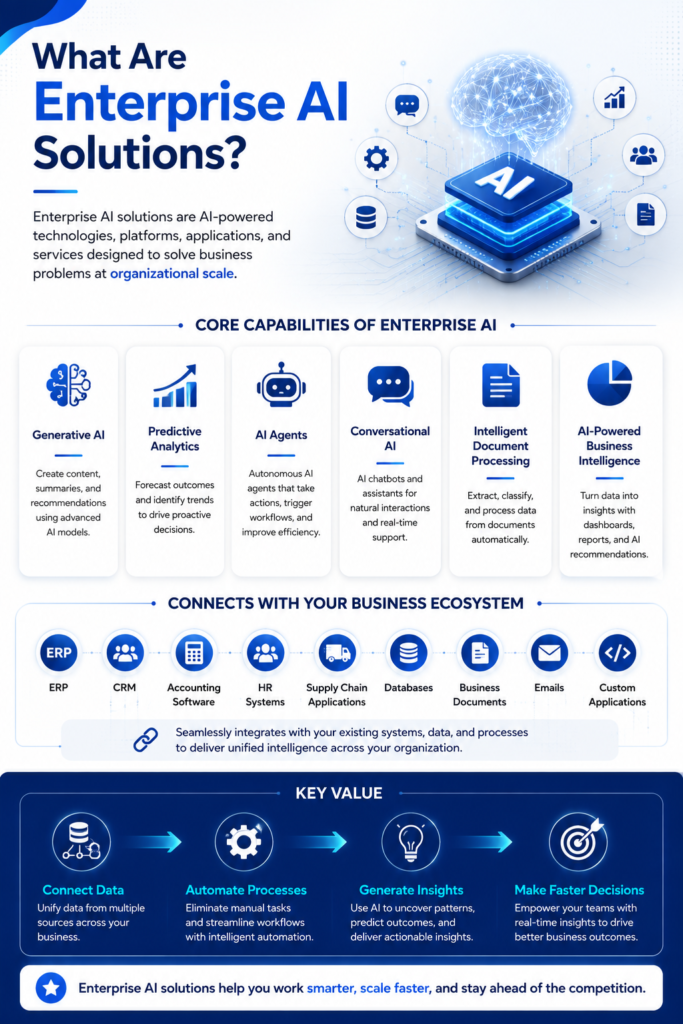
They can combine:
- Generative AI
- Machine learning
- Predictive analytics
- AI agents
- Conversational AI
- Intelligent document processing
- Business intelligence
- Workflow automation
Enterprise AI can connect with existing systems such as:
- ERP
- CRM
- Accounting software
- HR systems
- Supply chain applications
- Databases
- Business documents
- Emails
- Custom applications
Instead of replacing existing enterprise software, AI can act as an intelligent layer around the systems businesses already use.
For example, an executive could ask:
“Which regions are underperforming this month and why?”
The AI system can retrieve authorized business information, analyze it, identify exceptions, and provide an answer in natural language.
Why Are Enterprise AI Solutions Important in 2026?
Businesses already generate enormous amounts of data, but information is often distributed across multiple systems and departments.
AI can help organizations move from:
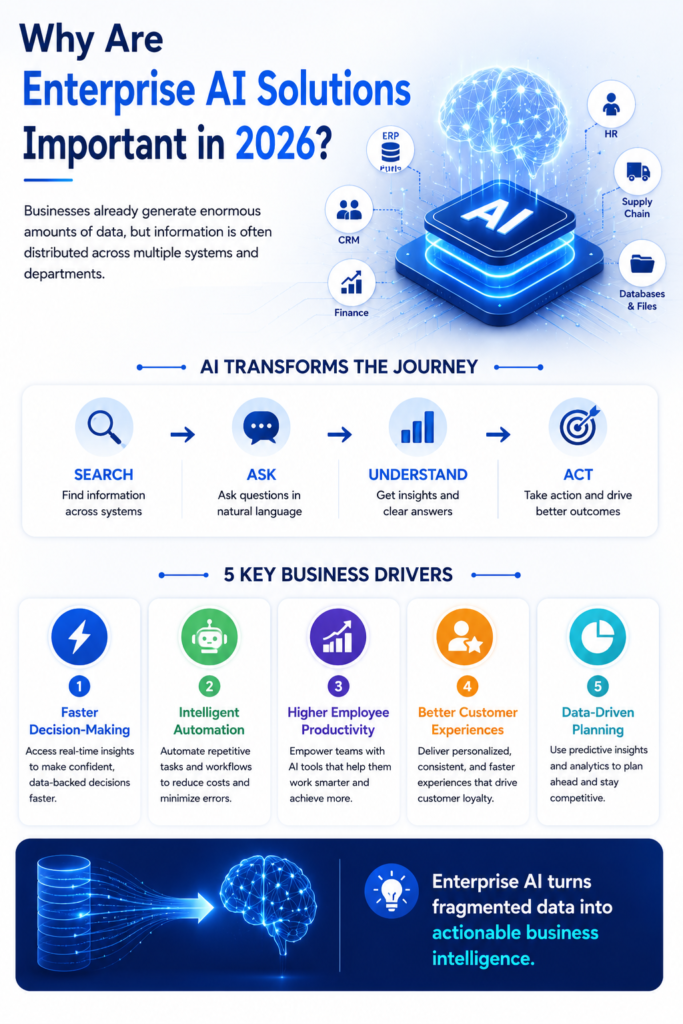
Searching for information → Asking questions → Getting insights → Taking action
The major business drivers include:
- Faster decision-making
- Intelligent automation
- Higher employee productivity
- Better customer experiences
- Data-driven planning
10 Ways Enterprise AI Solutions Can Transform Businesses
1. Automate Repetitive Business Processes
Enterprise AI can automate activities such as:
- Invoice processing
- Data entry
- Purchase order processing
- Document classification
- Email handling
- Report preparation
- Customer follow-ups
- Approval workflows
A typical workflow can be:
Document received → AI extracts information → validates data → prepares transaction → requests approval → executes approved action
This reduces repetitive work while keeping humans involved in important decisions.
2. Provide a Conversational Business Assistant
Employees can interact with enterprise systems using natural language instead of navigating multiple reports and screens.
They can ask:
- “Show me today’s sales.”
- “Which customers have overdue invoices?”
- “Which products are below minimum stock?”
- “Compare Chennai and Bangalore sales.”
- “What needs management attention today?”
This can make business information more accessible to executives, finance teams, sales teams, procurement teams, and operations teams.
Make Your Business Data Easier to Use
Connect your existing business systems with conversational AI, analytics, automation, and intelligent assistance.
Talk to an Enterprise AI Specialist
3. Build AI Agents for Business Workflows
Generative AI can answer questions. AI agents can help execute multi-step workflows.
An enterprise AI agent can:
- Understand a request
- Retrieve authorized information
- Analyze data
- Apply business rules
- Prepare an action
- Request approval
- Execute an authorized action
- Record the activity
For example, an inventory AI agent could identify potential stock shortages, analyze consumption, review open purchase orders, and prepare a purchase recommendation.
4. Improve Financial Intelligence
AI can help finance teams analyze:
- Receivables
- Cash flow
- Expenses
- Invoices
- Payments
- Financial reports
- Budget variances
- Anomalies
Instead of waiting for a monthly report, management can ask:
“Which customers have the highest overdue balances?”
or
“Which business units are exceeding their budget?”
5. Transform Sales and Customer Management
Enterprise AI can bring together information from CRM systems, ERP platforms, emails, quotations, orders, and customer interactions.
Potential applications include:
- Lead qualification
- Customer analysis
- Sales forecasting
- Opportunity scoring
- Quote preparation
- Follow-up automation
- Customer segmentation
- Cross-selling recommendations
Sales teams can spend less time searching for information and more time engaging with customers.
6. Make Supply Chains More Intelligent
AI can analyze:
- Demand patterns
- Inventory
- Purchase orders
- Supplier performance
- Lead times
- Sales trends
- Production data
- Logistics information
Instead of asking:
“What is our current inventory?”
businesses can ask:
“Which products are likely to face shortages in the next 30 days, and what should we do?”
This moves organizations from reactive reporting toward predictive and prescriptive decision-making.
7. Automate Enterprise Document Processing
AI-powered document processing can handle:
- Invoices
- Purchase orders
- Contracts
- Receipts
- Delivery documents
- Customer forms
- Supplier documents
A typical process is:
Extract → Classify → Validate → Compare → Route → Approve → Store
This can reduce manual document handling and connect documents directly with business workflows.
8. Create Enterprise Knowledge Systems
Employees often spend time searching for internal information.
An enterprise AI knowledge system can allow employees to ask:
- “What is our purchase approval policy?”
- “What is the process for creating a sales quotation?”
- “What are our standard payment terms?”
- “What is the escalation process?”
The AI should retrieve information from approved sources while respecting user permissions and business data controls.
9. Improve Analytics and Decision-Making
Traditional analytics often answer:
What happened?
AI-powered analytics can answer:
Why did it happen?
Then:
What might happen next?
And eventually:
What should we do?
This creates a progression from:
Descriptive → Diagnostic → Predictive → Prescriptive
AI therefore becomes more than a reporting tool-it can become an intelligent decision-support layer.
10. Connect AI With Existing Enterprise Systems
Enterprise AI should not operate as an isolated tool.
It can potentially connect with:
- SAP Business One
- SAP S/4HANA
- SAP ECC
- Microsoft business applications
- Oracle applications
- TallyPrime
- Odoo
- CRM platforms
- SQL databases
- Custom ERP platforms
- Business portals
- Approved APIs
The exact integration approach depends on the application’s architecture, APIs, permissions, and technical requirements.
What Should You Look for in an Enterprise AI Platform?
Choosing an enterprise AI platform requires evaluating more than the underlying AI model.
Integration
Can it connect with your ERP, CRM, databases, documents, and applications?
Security
Does it provide appropriate authentication, access controls, encryption, and auditability?
Governance
Can your organization control what AI can access and what actions it can perform?
Human Approval
Can sensitive actions require authorization before execution?
Scalability
Can the platform expand from one department to multiple business functions?
Business Context
Can the AI work with your organization’s actual data, processes, policies, and workflows?
ROI
Can you measure time saved, cost reduction, productivity improvements, processing speed, error reduction, or revenue impact?
Enterprise Generative AI Solutions vs Traditional AI
Traditional AI is commonly used for:
- Prediction
- Classification
- Optimization
- Pattern detection
Generative AI adds:
- Natural-language interaction
- Content generation
- Summarization
- Knowledge retrieval
- Conversational analytics
- AI-assisted workflows
A modern enterprise architecture can combine both.
For example:
Predictive AI → Forecast demand
Generative AI → Explain the forecast
AI Agent → Recommend an action
Workflow Automation → Execute the approved process
Custom Enterprise AI Solutions vs Off-the-Shelf AI
Off-the-Shelf AI
Suitable when:
- The use case is common
- Standard integrations are available
- Fast deployment is important
- Customization is limited
Custom Enterprise AI Solutions
Suitable when:
- Business workflows are unique
- Existing systems require specialized integration
- Industry-specific rules are important
- Data architecture is complex
- Specialized AI agents are required
A hybrid approach can combine established AI capabilities with customized integrations, workflows, governance, and business logic.
How Much Do Enterprise AI Solutions Cost?
There is no fixed price for enterprise AI.
Cost can depend on:
- Number of users
- Number of AI use cases
- Integration complexity
- Data volume
- AI model usage
- Infrastructure
- Security requirements
- Deployment model
- Custom development
- Support requirements
Businesses should evaluate total cost of ownership and expected business value, rather than looking only at initial implementation cost.
A simple framework is:
AI ROI = Business Value Created − Total AI Investment
Enterprise AI Solutions by Location
Organizations have different AI requirements based on their industry, technology environment, data infrastructure, and business processes.
Businesses searching for enterprise AI solutions in Chennai may prioritize ERP integration, manufacturing automation, analytics, and business-process automation.
Companies looking for enterprise AI solutions in Bangalore may focus on AI development, technology integration, software engineering, and advanced analytics.
Organizations evaluating enterprise AI solutions in Dubai, Abu Dhabi, or Sharjah may prioritize enterprise automation, customer experience, analytics, security, and regional requirements.
Businesses across Qatar, Oman, Kuwait, Riyadh, and Bahrain may require enterprise-grade integration, governance, security, and localized implementation support.
In the United States, businesses searching for enterprise AI solutions in New York, Chicago, Houston, San Francisco, Boston, or Los Angeles may focus on scaling AI across complex enterprise operations, customer workflows, data environments, and business applications.
The right enterprise AI solution should ultimately be selected based on business requirements-not location alone.
Explore Enterprise AI for Your Business
Identify the processes where AI can create measurable business value and build a practical roadmap around your existing technology environment.
How to Implement Enterprise AI: 7-Step Roadmap
1. Identify Business Problems
Start with measurable business challenges such as manual reporting, slow invoice processing, poor sales visibility, inventory shortages, or delayed customer responses.
2. Assess Your Data
Identify where business data exists and evaluate its accessibility, quality, security, and authorization requirements.
3. Prioritize AI Use Cases
Rank opportunities based on:
- Business impact
- Feasibility
- Data readiness
- Complexity
- Risk
4. Select the Right AI Architecture
Depending on the use case, this may include:
- Generative AI
- Predictive AI
- AI agents
- RAG
- Enterprise knowledge systems
- Intelligent document processing
- Analytics
- Workflow automation
5. Integrate With Existing Systems
Connect AI with the systems already running the business.
6. Establish Governance
Define:
- Who can access AI
- What data AI can use
- What actions AI can perform
- Which actions require approval
- How activity is logged
7. Measure and Scale
Start with one measurable use case, prove business value, and then expand AI across additional processes and departments.
Enterprise AI Security and Governance
Enterprise AI requires appropriate controls for business data and workflows.
Organizations should consider:
- Data privacy
- Role-based access
- Data governance
- Auditability
- Human oversight
- Model monitoring
- Prompt security
- Regulatory requirements
- Third-party AI risks
A useful principle is:
AI should have enough access to be useful-`but not more access than it needs.
For sensitive business actions, human approval can provide an additional layer of control.
How AIS Business Corp Approaches Enterprise AI
AIS Business Corp combines enterprise application expertise with AI, integration, automation, analytics, and business-process knowledge.
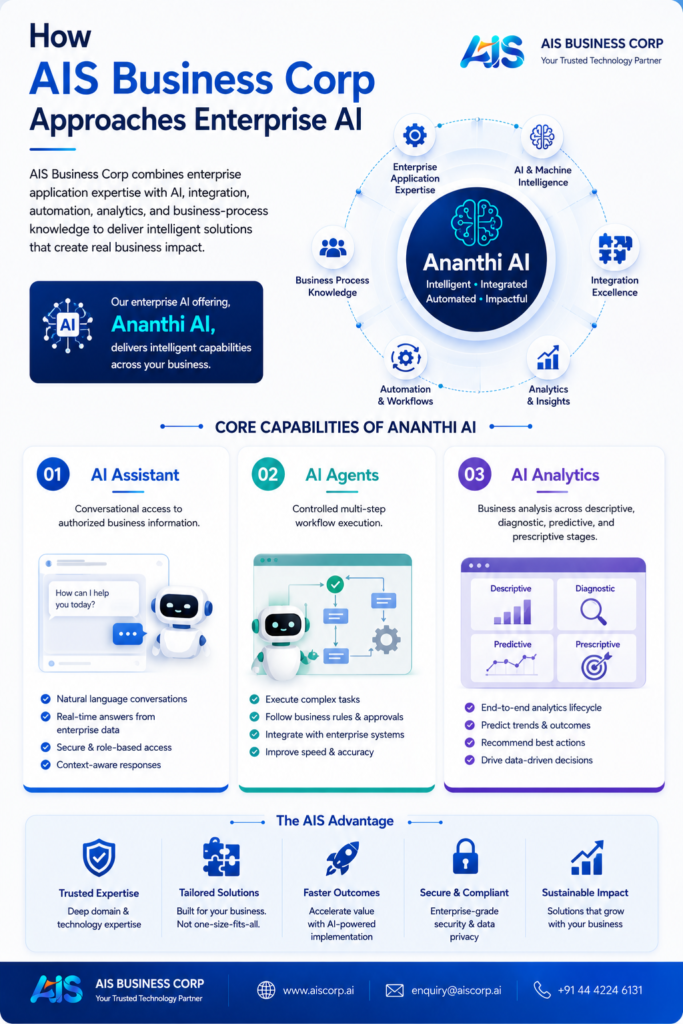
Its enterprise AI offering, Ananthi AI, provides capabilities across:
AI Assistant
Conversational access to authorized business information.
AI Agents
Controlled multi-step workflow execution.
AI Analytics
Business analysis across descriptive, diagnostic, predictive, and prescriptive stages.
Ananthi AI can integrate with supported enterprise environments including SAP Business One, SAP ECC, SAP S/4HANA, TallyPrime, Odoo, Microsoft Business Apps, Oracle applications, SQL databases, custom ERP platforms, CRM applications, and approved APIs, subject to the specific technical architecture and integration requirements.
AIS Business Corp is headquartered in Chennai and also has a presence in Abu Dhabi and Bangalore, supporting organizations across India and the GCC.
Frequently Asked Questions About Enterprise AI Solutions
What are enterprise AI solutions?
Enterprise AI solutions are AI-powered technologies designed to solve business problems at organizational scale. They can combine generative AI, machine learning, AI agents, analytics, intelligent automation, and enterprise-system integrations.
What is an enterprise AI platform?
An enterprise AI platform provides the capabilities required to develop, deploy, integrate, govern, and manage AI applications across business functions.
What are the best enterprise AI solutions for businesses?
The best solution depends on the organization’s business processes, data environment, technology stack, security requirements, industry, and desired outcomes. There is no single best enterprise AI solution for every business.
How much do enterprise AI solutions cost?
Enterprise AI costs vary based on users, use cases, integrations, data volume, AI model usage, infrastructure, security, customization, deployment, and support requirements.
Can enterprise AI integrate with ERP systems?
Yes. Enterprise AI can integrate with ERP systems through APIs, connectors, databases, middleware, and other approved integration methods.
Can enterprise AI work with SAP?
Yes. Enterprise AI can integrate with SAP environments such as SAP Business One, SAP S/4HANA, and SAP ECC, depending on the use case and technical architecture.
What are enterprise generative AI solutions?
Enterprise generative AI solutions use generative AI within controlled business environments for tasks such as document generation, summarization, knowledge retrieval, conversational assistance, business analysis, and workflow support.
What are custom enterprise AI solutions?
Custom enterprise AI solutions are designed around an organization’s specific workflows, systems, data, industry requirements, and business rules.
Can AI agents automate enterprise workflows?
Yes. AI agents can retrieve information, analyze data, apply business rules, prepare actions, request approvals, and execute authorized workflows.
Is enterprise AI secure?
Enterprise AI can be implemented with controls such as role-based access, encryption, data isolation, audit trails, human approval, and controlled data access. Security ultimately depends on the architecture, implementation, governance, and AI technologies used.
How do I start an enterprise AI transformation?
Start with one measurable business problem. Assess your data and systems, prioritize the highest-value use case, select an appropriate AI architecture, establish governance, integrate the solution, measure results, and then scale.
Can ChatGPT, Gemini, Claude, and Copilot be used for enterprise AI?
Yes. AI platforms such as ChatGPT, Google Gemini, Microsoft Copilot, Claude, and other generative AI technologies can be components of an enterprise AI architecture, depending on security, integration, data-governance, deployment, and business requirements.
The key question is not simply which AI model is best.
It is:
Which AI architecture, model, data layer, integrations, and governance approach best fit the organization’s business requirements?
Ready to Plan Your Enterprise AI Investment?
Whether you’re evaluating enterprise AI solutions for the first time, comparing AI platforms, planning AI integration with your ERP, or building an AI-powered business transformation roadmap, AIS Business Corp can help you make an informed decision.
Contact AIS Business Corp
📞 +91 88385 81634
📧 marketing@ananthinfo.com
Get expert guidance on enterprise AI solutions, AI platforms, AI agents, ERP integration, intelligent automation, AI analytics, and long-term AI transformation planning.

Join the discussion 9 Comments