


In this guide, we explore how ai finance assistant transforms enterprise operations and what business leaders need to know in 2026.Finance operations are becoming more complex as organizations manage growing transaction volumes, multi-entity accounting structures, digital payment ecosystems, and increasing compliance requirements. Traditional financial workflows that once depended heavily on manual processing — chasing overdue payments, preparing reports, and monitoring cash flow largely across spreadsheets and ERP screens — are no longer efficient enough to support modern operational demands. An AI finance assistant is designed specifically to reduce this manual burden.
As a specialized form of AI assistant for business, a finance-focused assistant understands financial terminology, reporting cycles, and the specific data structures finance teams work with daily. Finance teams today are expected to deliver faster reporting, better forecasting, accurate reconciliation, real-time financial visibility, fraud prevention, and improved operational efficiency — all while managing financial data flowing through ERP systems, banking platforms, procurement applications, customer transactions, and payment gateways.
This guide explains how an AI finance assistant works, covering cash application automation, fraud detection, predictive accounting, key use cases, implementation considerations, and what businesses should evaluate before getting started.
What an AI Finance Assistant Can Do
Modern AI capabilities integrated into ERP platforms such as SAP S/4HANA and SAP Business One help automate financial workflows, improve reporting accuracy, reduce manual effort, and strengthen operational control. Finance-focused AI assistants typically support a defined set of high-value tasks.
- Answering questions about cash position, receivables, and payables.
- Summarizing financial reports in plain language.
- Flagging unusual transactions or budget variances.
- Drafting payment reminder communications.
- Preparing recurring management reports automatically.
Cash Application Automation: Accounts Receivable AI Agent
Cash application is the process of matching incoming payments with customer invoices. Traditionally, finance teams manually verify payments, match invoices, resolve discrepancies, track partial payments, and update ERP records. As transaction volumes increase, manual cash application becomes difficult to manage efficiently — organizations processing large numbers of payments often face delayed reconciliation, incorrect invoice matching, outstanding receivables, reduced cash visibility, and customer disputes.
An accounts receivable AI agent improves this significantly. AI-driven cash application systems use machine learning models to identify payment patterns and automatically match payments with invoices, evaluating customer payment history, invoice references, transaction values, banking information, and historical settlement behavior. These systems can even identify probable matches when payment details are incomplete or inconsistent, reducing manual effort while improving reconciliation accuracy and receivables visibility. Organizations using intelligent SAP environments increasingly integrate automation tools such as SAP B1 bots and workflow automation capabilities to streamline repetitive finance operations further.
AI Payment Follow-Up Automation
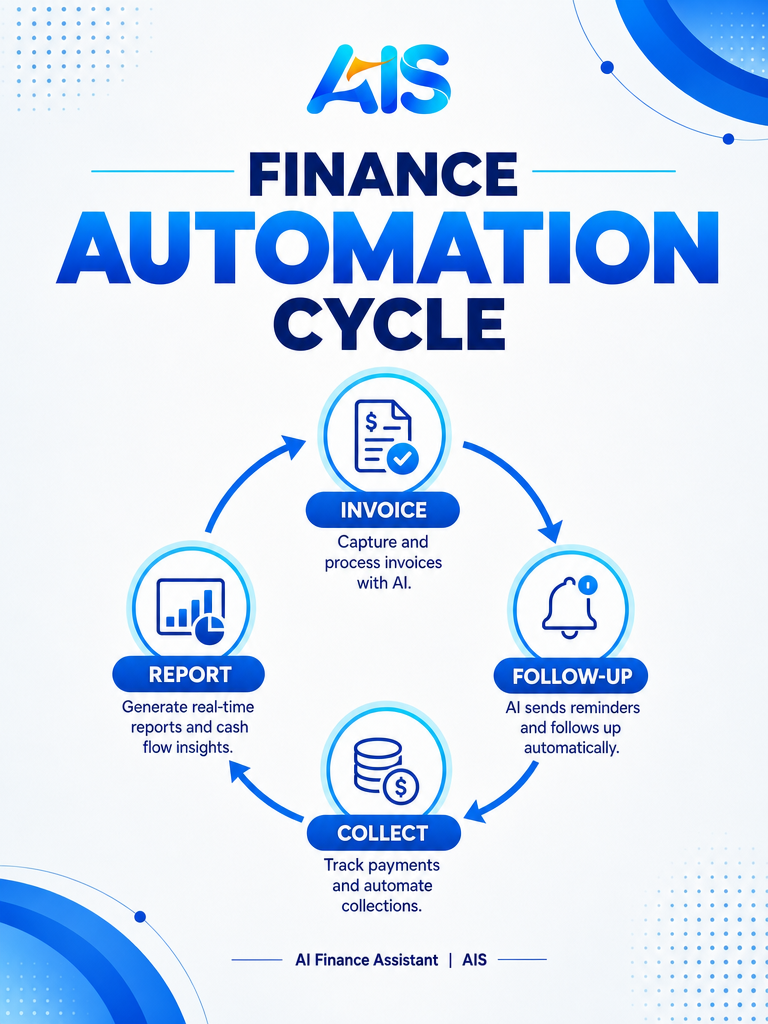
AI payment follow-up automation typically follows an escalating pattern, moving from a gentle nudge to a defined escalation path rather than treating every overdue account the same way.
- Gentle reminder shortly after the due date.
- Follow-up communication after a defined grace period.
- Escalation to a finance team member for significantly overdue accounts.
- Automatic update to customer risk status if patterns persist.
AI Fraud Detection Protects Financial Integrity
As digital financial ecosystems expand, fraud risks continue growing — unauthorized transactions, invoice fraud, duplicate payments, vendor manipulation, expense fraud, and insider threats are all on the rise. Traditional fraud detection methods often rely heavily on manual review and static rules, which struggle to keep pace.
AI-driven fraud monitoring provides a more intelligent approach. AI fraud detection systems continuously analyze financial activity to identify unusual behavior, with machine learning models monitoring transaction patterns, user activity, payment frequency, geographic anomalies, timing inconsistencies, and vendor behavior. Instead of relying only on predefined rules, AI systems learn from historical financial data and improve detection accuracy continuously, enabling organizations to identify suspicious activities faster and reduce financial risk.
Predictive Accounting Improves Financial Planning
Traditional accounting focuses mainly on historical reporting. Predictive accounting introduces a forward-looking approach using AI cash flow forecasting models that analyze historical financial data, revenue trends, payment cycles, expense behavior, operational patterns, and customer transactions to forecast future financial outcomes. This helps organizations improve budgeting accuracy, cash flow planning, and strategic decision-making.
These three capabilities become far more effective when integrated together inside ERP environments: cash application keeps receivables accurate through real-time reconciliation, fraud detection continuously monitors transactions for suspicious activity, and predictive accounting helps finance leaders anticipate upcoming financial conditions and operational risks. Together, they improve financial visibility, operational efficiency, risk management, cash flow planning, compliance monitoring, and decision-making — creating a more intelligent, connected finance ecosystem.
AI Management Reporting for Finance Teams
AI management reporting can automatically compile recurring reports — monthly close summaries, budget variance reports, departmental spend reviews — reducing the manual effort finance teams spend assembling this information from multiple sources. Organizations gain real-time visibility into incoming payments, outstanding receivables, fraud alerts, cash flow trends, financial forecasts, and reporting metrics, without relying entirely on delayed reporting cycles. This improves financial control and operational responsiveness, and AI systems also support compliance and audit readiness through automated monitoring, transaction traceability, anomaly detection, and continuous auditing support.
Measuring the Business Impact of an AI Finance Assistant
Before starting an implementation, it helps to define what success will actually look like — otherwise it becomes difficult to judge whether the investment paid off once the system is live.
Common metrics organizations track include time saved per week on the target process, reduction in manual errors, and faster turnaround on the specific workflow being automated or analyzed. Where applicable, teams also track direct cost savings from reduced headcount needs or avoided losses (such as fewer missed reorders or late payment reminders).
A simple way to frame this is: measure the baseline (how the process works today, including time spent and error rates), implement the solution for a defined pilot period, then measure the same metrics again. The delta between the two gives a concrete, defensible picture of the return on investment — far more convincing internally than anecdotal impressions alone.
What Internal Teams Need to Be Involved
For related approaches, see our guide on AI agents vs AI assistants.
An AI finance assistant automates reporting, dunning follow-ups and exception alerts — freeing finance teams for analysis. Successful adoption of an AI finance assistant rarely rests on IT alone. The most effective implementations typically involve a small, cross-functional group from the outset.
- IT or a technical partner to handle integration and security.
- A business process owner who understands the day-to-day workflow being changed.
- End users who will actually interact with the system, providing early feedback.
- An executive sponsor who can help prioritize the initiative and remove organizational roadblocks.
A Practical Readiness Checklist Before Adopting an AI Finance Assistant
Before committing budget and time, it helps to honestly assess organizational readiness. The following checklist reflects questions worth answering internally first.
- Is there a specific, measurable business problem this is meant to solve, rather than a vague goal of “using more AI”?
- Is the relevant business data accessible, reasonably clean, and available through an API, database, or export?
- Is there a clear owner internally who will champion the initiative past the initial pilot phase?
- Has leadership agreed on what level of AI autonomy is acceptable for this use case, and what should always require human approval?
- Is there a realistic timeline and budget that accounts for integration work, not just the AI component itself?
Where This Is Heading
Finance operations are becoming increasingly data-driven and automated. Organizations now expect real-time reporting, automated reconciliation, intelligent forecasting, AI-powered analytics, continuous fraud monitoring, and faster financial closing cycles. AI is becoming a core part of enterprise finance infrastructure rather than an optional enhancement.
Businesses that build a foundation now — clean data access, clear governance policies, and internal familiarity with how AI fits into daily workflows — will generally find it easier to adopt newer capabilities as they mature. Organizations starting from scratch each time tend to face a steeper climb.
Where an AI Finance Assistant Creates the Most Value
While every business can benefit from an AI finance assistant, certain industries and organizational profiles tend to see faster or more pronounced results.
Manufacturing and Distribution
Manufacturers and distributors dealing with complex inventory, multi-location operations, and supplier coordination often see some of the fastest returns, since these businesses generate large volumes of transactional data that benefit from faster, more automated handling. Industry-specific ERP environments — for packaging, print, dairy, engineering and construction, or energy operations — each have their own production tracking, job costing, batch tracking, or asset monitoring needs that AI-driven finance automation supports directly.
Professional Services and Consulting
Service-based businesses use an AI finance assistant to reduce time spent on administrative tasks, freeing billable staff to focus on client-facing work rather than internal reporting and coordination.
Retail and Wholesale Distribution
Retail and wholesale businesses managing high transaction volumes and thin margins benefit through faster decision cycles, reduced manual reconciliation, and earlier visibility into performance shifts.
Mid-Size Enterprises Running SAP or Similar ERP Platforms
Mid-size enterprises already running SAP Business One are well positioned to adopt an AI finance assistant, since the underlying transactional data needed already exists within their systems. Many organizations also deploy cloud-hosted ERP environments to improve scalability and centralized access, while others continue with on-premise deployments where greater infrastructure control or industry-specific compliance is required.
Common Mistakes to Avoid
Organizations adopting an AI finance assistant sometimes run into avoidable setbacks. Being aware of these common mistakes upfront can save significant time and rework.
- Starting too broad — attempting to apply AI across every finance function at once instead of proving value with one well-scoped use case first.
- Underestimating data quality issues — cash application and fraud detection accuracy depend on accurate, accessible underlying data, and poor data hygiene undermines results regardless of how capable the AI is.
- Skipping governance and access control planning until after deployment, rather than designing it in from the start.
- Choosing a vendor based on demos alone, without verifying real integration experience with your specific ERP systems.
- Failing to define what success looks like before starting, making it difficult to measure the actual impact later.
How AIS Business Corp Approaches This
AIS Business Corp works with organizations to implement AI finance assistant capabilities — cash application automation, fraud detection, and predictive accounting — in a way that fits their existing technology environment rather than requiring disruptive replacement of systems already in place. This typically starts with a structured discovery phase to understand current workflows, data sources, and pain points, followed by a focused pilot on one well-defined use case, such as automating cash application for a single business unit before expanding further. Rather than treating this as a one-time project, AIS Business Corp emphasizes iterative refinement — monitoring real usage, gathering feedback from the finance teams actually using the system, and adjusting scope, automation boundaries, and integrations accordingly. This approach reduces risk while still allowing businesses to expand capability steadily once initial value is proven.
Related Resources
AI finance assistants pair naturally with broader AI analytics and predictive forecasting capabilities.
- Explore Enterprise AI Assistants.
- Predictive Analytics for Business.
- Enterprise AI Solutions: 10 Ways Businesses Can Transform with AI.
Frequently Asked Questions
What is an AI finance assistant?
An AI finance assistant is a specialized AI assistant for business focused on financial tasks such as cash application automation, fraud detection, predictive accounting, reporting, and collections follow-up.
How does an accounts receivable AI agent help with collections?
An accounts receivable AI agent monitors overdue invoices, prioritizes follow-ups, and drafts reminder communications, reducing the manual workload of the collections process.
How accurate is AI cash flow forecasting?
Accuracy depends on data quality and historical patterns, but AI cash flow forecasting generally improves on static historical averages by incorporating current receivables and payables data.
How does AI fraud detection differ from traditional rule-based monitoring?
Traditional fraud detection relies on manual review and static rules. AI-driven fraud monitoring continuously analyzes transaction patterns, user activity, and vendor behavior, learning from historical data to identify unusual activity faster and more accurately over time.
Can AI management reporting replace a finance team?
No, AI management reporting automates the compilation of recurring reports, but finance teams remain essential for analysis, judgment, and decision-making.
Conclusion
An AI finance assistant can meaningfully reduce the manual workload finance teams face around cash application, fraud monitoring, forecasting, and collections. By automating routine follow-ups and report preparation while continuously watching for unusual activity, finance professionals can focus more time on analysis and strategic decisions.
Talk to an AIS Business Corp specialist to explore how an AI finance assistant can be tailored to your organization’s systems, data, and workflows.
You can also explore more implementation guides on the AIS Business Corp blog.
Related resource: IBM on AI agents for business automation on ibm.com.
