


Introduction
AI-powered GST reconciliation software is an important process for businesses that need to maintain accurate purchase records and review Input Tax Credit (ITC). As invoice volumes increase, manually comparing purchase data with GST records can become time-consuming and difficult to manage.
AI GST reconciliation software helps businesses streamline invoice matching, identify potential discrepancies, and improve visibility into reconciliation activities. AI-assisted analysis can also help finance teams identify recurring mismatches and prioritize records that require further review.
AIS Business Corp offers GSTHub, an AI-powered GST reconciliation and compliance platform designed to help businesses centralize reconciliation, improve ITC visibility, manage exceptions, and access GST-related insights.
This guide explains how AI improves GST reconciliation and how GSTHub can support more structured GST data management.
1. What Is AI GST Reconciliation Software?
AI GST reconciliation software combines GST data processing, reconciliation rules, and AI-assisted analysis to help businesses compare financial records and identify potential mismatches.
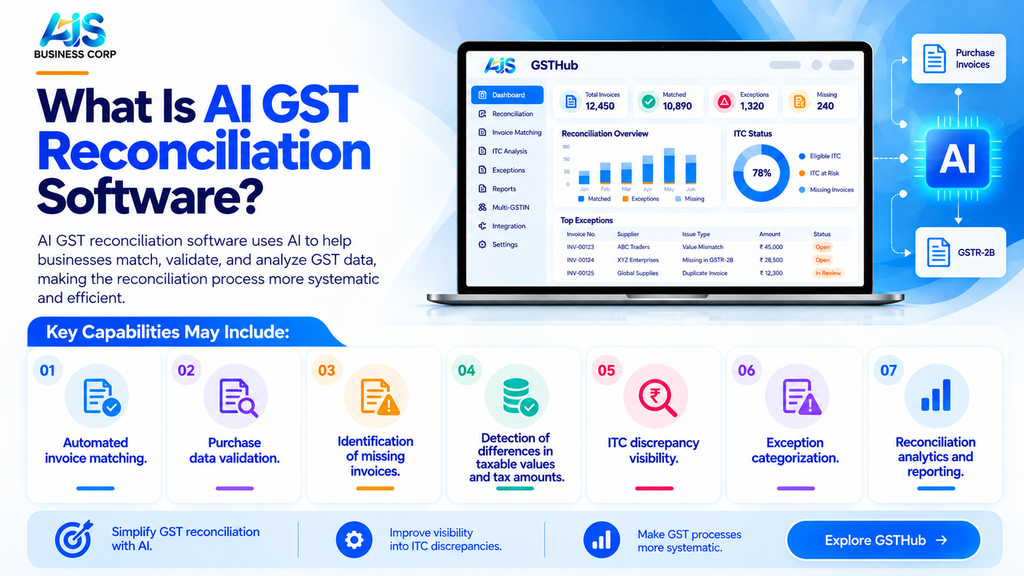
Key capabilities may include:
- Automated invoice matching.
- Purchase data validation.
- Identification of missing invoices.
- Detection of differences in taxable values and tax amounts.
- ITC discrepancy visibility.
- Exception categorization.
- Reconciliation analytics and reporting.
GSTHub by AIS Business Corp is designed to support centralized reconciliation and AI-assisted workflows that help finance teams review GST data more efficiently.
2. Why Businesses Need AI-Powered GST Software
Manual GST reconciliation can create challenges when businesses manage large invoice volumes, multiple GST registrations, and data from different systems.
AI-powered GST software can help businesses:
- Reduce repetitive invoice comparisons.
- Identify potential mismatches more systematically.
- Organize exceptions for investigation.
- Improve visibility into purchase-related ITC discrepancies.
- Identify recurring data-quality issues.
- Support centralized reporting across business operations.
AI supports the reconciliation process, but finance teams must validate important results and assess ITC eligibility under applicable GST requirements.
3. How AI Improves Invoice Matching
Invoice matching involves comparing purchase records with relevant GST data using fields such as supplier GSTIN, invoice number, invoice date, taxable value, and tax amounts.
AI-assisted matching can help identify potential matches and highlight transactions that need additional verification.
Step 1: Import Invoice Data
Collect purchase records and relevant GST data from supported systems or files.
Step 2: Validate Records
Identify missing fields, duplicate entries, and inconsistent invoice details.
Step 3: Match Invoice Information
Compare relevant invoice fields using configured reconciliation rules and available AI-assisted capabilities.
Step 4: Identify Mismatches
Highlight records with missing invoices, GSTIN differences, invoice discrepancies, or variations in tax amounts.
Step 5: Review Exceptions
Finance teams investigate discrepancies and determine the appropriate corrective action.
Step 6: Generate Reports
Prepare reconciliation summaries showing matched records and outstanding exceptions.
This structured process helps reduce repetitive manual work while maintaining appropriate human review.
4. How AI Improves ITC Visibility
ITC reconciliation requires businesses to review purchase records against relevant GST data and determine whether transactions meet applicable requirements.
AI-assisted GST reconciliation can help identify potential discrepancies, including:
- Purchase invoices missing from comparison data.
- Differences in supplier GSTINs.
- Invoice-number and date mismatches.
- Differences in taxable values.
- Variations in GST amounts.
- Duplicate or incomplete records.
By organizing these exceptions, software can help finance teams prioritize their investigations and maintain clearer reconciliation records.
Important: AI-generated matches or risk indicators do not establish ITC eligibility. Businesses must verify the supporting information and applicable GST requirements before making ITC decisions.
5. AI GST Software Features to Look For
When evaluating AI GST software, businesses should consider the following capabilities.
AI-assisted invoice matching: Helps identify potential matches across purchase and GST records.
Exception analysis: Helps categorize discrepancies and highlight records requiring review.
GST analytics: Provides visibility into reconciliation status and recurring issues.
ITC discrepancy tracking: Organizes potential mismatches for further investigation.
Multi-GSTIN management: Supports centralized visibility across multiple registrations, where available.
ERP integration: Connects supported accounting and enterprise systems with GST workflows.
Reporting and audit trails: Helps finance teams review reconciliation outcomes and maintain relevant records.
Security and access controls: Supports appropriate handling of sensitive financial information.
6. How GSTHub Uses AI-Focused Capabilities
GSTHub by AIS Business Corp is an AI-powered GST reconciliation and compliance platform designed to help businesses centralize reconciliation and improve visibility into GST-related data.
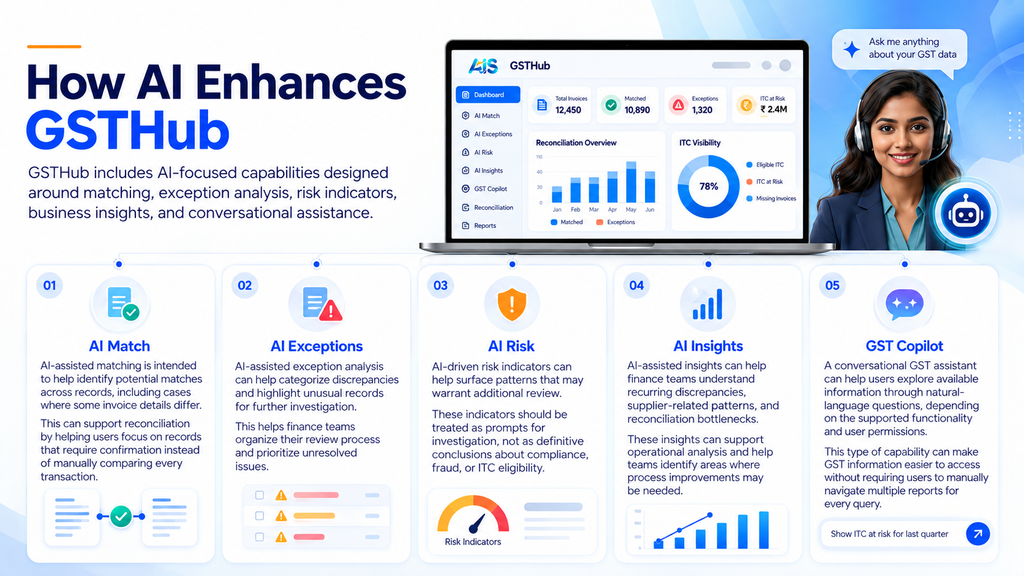
Its stated AI-focused capabilities include:
AI Match
Supports AI-assisted invoice matching workflows, depending on available data and configuration.
AI Exceptions
Helps organize and analyze discrepancies that require further investigation.
AI Risk
Supports the identification of patterns or indicators that may warrant additional review.
AI Insights
Helps surface relevant patterns and reconciliation information for finance-team analysis.
GST Copilot
Provides conversational assistance for accessing supported GST information, subject to platform capabilities and user permissions.
These capabilities are intended to support finance teams, not replace validation or compliance decisions made by authorized personnel.
7. GST Automation and ERP Integration
AI GST reconciliation becomes more useful when relevant financial information can be collected from existing business systems.
GSTHub is designed to support integration with ERP and accounting environments, subject to available connectors and implementation scope.
Potential integration environments include SAP, Oracle, Microsoft Dynamics, Tally, Odoo, and custom ERP systems.
A typical workflow includes:
- Import purchase and invoice data.
- Map relevant source-system fields.
- Validate records.
- Reconcile data and identify discrepancies.
- Review exceptions.
- Generate reports.
Businesses should confirm specific integrations, supported data formats, and implementation requirements with AIS Business Corp.
8. Benefits of AI GST Reconciliation Software
AI-assisted GST reconciliation can help businesses improve their financial workflows through:
- Reduced manual effort: Automate repetitive comparisons.
- Improved discrepancy visibility: Highlight records requiring attention.
- Structured ITC reviews: Organize potential mismatches for investigation.
- Better reporting: Provide clearer reconciliation summaries.
- Centralized information: Bring relevant data into a structured workflow.
- Scalable processes: Support growing transaction volumes when the solution is configured for business needs.
Actual benefits depend on data quality, product configuration, integration, and internal review processes.
Frequently Asked Questions
1. What is AI GST reconciliation software?
It helps businesses compare purchase records with relevant GST data using reconciliation rules and AI-assisted capabilities to identify potential mismatches.
2. How does AI improve invoice matching?
AI-assisted matching can help identify potential matches and highlight records that need further review, reducing repetitive manual comparisons.
3. Can AI GST software improve ITC visibility?
It can help identify and organize potential ITC-related discrepancies. Businesses must verify records and assess eligibility under applicable GST rules.
4. What is GSTHub by AIS Business Corp?
GSTHub is an AI-powered GST reconciliation and compliance platform designed to support centralized reconciliation, ITC visibility, exception management, analytics, and supported ERP integration.
5. Can GSTHub integrate with ERP systems?
GSTHub is designed to support ERP and accounting integration. Businesses should confirm supported systems and integration methods with AIS Business Corp.
6. Does AI eliminate manual verification?
No. AI can assist with matching and exception analysis, but finance teams should validate important results before taking corrective or compliance-related action.
Conclusion
AI-powered GST reconciliation software can help businesses organize invoice matching, identify potential ITC discrepancies, and improve visibility into GST-related data.
GSTHub by AIS Business Corp combines centralized reconciliation workflows with AI-focused capabilities designed to support matching, exception analysis, analytics, and GST information access.
For businesses looking to improve GST reconciliation, GSTHub provides a platform to evaluate against their transaction volumes, data sources, and integration requirements.
Improve GST reconciliation and ITC visibility with GSTHub by AIS Business Corp.
Website: https://aiscorp.ai/
Email: marketing@ananthinfo.com
Phone: +91 88385 81634
