


Introduction
GST Compliance Software is an essential responsibility for businesses in India. Managing GST returns, validating invoice data, reconciling transactions, and reviewing Input Tax Credit (ITC) can become time-consuming when handled manually.
GST compliance software helps businesses organize GST data, identify discrepancies, streamline reconciliation, and support return-related workflows.
AIS Business Corp offers GSTHub, an AI-powered GST reconciliation and compliance platform designed to improve ITC visibility, manage exceptions, centralize GST data, and support finance teams with structured workflows.
This guide covers key GST compliance requirements, essential software features, and how GSTHub can support businesses in managing GST-related processes.
1. What Is GST Compliance Software?
GST compliance software helps businesses manage GST-related data and workflows, including:
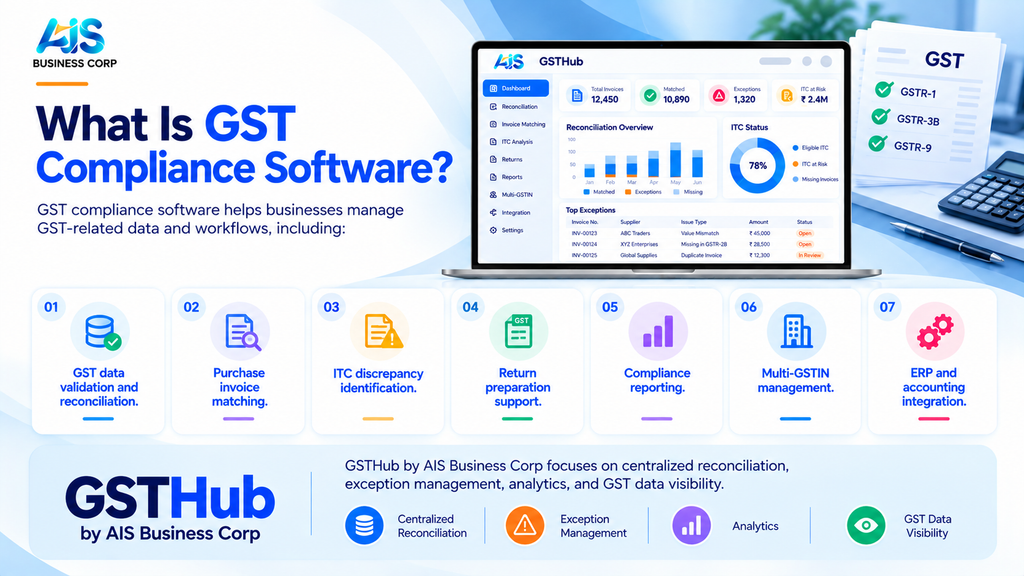
- GST data validation and reconciliation.
- Purchase invoice matching.
- ITC discrepancy identification.
- Return preparation support.
- Compliance reporting.
- Multi-GSTIN management.
- ERP and accounting integration.
GSTHub by AIS Business Corp focuses on centralized reconciliation, exception management, analytics, and GST data visibility.
2. Understanding GSTR-1, GSTR-3B and Annual Returns
GSTR-1
GSTR-1 reports details of outward supplies. Businesses need accurate sales invoices, customer details, taxable values, and tax information to prepare the return.
GSTR-3B
GSTR-3B is a summary return used to report relevant tax liabilities, eligible ITC, and other required information. Accurate source data and appropriate review are important before submission.
Annual Returns
Annual GST compliance may involve GSTR-9 and, where applicable, GSTR-9C. Businesses may need to review yearly transaction data, reconcile records, and investigate differences.
The exact filing requirements depend on the taxpayer’s circumstances and applicable GST rules. Businesses should verify current requirements before filing.
3. Common GST Compliance Challenges
Businesses may face several challenges when managing GST manually:
- Incomplete or inconsistent invoice data.
- Differences between purchase records and GST data.
- Missing invoices and potential ITC mismatches.
- Repetitive spreadsheet-based reconciliation.
- Limited visibility into unresolved exceptions.
- Difficulties managing multiple GSTINs.
- Time-consuming reporting and audit preparation.
A structured GST compliance platform helps organize these activities and makes discrepancies easier to review.
4. Essential Features of GST Compliance Software
When evaluating GST software, businesses should consider the following capabilities.
Data validation: Identify incomplete, duplicate, or inconsistent records.
GST reconciliation: Compare purchase records with relevant GST data.
ITC visibility: Highlight potential discrepancies for further investigation.
Exception management: Track unmatched transactions and resolution progress.
Return preparation support: Organize and validate information required for supported returns.
Multi-GSTIN management: Provide registration-level and consolidated visibility.
ERP integration: Connect relevant data from supported accounting and ERP systems.
Reporting and audit trails: Support internal reviews through structured reports and relevant activity records.
5. How AI Improves GST Compliance
AI can help finance teams analyze large datasets, identify patterns, and prioritize discrepancies.
GSTHub includes AI-focused capabilities designed around:
- AI Match: AI-assisted invoice matching.
- AI Exceptions: Categorization and review of discrepancies.
- AI Risk: Indicators that may require further investigation.
- AI Insights: Analysis of patterns and reconciliation issues.
- GST Copilot: Conversational access to supported GST information.
AI assists the reconciliation process but does not replace human verification or determine ITC eligibility automatically.
6. GST Reconciliation and ERP Integration
Businesses often maintain financial information in ERP and accounting systems. Integrating these systems with GST workflows can reduce repetitive data handling.
GSTHub is designed to support integration with ERP and accounting environments, subject to available connectors and implementation scope.
Potential integration environments include SAP, Oracle, Microsoft Dynamics, Tally, Odoo, and custom ERP systems.
A typical workflow involves data import, field mapping, validation, reconciliation, exception review, and reporting. Businesses should confirm specific integration capabilities with AIS Business Corp.
7. Why Consider GSTHub by AIS Business Corp?
GSTHub is an AI-powered GST reconciliation and compliance platform designed to help businesses manage GST-related information through a centralized workflow.
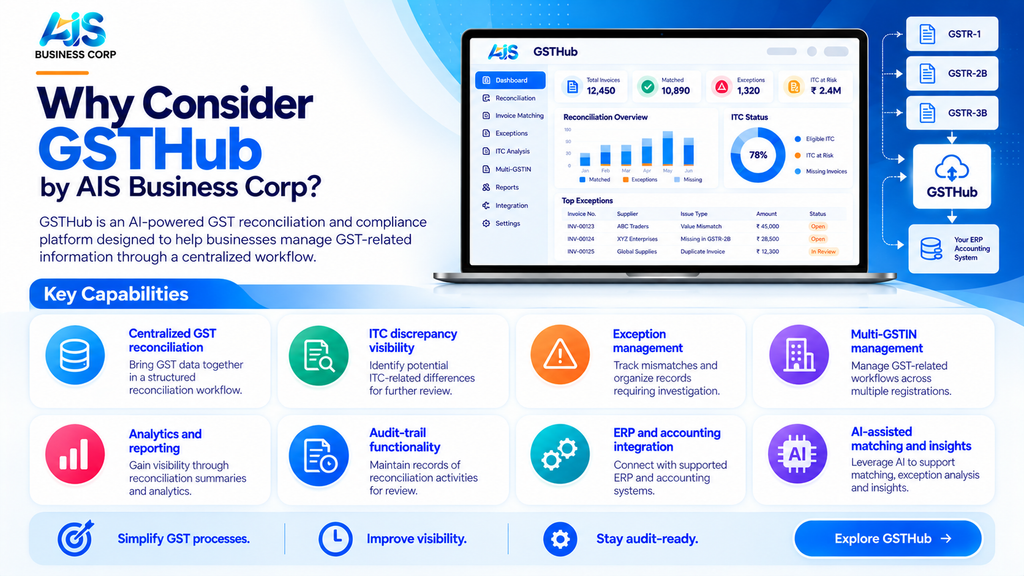
Key capabilities include:
- Centralized GST reconciliation.
- ITC discrepancy visibility.
- Exception management.
- Multi-GSTIN management.
- Analytics and reporting.
- Audit-trail functionality.
- ERP and accounting integration.
- AI-assisted matching and insights.
GSTHub can be evaluated by businesses seeking to organize GST reconciliation and improve visibility into unresolved discrepancies.
The specific return preparation and direct filing capabilities required should be confirmed with AIS Business Corp.
8. How to Choose the Right GST Compliance Software
Before selecting a solution, businesses should:
- Identify their GST compliance and reconciliation requirements.
- Assess transaction volumes and data sources.
- Check invoice-matching and exception-management features.
- Verify ERP and accounting integration.
- Review security, access controls, and reporting.
- Request a demonstration using representative business scenarios.
- Compare subscription, implementation, and support costs.
Choosing software based on actual business requirements helps ensure that the solution fits existing workflows.
Frequently Asked Questions
What is GST compliance software?
It helps businesses organize GST data and manage workflows such as validation, reconciliation, reporting, and return preparation, depending on the product’s capabilities.
What is the difference between GSTR-1 and GSTR-3B?
GSTR-1 reports outward-supply details, while GSTR-3B is a summary return covering relevant tax liabilities, eligible ITC, and other required information.
Can GST software help with annual returns?
Some solutions support annual-return-related data preparation, reconciliation, and reporting. Confirm whether the required GSTR-9 and GSTR-9C workflows are supported.
What is GSTHub?
GSTHub is an AI-powered GST reconciliation and compliance platform from AIS Business Corp, with capabilities including reconciliation, ITC visibility, exception management, analytics, and supported system integration.
Can GSTHub integrate with ERP systems?
GSTHub is designed to support ERP and accounting integration. Available systems and integration methods should be confirmed with AIS Business Corp.
Conclusion
Effective GST compliance requires accurate data, consistent reconciliation, and structured review processes. GST compliance software can help businesses reduce manual effort, identify discrepancies, and organize GST-related information.
GSTHub by AIS Business Corp brings together centralized reconciliation, ITC visibility, exception management, analytics, and integration capabilities to support businesses in managing GST workflows.
Simplify GST reconciliation with GSTHub by AIS Business Corp.
Website: https://aiscorp.ai/
Email: marketing@ananthinfo.com
Phone: +91 88385 81634
