


In this guide: omnichannel retail management software explained end to end — what it does, the features that matter, and how to roll it out in your stores.
the omnichannel platform connects your physical stores, online shop, and marketplaces to one pool of inventory and one customer view. When a shopper buys online and picks up in store, or returns a web order at the counter, the same system records every step.
Without that connection, every channel becomes its own little island: separate stock counts, separate promotions, and separate customer histories that never meet. This guide explains how omnichannel retail management software works, which capabilities matter, and how SAP Business One based platforms like Retail Pro AI unify commerce with back-office ERP.
Why Omnichannel Retail Management Software Wins
Omnichannel retail management software: Key Considerations
Omnichannel retail management software enables enterprise teams to make faster, data-driven decisions. Organizations implementing omnichannel retail management software report significant efficiency gains and reduced manual effort.
Customers do not think in channels. They browse on mobile at lunch, order for delivery, and expect the neighborhood store to honor the online price. Retailers that treat e-commerce as a separate business pay for that split twice: once in duplicated stock and once in customer frustration.
the framework removes the split. One product catalog, one price book, and one inventory pool serve every channel. A jacket seen online is the same jacket the POS sells, and a return in any location updates the same stock record.
The operational benefits compound. Safety stock drops because channels share inventory instead of each buffering its own. Promotions launch everywhere at once. And store staff can see online demand, turning the shop floor into a fulfillment hub rather than a silo.
Core Capabilities to Look For
When comparing the framework, make sure these capabilities are native rather than bolted on:
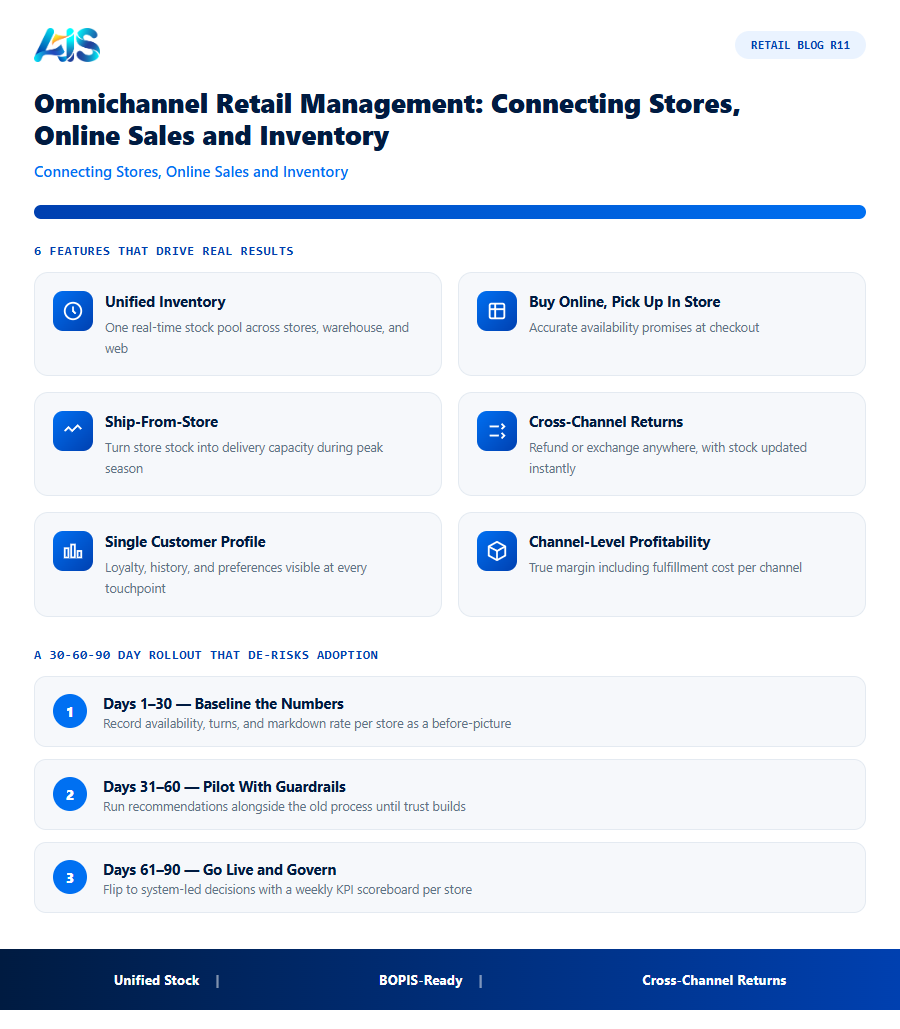
- Unified inventory — one real-time stock pool across stores, warehouse, and web.
- Buy online, pick up in store (BOPIS) — with accurate availability promises at checkout.
- Ship-from-store — turn store stock into delivery capacity during peak season.
- Cross-channel returns — refund or exchange anywhere, with stock updated instantly.
- Single customer profile — loyalty, history, and preferences visible at every touchpoint.
- Channel-level profitability — true margin including fulfillment cost per channel.
SAP lists omnichannel among the defining capabilities of modern retail platforms in its retail industry solutions — a useful benchmark when you compare vendors.
Omnichannel Retail Management Software: Implementation Roadmap
Going omnichannel is a program, not a plug-in. Retailers who succeed tend to follow the same sequence:
A useful rule of thumb: no channel gets a new capability until the underlying inventory is unified. Features built on fragmented stock simply automate the confusion.
Common Pitfalls (and How to Avoid Them)
Three failures account for most troubled omnichannel projects. First, parallel stock: keeping a separate web inventory “for safety” recreates the silo problem overnight. Second, manual transfers: if moving a unit between channels requires a spreadsheet, availability promises will drift from reality. Third, no cost view: without fulfillment cost per channel, free shipping offers quietly eat the margin.
Avoid all three by choosing the framework that treats the ERP as the system of record — which is exactly why platforms built on SAP Business One, like Retail Pro AI, appeal to retailers who already run their back office on it.
Store and online stock reconcile the way multi-branch retail distribution describes for branch networks..
How the Investment Pays for Itself
The business case for the omnichannel platform is unusually straightforward because the costs of the status quo are visible every single week — in markdowns, rush orders, overtime, and write-offs. Put numbers on those leaks and the software starts paying for itself.
Then look at working capital. Inventory is usually a retailer’s largest use of cash after property, so a ten to fifteen percent reduction in average holdings — a realistic outcome once the framework is running — releases funds that can pay down debt or fund new ranges. Labour is the third lever: buyers, planners, and store managers reclaim hours previously lost to spreadsheets, stock counts, and expediting.
There is also a compounding effect that spreadsheets understate. Cleaner stock data improves every downstream decision: forecasts get sharper, suppliers perform better against reliable orders, and store teams stop firefighting. Each quarter the system runs, the recommendations get more precise because they learn from more history — the return grows while the subscription cost stays flat.
A 30-60-90 Day Rollout That De-risks Adoption
The safest way to adopt the omnichannel platform is in waves: prove it in a few stores, harden the process, then scale. A 30-60-90 day plan keeps momentum while giving every stakeholder an early win.
Training is lighter than most teams fear. Store champions need a single hands-on session plus a one-page crib sheet; buyers and planners need half a day on approvals, exceptions, and tuning. Because daily work happens through familiar screens and plain-language alerts, adoption rarely becomes the bottleneck.
- Days 1-30 — baseline the numbers: record availability, turns, and markdown rate per store so the framework has a before-picture to beat.
- Days 31-60 — pilot with guardrails: run system recommendations alongside the old process, overriding only with a logged reason, until trust builds.
- Days 61-90 — go live and govern: flip to system-led decisions, review exceptions weekly, and publish a visible KPI scoreboard per store.
Common Omnichannel Fulfillment Scenarios
Omnichannel retail management shows its value most clearly in the fulfillment scenarios that break simple, disconnected systems. A platform worth adopting should handle each of these cleanly:
- Buy online, pick up in store (BOPIS) — the online order must reserve stock at the fulfilling store instantly, so a walk-in customer cannot buy the last unit before pickup.
- Ship from store — an online order routes to the nearest store with stock rather than a central warehouse, cutting delivery time and shipping cost, but requires that store’s inventory to be trusted in real time.
- In-store return of an online purchase — the store needs visibility into an order placed on a different channel, and the return must update central stock, not just that store’s local count.
- Endless aisle — a customer in-store orders an out-of-stock size or color from another location or the warehouse, requiring the sales associate to see real-time stock everywhere, not just on-site.
Each of these scenarios fails quietly when systems are disconnected — the sale looks fine to the customer, but stock counts drift out of sync and the next customer hits a false stockout or a double-sold item. Testing omnichannel retail management software against these four scenarios specifically, rather than a generic demo, is the fastest way to separate genuinely unified platforms from tools that only look connected in a sales presentation.
A Composite Example: Fixing Phantom Stock After a BOPIS Launch
A mid-size homeware chain — a composite based on patterns seen across several rollouts — launched buy-online-pickup-in-store without first unifying its inventory feed, keeping the e-commerce platform’s stock count synced to the ERP only once every four hours via a scheduled batch job. Within the first month, the pattern that emerged was predictable: popular items sold out in-store between sync windows while the website kept showing them as available, generating a wave of pickup orders that stores could not fulfill.
Store staff absorbed the failure manually — calling customers to apologize, offering substitutes, or expediting a same-day transfer from another location — which cost more in labor and goodwill than the sync delay ever saved in infrastructure simplicity. The chain’s actual fix was not a bigger e-commerce platform; it was moving to real-time inventory decrementing at the point of sale, so a register sale in-store immediately removed that unit from what the website could promise online, closing the four-hour gap entirely.
The broader lesson: omnichannel retail management fails most often not from a missing feature but from a sync interval that was fast enough for a demo but too slow for actual trading volume. Before signing any omnichannel platform, ask specifically how fast a sale in one channel becomes visible in every other channel — seconds, not hours, is the standard that prevents this failure mode.
Choosing Between Marketplace Integration Approaches
Retailers selling through Amazon, eBay, or similar marketplaces alongside their own stores and website face a specific omnichannel decision: how tightly to integrate marketplace inventory with the rest of the business. Two approaches are common:
- Allocated marketplace stock — a fixed portion of total inventory is set aside specifically for marketplace sales, isolated from store and web stock. Simpler to implement, but wastes inventory that could have sold through a different channel, and risks a marketplace stockout while the same item sits unsold in a store.
- Fully pooled marketplace stock — marketplace listings draw from the same live inventory pool as every other channel, with the platform managing which units to commit where based on real-time demand across all channels. This maximizes sell-through but requires the marketplace integration to update inventory in near real time to avoid overselling on a channel with strict penalty policies for cancelled orders.
Marketplaces are generally unforgiving of overselling, penalizing seller accounts for cancelled orders, so retailers moving toward pooled inventory should confirm their omnichannel platform’s marketplace sync speed specifically, not assume the same integration quality that works for their own website will transfer automatically.
Omnichannel retail management software: Frequently Asked Questions
What is the difference between multichannel and omnichannel retail?
Multichannel means selling in several places with separate stock and customer records. Omnichannel means one inventory pool and one customer view across all channels, so experiences like buy-online-pickup-in-store work seamlessly.
Is an omnichannel platform only for large retailers?
No. Cloud pricing and ERP-native platforms have brought unified commerce within reach of small and mid-size retailers — often the biggest winners, since they feel stock distortion most.
How long does an omnichannel rollout take?
A focused implementation — one catalog, one stock pool, two channels — typically runs eight to twelve weeks. Adding ship-from-store, marketplaces, and loyalty extends the roadmap but each phase delivers standalone value.
What data do we need before starting with an omnichannel platform?
Clean item masters, accurate opening stock per location, supplier lead times, and at least six months of sales history. Most retailers already hold all four inside their POS and ERP — the implementation work is validation and deduplication, typically completed inside the first month.
Can small retail chains afford this kind of platform?
Yes. Cloud pricing scales with stores and users, so a five-store chain pays a fraction of what an enterprise deployment costs. Because the savings come from the same leaks — stockouts, markdowns, overstock — smaller chains often see faster payback in percentage terms.
Does this kind of platform replace our buyers and planners?
No — it upgrades them. the platform handles the repetitive arithmetic of forecasting and ordering so buyers can negotiate better terms, planners can shape ranges, and store teams can serve customers. Headcount rarely falls; output per head rises sharply.
the framework turns separate stores, web shops, and marketplaces into one coordinated business. Unify inventory first, add channel services on top, and measure true profitability per channel — that is the path from selling everywhere to winning everywhere. The retailers winning in 2026 are not the ones with the most stores — they are the ones whose stock decisions are fastest and most accurate. the framework is how a mid-size chain trades with the discipline of a national one. See how Retail Pro AI brings omnichannel retail management software together with AI inside SAP Business One — book a demo to see your own store data in action.
