


The shift toward structured digital invoicing in the United Arab Emirates is not just a regulatory update; it represents a fundamental redesign of how businesses exchange financial documents. As the UAE moves toward mandatory e-invoicing between 2026 and 2027, the adoption of a PEPPOL-based framework built on the 5-Corner architecture is transforming ERP systems, compliance processes, and tax reporting standards.
For VAT-registered businesses, finance leaders, IT teams, and ERP consultants, understanding how the PEPPOL network operates and how it connects to the Federal Tax Authority (FTA) is essential.
This comprehensive guide explains:
- What PEPPOL e-invoicing mean in the UAE context?
- How DCTCE 5-Corner Model works?
- The role of certified service providers
- PINT AE compliance requirements
- ERP integration strategy
- Technical architecture and data standards
- Implementation roadmap for 2026–2027
What is PEPPOL and why has UAE adopted it?
Understanding PEPPOL
PEPPOL (Pan-European Public Procurement Online) is an international electronic document exchange framework designed to standardize and secure cross-border transactions.
Rather than emailing PDFs, businesses exchange structured XML invoices through a secure, interoperable network of certified Access Points.
Why UAE chose PEPPOL?
The UAE selected a PEPPOL-based model because it:
- Ensures interoperability across ERP systems
- Reduces fraud through structured validation
- Supports real-time tax visibility
- Aligns with global digital tax best practices
- Enables scalability across B2B and B2G transactions
By leveraging PEPPOL, the UAE avoids building a closed proprietary system and instead adopts a globally recognized framework.
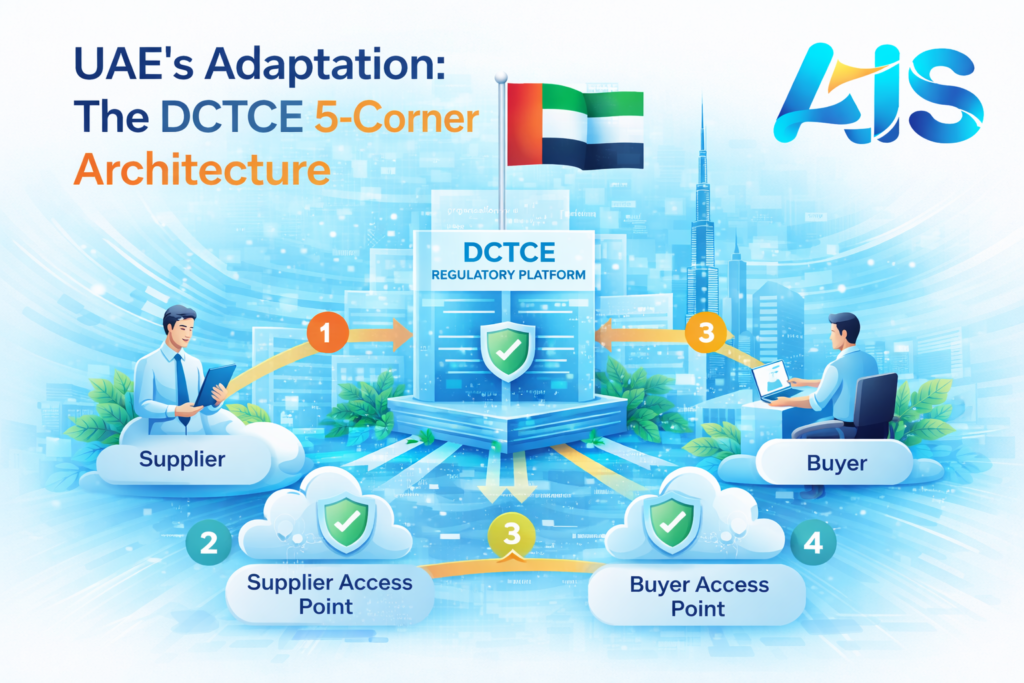
UAE’s Adaptation: The DCTCE 5-Corner Architecture
The UAE has implemented a localized version of the PEPPOL model known as the 5-Corner Architecture, commonly referenced in regulatory discussions as the DCTCE model.
How the 5-Corner Model Works?
Traditional PEPPOL uses a 4-corner model. The UAE adds an additional oversight layer.
The Five Corners:
- Supplier
- Supplier Access Point (ASP)
- Central Platform / Regulatory Layer
- Buyer Access Point
- Buyer
What Makes it Different?
The additional regulatory corner allows:
- Real-time validation
- Compliance monitoring
- Audit-ready reporting
- Central oversight
This structure ensures tax transparency without interrupting commercial data flow.
Detailed Breakdown of Each Corner
Corner 1 – Supplier
The supplier generates the invoice in a structured XML format from their ERP system.
Key Requirements:
- TRN validation
- VAT breakdown
- Invoice timestamp
- Mandatory tax data fields
- PINT AE compliance
Corner 2 – Supplier Access Point
The supplier does not send invoices directly to the buyer.
Instead, invoices are transmitted through a certified PEPPOL Access Point.
The Access Point:
- Validates format compliance
- Applies digital signature
- Encrypts data
- Routes securely
Corner 3 – Central Platform (Regulatory Layer)
This layer provides oversight functionality.
It may:
- Validate invoice schema
- Confirm compliance with UAE requirements
- Log reporting data
- Enable FTA audit visibility
Corner 4 – Buyer Access Point
The buyer receives the invoice through their own Access Point provider.
This ensures:
- Interoperability
- Secure receipt
- Automated ERP posting
Corner 5 – Buyer
The buyer’s ERP system automatically imports the validated invoice.
No manual PDF processing is required.
What is PINT AE Standard?
PINT AE stands for PEPPOL International Invoice UAE specification.
It is a localized version of PEPPOL BIS Billing 3.0 adapted to UAE VAT law.
Why PINT AE Matters
It ensures:
- VAT-compliant data fields
- TRN accuracy
- Standardized tax codes
- Proper VAT classification
- Alignment with UAE tax regulations
Without PINT AE compliance, invoices may be rejected.
Mandatory Data Elements Under PINT AE
Typical structured fields include:
- Supplier TRN
- Buyer TRN
- Invoice UUID
- Invoice issue date
- Supply date
- VAT rate
- Tax category
- Line item classification
- Currency code
- Digital signature
- Payment terms
Structured XML format replaces PDF-only formats.
Certified Service Providers in UAE
Businesses cannot directly connect to the PEPPOL network.
They must use:
- Accredited Access Point providers
- Certified PEPPOL Service Providers
- FTA-compliant integration vendors
Role of Access Points
Access Points:
- Convert ERP invoice to UBL XML
- Validate PINT AE compliance
- Apply encryption
- Transmit to buyer’s Access Point
- Maintain audit logs
Selecting the right provider is critical for long-term compliance.
ERP Connectivity: How Systems Integrate?
Integration Flow
ERP → Middleware → PEPPOL Access Point → Central Validation → Buyer Access Point → Buyer ERP
ERP Systems Commonly Integrated:
- SAP S/4HANA
- SAP Business One
- Oracle ERP
- NetSuite
- Microsoft Dynamics
- Custom ERP platforms
ERP Integration Technical Architecture
Key Components:
- XML Mapping Engine
- API Gateway
- Digital Signature Module
- Validation Engine
- Error Handling Dashboard
- Compliance Log Storage
Cloud ERP users typically integrate via API connectors.
On-premise ERP may require middleware adapters.
Security & Data Protection in PEPPOL UAE
Security layers include:
- End-to-end encryption
- Digital certificate authentication
- Secure Access Point routing
- Controlled identity verification
- Audit trails
Data residency considerations may apply depending on hosting structure.
Benefits of PEPPOL-Based E-Invoicing
1. Faster Processing
Automated validation reduces manual checks.
2. Reduced Errors
Structured data eliminates rekeying mistakes.
3. Fraud Prevention
Digital signatures and traceability reduce VAT fraud.
4. Interoperability
Works across ERP systems and industries.
5. Real-Time Compliance
Enhances audit readiness.
Implementation Roadmap for 2026-2027
Phase 1 – Assessment
- ERP capability review
- VAT configuration audit
- Data field mapping
Phase 2 – Provider Selection
- Evaluate certified Access Points
- Confirm SLA
- Validate compliance support
Phase 3 – Technical Integration
- XML template creation
- API configuration
- Sandbox testing
Phase 4 – Internal Testing
- End-to-end transaction testing
- Error validation simulation
Phase 5 – Go Live
Deploy before mandatory enforcement.
Common Implementation Challenges
- Poor master data quality
- Incorrect VAT classification
- ERP customization conflicts
- Digital signature misconfiguration
- Incomplete tax mapping
Early preparation prevents compliance risks.
Penalties & Rejection Risks
Invoices may be rejected if:
- TRN mismatch
- Incorrect VAT rate
- Missing mandatory fields
- XML format errors
- Invalid digital certificate
Repeated non-compliance may lead to administrative penalties.
B2B vs B2G Implications
PEPPOL supports both:
- Business-to-Business transactions
- Business-to-Government transactions
Government procurement systems may require strict PEPPOL compliance.
Preparing Your IT & Finance Teams
Successful implementation requires collaboration between:
- CFO
- Finance managers
- IT architects
- ERP consultants
- Compliance officers
Cross-functional readiness ensures smooth adoption.
Strategic Advantage Beyond Compliance
Forward-looking companies will use structured invoice data for:
- Cash flow analytics
- Supplier performance tracking
- Tax forecasting
- Digital transformation initiatives
E-invoicing becomes a strategic data asset.
Frequently Asked Questions
Is PEPPOL mandatory in UAE?
Yes, the UAE framework is PEPPOL-based.
Can we send PDF invoices?
No. Structured XML is required.
Do SMEs need Access Points?
Yes, if VAT-registered.
Is ERP upgrade mandatory?
Not always, but integration is required.
Can we choose any service provider?
Only certified or accredited providers should be used.
Will the FTA see every invoice?
The model enables regulatory oversight functionality.
The PEPPOL e-invoicing framework in the United Arab Emirates is reshaping digital tax compliance for 2026–2027.
Understanding:
- The 5-Corner architecture
- PINT AE standards
- Certified Access Points
- ERP connectivity requirements
It is essential for every VAT-registered business.
Organizations that begin early will:
- Avoid penalties
- Improve automation
- Enhance compliance readiness
- Gain a competitive advantage
PEPPOL is not simply a technology standard; it is the foundation of the UAE’s next-generation digital tax ecosystem.

