


In this guide: retail inventory optimization software explained end to end — what it does, the features that matter, and how to roll it out in your stores.
the optimizer answers the question every multi-store retailer faces daily: is the stock in the right place, in the right quantity, at the right time? Overstock ties up cash and forces markdowns; stockouts hand sales to competitors. Optimization means holding the minimum stock that still protects every sale.
AI changes what is possible. Instead of static reorder points, machine-learning models learn demand per store, per SKU, per season — and continuously rebalance. This guide explains the true cost of imbalance, how AI-driven retail inventory optimization works, and how platforms like Retail Pro AI apply it inside SAP Business One.
The True Cost of Overstock and Stockouts
The two failures feed each other. A store over-orders to avoid stockouts; the excess lands in the wrong location, sells slowly, and gets marked down — while the store that actually had demand ran empty weeks earlier. Cash is spent twice: once on the wrong stock, once on recovering the lost sale.
McKinsey retail research consistently identifies inventory distortion as one of the largest recoverable cost pools in retail. The fix is not buying less overall — it is allocating better, which is precisely what the platform automates.
How AI Drives Retail Inventory Optimization
AI models digest signals no analyst can combine manually — transaction history, seasonality, weather, local events, promotions — and turn them into per-store, per-SKU decisions:
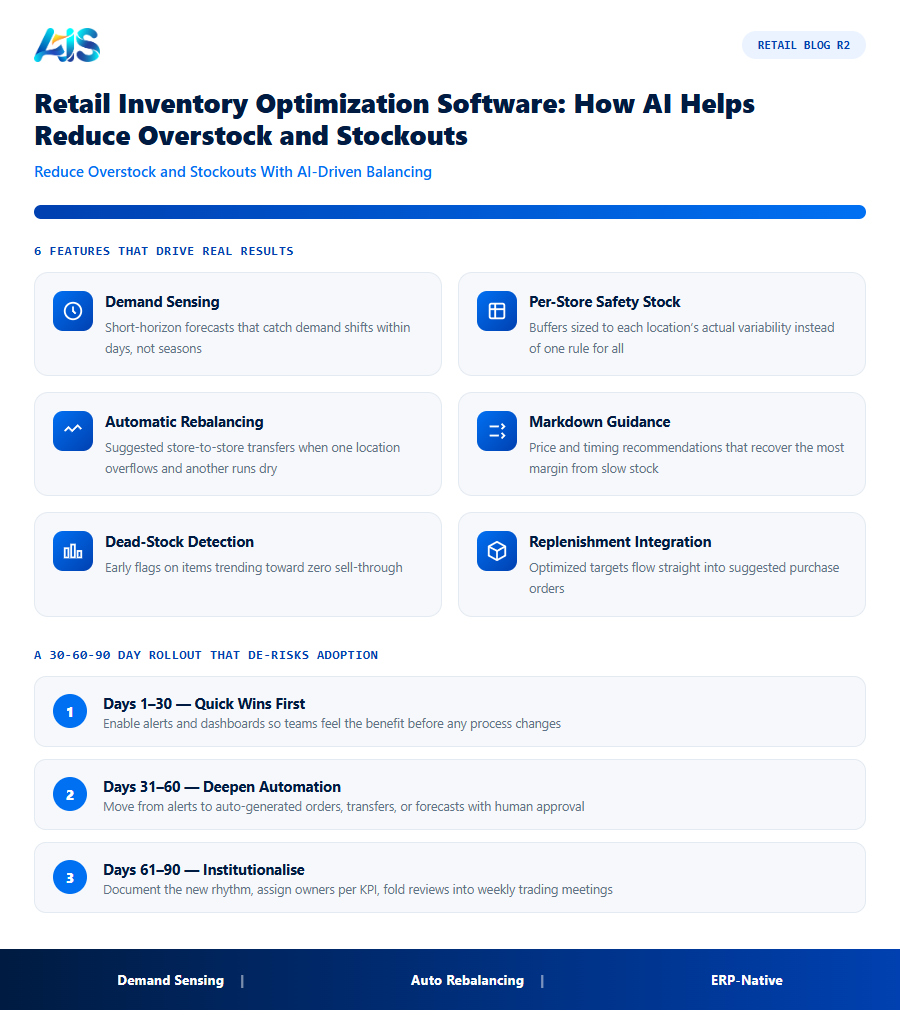
- Demand sensing — short-horizon forecasts that catch demand shifts within days, not seasons.
- Per-store safety stock — buffers sized to each location’s actual variability instead of one rule for all.
- Automatic rebalancing — suggested store-to-store transfers when one location overflows and another runs dry.
- Markdown guidance — price and timing recommendations that recover the most margin from slow stock.
- Dead-stock detection — early flags on items trending toward zero sell-through.
- Replenishment integration — optimized targets flow straight into suggested purchase orders.
The compounding effect matters more than any single feature: fewer stockouts lift sales, leaner stock frees cash, and better markdowns protect margin — the same inventory works harder.
Retail Inventory Optimization Software in Action: A Launch Week
Consider a 12-store fashion chain launching a seasonal collection. Without optimization, the chain ships the same initial quantity everywhere; by week two, three stores are reordering while five are marking down. With the platform, launch quantities follow each store’s own forecast, and week-two transfers flow from the same models that spotted the demand gaps.
The chain no longer reacts to imbalance — it anticipated it. Markdown depth shrinks, and the collection sells through at higher full price because the right sizes reached the right postcodes.
Choosing a Retail Inventory Optimization Platform
Evaluate platforms on the depth of their optimization logic, not the polish of their dashboards:
- Per-store forecasting — models that learn each location, not chain-wide averages.
- Transfer automation — suggestions that turn into approved moves in one click.
- Markdown intelligence — price guidance tied to sell-through and margin.
- ERP-native data — decisions built on the same transactions finance trusts.
Platforms such as Retail Pro AI combine these with SAP Business One, so optimization runs on live ERP truth rather than a stale export.
How the Investment Pays for Itself
Retail inventory optimization software earns its budget the same way any good operations tool does: by converting hidden losses into visible savings. Retailers who measure the before-and-after almost always find the investment repaid inside the first year.
Do not ignore the soft savings either. Fewer emergency transfers mean lower freight bills; cleaner data means fewer disputes with suppliers; calmer stores mean lower staff turnover. None of these appears on a vendor quote, yet together they often rival the headline gains from the platform in the first full year.
Do not forget the human dividend. Buyers who stop wrestling spreadsheets start negotiating harder; store managers who trust the numbers spend Saturdays selling instead of counting. Morale and retention improve when teams feel equipped rather than overwhelmed, and that stability shows up in customer experience scores within a few months.
A 30-60-90 Day Rollout That De-risks Adoption
You do not need a year-long transformation to benefit from retail inventory optimization software. A focused 30-60-90 day rollout gets live data flowing in weeks and measurable KPI movement inside a quarter.
Integration checkpoints matter more than feature demos. Confirm that every sale, receipt, transfer, and return lands in the system within minutes, and reconcile the first week’s totals against the ERP daily. A rollout whose numbers tie out from day one earns the credibility that carries the rest of the change.
- Days 1-30 — quick wins first: enable alerts and dashboards from the platform so teams feel the benefit before any process changes.
- Days 31-60 — deepen automation: move from alerts to auto-generated orders, transfers, or forecasts with human approval.
- Days 61-90 — institutionalise: document the new rhythm, assign owners per KPI, and fold reviews into the weekly trading meeting.
Overstock and Stockouts by Retail Category
Retail inventory optimization software behaves differently depending on what you sell, because the cost of getting it wrong is different in every category. A few concrete examples show why a one-size formula rarely works.
- Grocery and fresh food — a stockout on a perishable line is unrecoverable revenue for that day, but overordering means write-offs within 48-72 hours. Optimization models here weight shelf life and delivery frequency as heavily as sales velocity.
- Fashion and apparel — overstock at season end forces markdowns that erode margin; the software needs to flag slow-moving sizes and colors early enough to reallocate or discount before the window closes.
- Electronics — high unit cost makes overstock expensive to carry, while stockouts on hero products during launch periods cost disproportionate revenue; optimization software should treat new releases differently from steady-state SKUs.
- Pharmacy and health — regulatory requirements and expiry dates mean optimization must balance availability against controlled, auditable ordering, not just minimize cost.
Retail inventory optimization software that lets you tune these parameters by category — rather than applying one global reorder rule — consistently outperforms generic tools once measured over a full season.
Multi-category retailers should also expect the optimization model to reweight itself as a product moves through its lifecycle. A new SKU behaves differently in its first six weeks than a mature bestseller, and a discontinued line needs to be excluded from replenishment logic entirely rather than reordered on autopilot. Platforms that expose these lifecycle stages to buyers — rather than treating every item identically from launch to clearance — give teams the confidence to trust automated recommendations instead of manually overriding them every week.
How Safety Stock Calculations Actually Change Under AI Optimization
Most legacy systems size safety stock with a single formula applied chain-wide — often a flat number of days of cover, regardless of how erratic a SKU’s demand actually is at a given store. Retail inventory optimization software replaces that flat rule with a per-store, per-SKU calculation that accounts for demand variability, supplier lead-time variability, and the service level the retailer wants to guarantee.
In practice this means two stores carrying the identical SKU can hold meaningfully different safety stock: a location with steady, predictable footfall needs a thin buffer, while a location near a college campus with spiky, event-driven demand needs a deeper one — even if their average weekly sales are identical. Chain-wide flat rules either starve the volatile store or over-buffer the stable one; per-location math fixes both at once.
The same logic extends to lead-time risk. A supplier with a reliable seven-day lead time needs a smaller buffer than one whose deliveries swing between five and fourteen days, even for the same average. Optimization models that ingest actual delivery history — not the lead time printed on the purchase order — catch this automatically, which is why retailers moving from static reorder points to AI-driven optimization typically see their safety stock investment shrink in dollar terms even as service levels improve.
Questions to Ask Before Trusting an Optimization Recommendation
AI recommendations are only as good as the judgment applied to them in the first few months. Buyers evaluating a suggested transfer, markdown, or reorder should be able to answer these quickly:
- What data window did the model use? A recommendation built on the last four weeks behaves very differently around a holiday spike than one built on a full year including last year’s same season.
- Does the suggestion account for a known future event — a planned promotion, a store closure, a new competitor opening nearby — that historical data alone cannot see?
- Is the confidence level visible? Good optimization software shows how much history and how much variability sit behind each number, so buyers know when to trust it outright and when to sanity-check it.
- Can the override be logged and fed back into the model? Every manual correction is training data; platforms that capture the reason for an override improve faster than ones where corrections vanish into a spreadsheet.
Retailers who build this quick-check habit into their weekly buying rhythm get the speed of automation without losing the judgment that experienced planners bring to genuinely unusual situations.
Retail inventory optimization software: Frequently Asked Questions
What results can AI inventory optimization deliver?
Retailers typically report meaningful reductions in stockouts and overstock within two to three quarters, alongside higher inventory turnover and freed-up working capital. Results depend on data quality and how consistently suggestions are actioned.
Do I need clean historical data for AI optimization?
Roughly a year of transaction history is ideal, but platforms built on an ERP like SAP Business One can start with live sales data and improve as models learn. Clean item and store master data matters more than perfect history.
How is this different from standard replenishment tools?
Replenishment tools answer “when do I reorder?” Optimization software answers “where should every unit sit, how much should we hold in total, and what should we do about the stock that is not selling?” — a continuous, store-level balancing act.
Can small retail chains afford retail inventory optimization software?
Yes. Cloud pricing scales with stores and users, so a five-store chain pays a fraction of what an enterprise deployment costs. Because the savings come from the same leaks — stockouts, markdowns, overstock — smaller chains often see faster payback in percentage terms.
Does this kind of platform replace our buyers and planners?
No — it upgrades them. the platform handles the repetitive arithmetic of forecasting and ordering so buyers can negotiate better terms, planners can shape ranges, and store teams can serve customers. Headcount rarely falls; output per head rises sharply.
What data do we need before starting with this kind of platform?
Clean item masters, accurate opening stock per location, supplier lead times, and at least six months of sales history. Most retailers already hold all four inside their POS and ERP — the implementation work is validation and deduplication, typically completed inside the first month.
the platform turns stock from a static cost into a dynamic asset. Let AI forecast demand per store, rebalance continuously, and guide markdowns — and the same inventory budget covers more sales with less cash. That is the quiet math behind retail’s best-run chains. Start narrow, measure honestly, and scale what the numbers prove. That discipline, powered by the platform, turns inventory from your biggest risk into your most reliable advantage. See how Retail Pro AI brings retail inventory optimization software together with AI inside SAP Business One — book a demo to see your own store data in action.
