


Top UAE e-invoicing implementation service company for FTA-compliant digital invoicing solutions are becoming increasingly essential as businesses across the United Arab Emirates prepare for the country’s digital tax transformation. The UAE government is rapidly moving toward a modern tax ecosystem where electronic invoices replace traditional paper or PDF billing processes.
For companies operating in Dubai, Abu Dhabi, Sharjah, Ajman, Ras Al Khaimah, Fujairah, Umm Al Quwain, and UAE free zones, implementing a compliant e-invoicing system is no longer just a technological upgrade, it is a strategic necessity.
Organizations that adopt digital invoicing early will gain advantages such as improved compliance, faster financial workflows, reduced operational costs, and seamless integration with enterprise resource planning (ERP) systems. However, implementing e-invoicing correctly requires technical expertise, regulatory understanding, and robust system architecture.
This is where a UAE e-invoicing implementation service company plays a critical role by providing end-to-end implementation, ERP integration, compliance consulting, and automated invoice management solutions.
Understanding UAE E-Invoicing
E-invoicing refers to the electronic creation, exchange, and storage of invoices in a structured digital format that can be automatically processed by accounting systems and tax authorities.
Unlike conventional invoices, which may be generated as PDFs or printed documents, e-invoices contains structured data fields that allow seamless digital communication between suppliers, buyers, and government platforms.
Key Features of E-Invoicing
- Structured digital invoice formats
- Real-time invoice validation
- Automated data exchange between businesses
- Secure digital storage and archiving
- Integration with ERP and accounting systems
These capabilities enable organizations to streamline financial processes while ensuring regulatory compliance.
Why UAE Businesses Need E-Invoicing Implementation Services?
Implementing e-invoicing involves several technical and regulatory steps. Businesses must ensure that their invoicing systems meet compliance standards while maintaining operational efficiency.
A professional UAE e-invoicing implementation service provider helps businesses navigate these complexities.
Major Challenges Businesses Face
| Challenge | Description |
| System Integration | Integrating e-invoicing with existing ERP systems |
| Compliance Requirements | Meeting FTA digital invoicing standards |
| Data Security | Protecting sensitive financial information |
| Automation | Eliminating manual invoice processing |
| Scalability | Managing increasing invoice volumes |
Implementation partners address these challenges by designing scalable and compliant digital invoicing solutions.
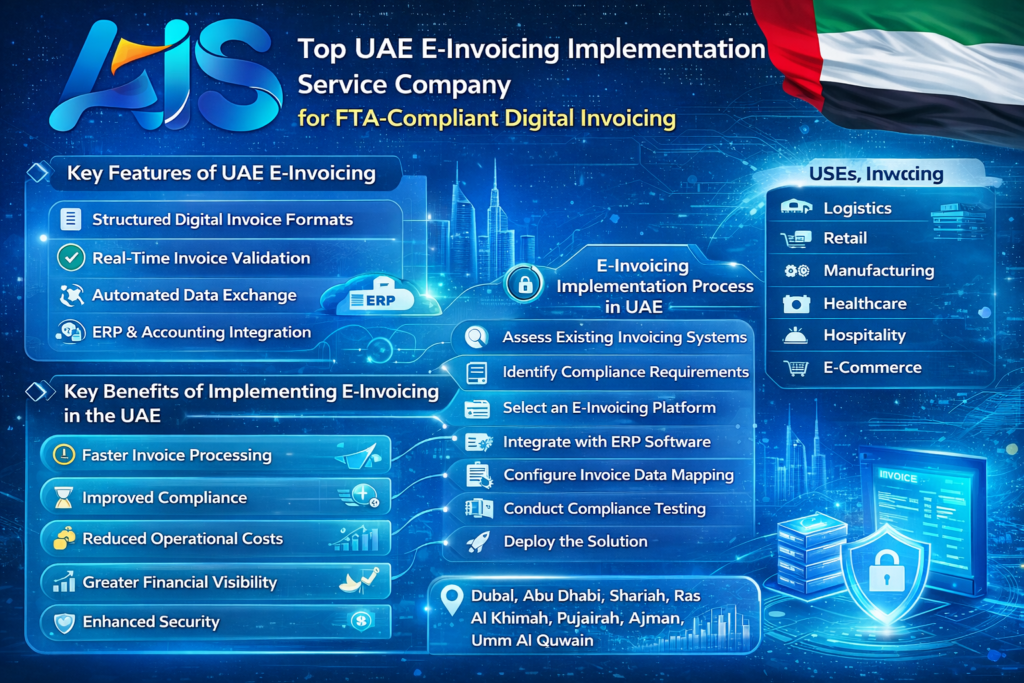
Key Benefits of Implementing E-Invoicing in the UAE
Adopting e-invoicing provides numerous operational and financial benefits.
1. Faster Invoice Processing
Automated systems significantly reduce invoice processing time, allowing businesses to manage transactions more efficiently.
2. Improved Compliance
Digital invoicing ensures businesses follow the regulatory standards required for VAT reporting and financial documentation.
3. Reduced Operational Costs
Eliminating paper-based invoicing reduces administrative costs associated with printing, storage, and manual processing.
4. Greater Financial Visibility
Businesses gain real-time insights into financial transactions, improving decision-making and financial planning.
5. Enhanced Security
Digital invoice platforms provide encrypted data transmission and secure storage.
UAE E-Invoicing Implementation Process
Successful e-invoicing implementation follows a structured approach to ensure seamless adoption and compliance.
Step-by-Step Implementation Framework
| Step | Implementation Activity |
| 1 | Assess existing invoicing systems |
| 2 | Identify compliance requirements |
| 3 | Select an e-invoicing platform |
| 4 | Integrate with ERP or accounting software |
| 5 | Configure invoice data mapping |
| 6 | Conduct compliance testing |
| 7 | Deploy the solution |
| 8 | Train staff and monitor performance |
This structured process ensures businesses transition smoothly to digital invoicing.
ERP Integration for UAE E-Invoicing
ERP integration is one of the most critical components of e-invoicing implementation.
Most companies already use ERP platforms to manage financial data. Integrating e-invoicing with ERP systems enables automated invoice generation, validation, and reporting.
Common ERP Systems Used in the UAE
| ERP Platform | Business Usage |
| SAP | Enterprise financial management |
| Oracle NetSuite | Cloud ERP for growing companies |
| Microsoft Dynamics | Finance and operations management |
| Zoho Books | SME accounting automation |
| Tally | Accounting and financial reporting |
ERP integration allows invoices to be generated directly from business transactions, eliminating manual work.
Compliance Requirements for UAE Digital Invoicing
Businesses implementing e-invoicing must ensure their systems comply with government regulations.
Essential Compliance Elements
- Structured invoice formats
- Unique invoice identification numbers
- Seller and buyer tax information
- Accurate VAT calculation
- Secure invoice storage
Failure to meet these standards may result in compliance issues or operational inefficiencies.
Industries That Require UAE E-Invoicing Implementation
E-invoicing is relevant across nearly every industry operating in the UAE economy.
Key Industries
| Industry | Use Case |
| Logistics | Freight and shipment invoicing |
| Retail | Transaction billing automation |
| Manufacturing | Supply chain invoice management |
| Healthcare | Medical billing automation |
| Hospitality | Service invoicing and billing |
| E-commerce | High-volume digital transactions |
Businesses in these industries benefit from faster billing cycles and improved financial transparency.
E-Invoicing Adoption Across UAE Cities
Companies across the UAE’s major economic hubs are adopting digital invoicing technologies.
Major Adoption Areas
- Dubai
- Abu Dhabi
- Sharjah
- Ajman
- Ras Al Khaimah
- Fujairah
- Umm Al Quwain
Additionally, businesses operating in free zones must ensure their invoicing processes comply with national digital standards.
Choosing the Right UAE E-Invoicing Implementation Service Company
Selecting the right implementation partner can significantly impact the success of your digital invoicing transformation.
Key Factors to Consider
1. Regulatory Expertise
The provider should have in-depth knowledge of UAE tax compliance and digital invoicing standards.
2. ERP Integration Capabilities
Ensure the service provider supports integration with your existing ERP system.
3. Scalable Infrastructure
Your solution should handle increasing transaction volumes as your business grows.
4. Data Security and Compliance
Implementation partners must follow strict cybersecurity practices to protect financial data.
5. Ongoing Technical Support
Choose a provider that offers continuous support, system updates, and compliance monitoring.
Future of E-Invoicing in the UAE
The UAE government is committed to creating a fully digital financial ecosystem.
The future of e-invoicing will include:
- Real-time invoice reporting
- Automated tax compliance
- Integrated digital tax platforms
- Cross-border electronic invoicing
These developments will further enhance transparency and efficiency within the business environment.
Why Businesses Should Implement E-Invoicing Early?
Early adoption of digital invoicing offers several competitive advantages.
Key Benefits
- Faster financial processes
- Improved compliance readiness
- Reduced operational costs
- Better financial insights
- Enhanced customer experience
Companies that implement e-invoicing early will be better positioned to adapt to evolving regulatory requirements.
Role of E-Invoicing Implementation Companies
Implementation partners provide businesses with a comprehensive digital invoicing infrastructure.
Key Services Provided
| Service | Description |
| Compliance Consulting | Understanding regulatory requirements |
| System Integration | Connecting ERP systems with invoicing platforms |
| Data Mapping | Structuring invoice data fields |
| Platform Deployment | Setting up e-invoicing software |
| Training | Educating staff on system usage |
| Support | Ongoing system maintenance |
These services help businesses successfully transition to automated invoicing environments.
Frequently Asked Questions (FAQs)
What is UAE e-invoicing?
UAE e-invoicing is a digital invoicing system where invoices are generated, transmitted, and stored electronically in structured formats.
Why is e-invoicing important for businesses?
It improves tax compliance, reduces manual errors, and streamlines financial operations.
Who needs e-invoicing implementation services?
Businesses of all sizes, including SMEs and large enterprises, require implementation services to ensure compliance and automation.
What does an e-invoicing implementation company do?
They help businesses design, integrate, and deploy digital invoicing systems that comply with government regulations.
Which ERP systems support e-invoicing?
Common ERP systems include SAP, Oracle NetSuite, Microsoft Dynamics, Zoho Books, and Tally.
Is e-invoicing mandatory in the UAE?
The UAE government is gradually implementing mandatory digital invoicing frameworks for businesses.
How long does e-invoicing implementation take?
Implementation timelines vary depending on system complexity but typically range from several weeks to a few months.
What industries benefit most from e-invoicing?
Industries such as logistics, retail, manufacturing, healthcare, hospitality, and e-commerce benefit greatly from digital invoicing.
Can SMEs adopt e-invoicing solutions?
Yes. Many e-invoicing platforms offer scalable solutions designed specifically for small and medium-sized businesses.
How can businesses prepare for e-invoicing implementation?
Businesses should assess their invoicing systems, upgrade ERP platforms, and partner with experienced implementation providers.
The transition to digital invoicing represents a major milestone in the UAE’s digital transformation journey. Businesses that adopt FTA-compliant e-invoicing systems will benefit from improved efficiency, streamlined financial processes, and enhanced regulatory compliance.
Partnering with a reliable UAE e-invoicing implementation service company ensures organizations successfully navigate the complexities of digital invoicing while preparing for the future of tax technology.
As the UAE continues to modernize its financial infrastructure, companies that embrace e-invoicing today will gain a competitive advantage in tomorrow’s digital economy.

