


UAE E-Invoicing for Food & Beverages Is Changing in 2026 – Are You Ready?
The UAE government is transforming tax compliance with mandatory electronic invoicing under the framework introduced by the Federal Tax Authority.
For the Food & Beverages (F&B) industry, including restaurants, cloud kitchens, catering companies, food manufacturers, distributors, supermarkets, and hospitality groups; compliance is no longer optional.
If you operate in Dubai, Abu Dhabi, Sharjah, Ajman, Ras Al Khaimah, Fujairah, Umm Al Quwain, or UAE Free Zones, this guide explains:
- UAE e-invoicing for food and beverages
- F&B e-invoicing UAE compliance roadmap
- City-specific implementation insights
- ERP & SAP integration strategy
- Penalty risks
- Commercial software requirements
- AI-ready invoice validation
- 2026 readiness checklist
Is UAE E-Invoicing Mandatory for Food & Beverages?
Yes. Under the UAE’s upcoming e-invoicing framework, businesses meeting VAT and regulatory criteria must issue structured electronic invoices.
The Federal Tax Authority is introducing a Peppol-based decentralized CTC (Continuous Transaction Control) model.
This impacts:
- Food manufacturers
- Restaurants & cafe chains
- Catering services
- Food & Beverages distributors
- FMCG wholesalers
- Food exporters
- Freezone food companies
If you fall under VAT registration thresholds or cross-border trading, you must prepare now.
Why UAE E-Invoicing for Food Industry is Critical?
The F&B industry is one of the highest transaction-volume sectors in the UAE. Consider:
- Thousands of daily POS invoices
- B2B bulk food supply invoices
- Inter-Emirate distribution
- Import/export documentation
- VAT zero-rated & standard-rated items
Manual invoicing or PDF invoices will not meet future structured data requirements.
UAE e-invoicing for food industry ensures:
✔ Real-time invoice validation
✔ Automated VAT reporting
✔ Reduced fraud
✔ Faster audits
✔ Seamless ERP compliance
How UAE E-Invoicing Works for Food & Beverage Businesses?
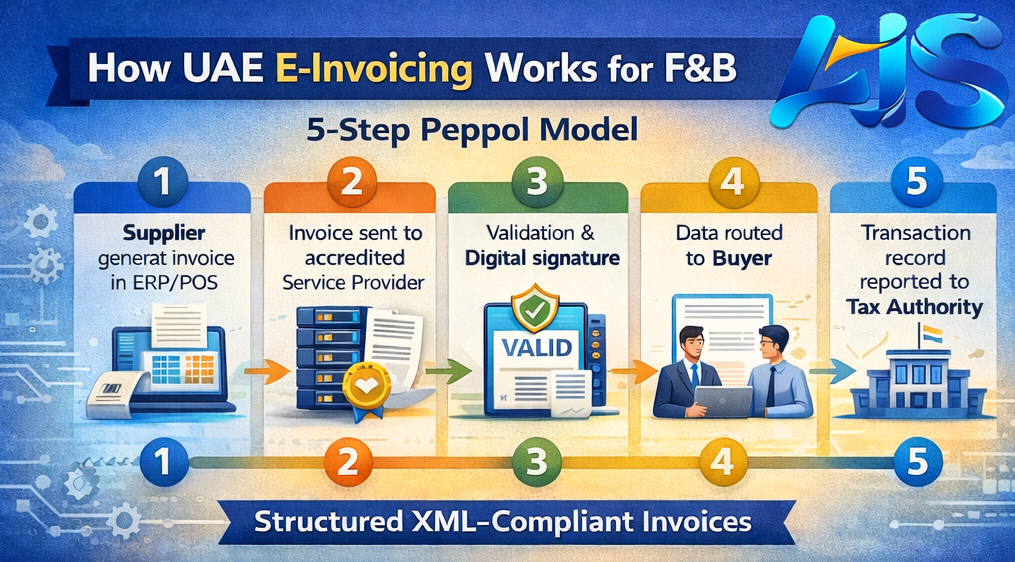
The UAE will implement a 5-corner Peppol model, which means:
- Supplier generates an invoice in ERP/POS
- Invoice sent to accredited Service Provider
- Validation & digital signature
- Data routed to the buyer
- Transaction record reported to tax authority
For F&B companies, this means your:
- Restaurant POS
- SAP Business One
- ERP systems
- Billing software
- Distribution management system
must generate structured XML-compliant invoices.
UAE E-Invoicing for Food Industry by Emirate
Food E-Invoicing Dubai
Dubai hosts major restaurant chains, hotels, and food distributors. Businesses must align their POS systems with e-invoice standards.
Industries affected:
- JAFZA food importers
- Dubai Industrial City manufacturers
- Cloud kitchens
Food E-Invoicing Abu Dhabi
Abu Dhabi F&B companies serving government contracts must ensure strict invoice validation compliance. Non-compliance can affect contract renewals.
Food E-Invoicing Sharjah
Sharjah-based food manufacturers and wholesalers require ERP integration due to high B2B transactions.
Food E-Invoicing Ajman
SME restaurants and grocery chains must upgrade billing software to a structured e-invoice format.
Food E-Invoicing Ras Al Khaimah
RAK freezone food exporters must implement compliant invoicing for cross-border VAT reporting.
Food E-Invoicing Fujairah
Logistics-heavy seafood and export businesses must integrate customs + invoice documentation.
Food E-Invoicing Umm Al Quwain
Growing SME F&B units must transition from manual invoicing to automated tax-compliant systems.
UAE Freezone Food Companies – Are They Included?
Yes. Freezone companies involved in:
- Domestic UAE trade
- Mainland transactions
- VAT-registered operations
must comply with UAE e-invoicing mandates.
Challenges in UAE E-Invoicing for F&B Sector
1. High Invoice Volume
Restaurants issue hundreds of invoices daily.
2. POS Integration Complexity
Legacy POS systems lack structured XML support.
3. VAT Classification Errors
Zero-rated vs standard-rated food items.
4. Multi-Branch Management
Centralized invoice control across the Emirates.
5. ERP Compatibility Issues
Older systems require an upgrade or middleware.
Why AIS Business Corp Is the Ideal E-Invoicing Partner?
AIS Business Corp is a leading SAP Silver Partner specializing in SAP Business One, ERP integration, and UAE compliance transformation.
For Food & Beverage businesses, AIS provides:
- End-to-end UAE e-invoicing implementation
- SAP Business One e-invoice integration
- POS integration services
- FTA-compliant invoice mapping
- Peppol-ready configuration
- Freezone & mainland advisory
- 24/7 compliance monitoring
With expansion plans across the Middle East, Europe, and India, AIS Business Corp combines ERP expertise with compliance intelligence.
SAP E-Invoicing UAE for Food Industry
If you use SAP, AIS configures:
- SAP Business One e-invoicing UAE
- Real-time XML generation
- Tax code mapping
- Digital signature automation
- API-based service provider connection
For large restaurant groups and food distributors, SAP automation eliminates compliance risk.
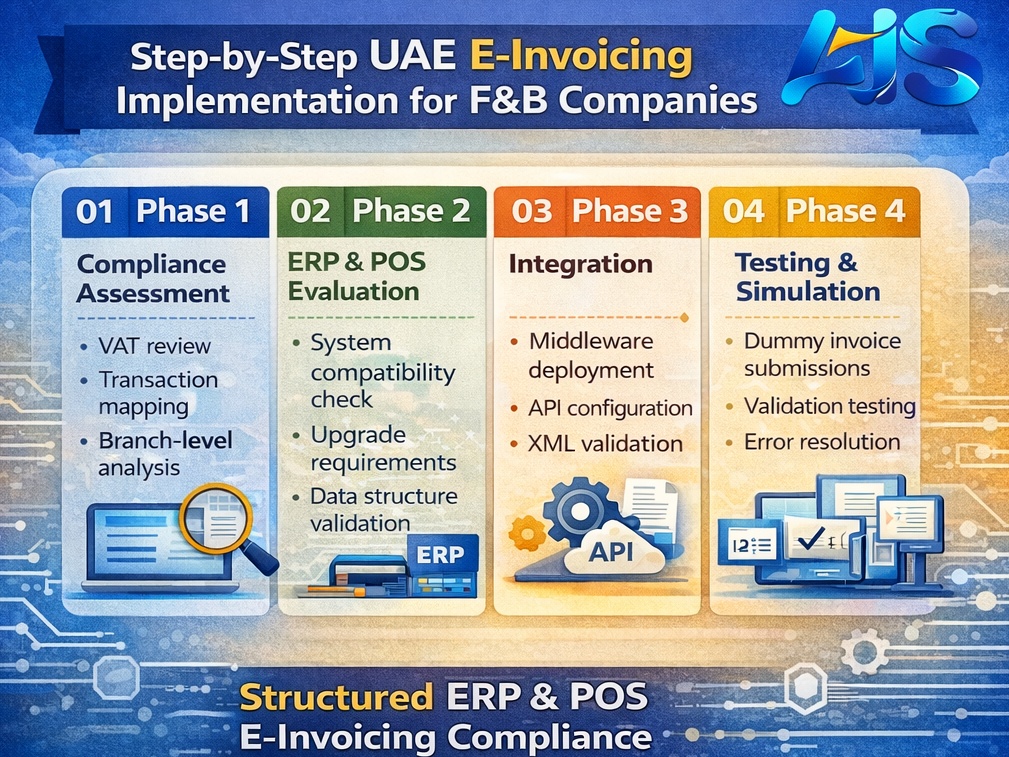
Step-by-Step UAE E-Invoicing Implementation for F&B Companies
Phase 1 – Compliance Assessment
- VAT review
- Transaction mapping
- Branch-level analysis
Phase 2 – ERP & POS Evaluation
- System compatibility check
- Upgrade requirements
- Data structure validation
Phase 3 – Integration
- Middleware deployment
- API configuration
- XML validation
Phase 4 – Testing & Simulation
- Dummy invoice submissions
- Validation testing
- Error resolution
Phase 5 – Go-Live & Monitoring
- Live invoice transmission
- Real-time reporting
- Audit readiness
Penalties for Non-Compliance
Failure to comply may result in:
- Financial penalties
- VAT audit risks
- Transaction rejection
- Operational disruption
- License renewal issues
The F&B sector is high-risk due to transaction frequency.
Benefits of UAE E-Invoicing for Food & Beverage Companies
✔ Faster payment cycles
✔ Reduced accounting workload
✔ Error-free VAT filing
✔ Audit-ready data
✔ Fraud prevention
✔ Improved supply chain transparency
AI & Automation in UAE F&B E-Invoicing
Modern systems enable:
- Automated invoice validation
- AI-driven VAT classification
- Predictive compliance alerts
- Centralized multi-branch dashboards
AIS integrates AI + ERP for next-generation compliance.
Why Early Implementation Gives Competitive Advantage?
Businesses implementing e-invoicing early will:
- Avoid system overload near the deadline
- Reduce last-minute penalties
- Gain operational efficiency
- Improve investor confidence
- Strengthen audit compliance
FAQs – UAE E-Invoicing for Food & Beverages
Is UAE e-invoicing mandatory for food and beverage businesses?
Yes, VAT-registered F&B businesses must comply under the UAE’s structured e-invoicing framework introduced by the Federal Tax Authority.
When will UAE e-invoicing start?
Implementation begins in phases from 2026.
Does e-invoicing apply to restaurants in Dubai?
Yes, food e-invoicing Dubai compliance applies to VAT-registered restaurants.
Do freezone food companies need e-invoicing?
Yes, if they trade within UAE mainland or are VAT registered.
What format is required for UAE e-invoice?
Structured XML format compliant with Peppol standards.
Can POS systems generate compliant e-invoices?
Only if upgraded to support structured XML and service provider integration.
Is SAP compatible with UAE e-invoicing?
Yes. SAP Business One can be configured for UAE e-invoice compliance.
What happens if F&B companies ignore e-invoicing?
They risk penalties, audit exposure, and operational disruptions.
How can AIS Business Corp help?
AIS provides full UAE e-invoicing implementation, SAP integration, and compliance advisory.
Which Emirates require compliance?
All Emirates: Dubai, Abu Dhabi, Sharjah, Ajman, Ras Al Khaimah, Fujairah, Umm Al Quwain.
Secure Your UAE F&B E-Invoicing Compliance Now
UAE e-invoicing for food and beverages is not just a compliance requirement; it’s a digital transformation opportunity.
Whether you operate a restaurant in Dubai, a food factory in Sharjah, or a distributor in Abu Dhabi, proactive implementation is critical.
Partner with AIS Business Corp to ensure your F&B business achieves full UAE e-invoicing compliance before 2026.
