

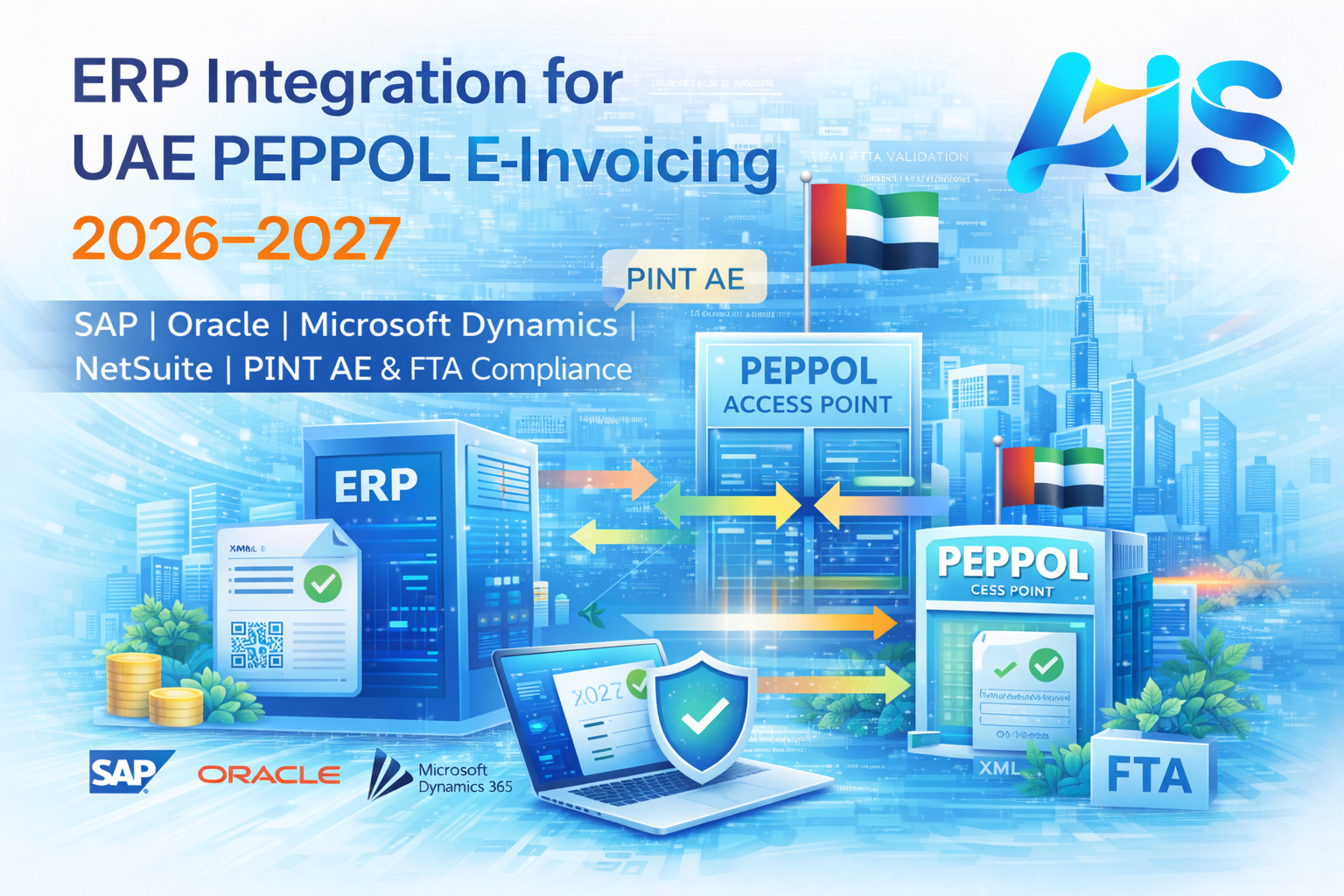
Why ERP Integration is the Core of UAE PEPPOL E-Invoicing Compliance?
The UAE’s PEPPOL-based e-invoicing mandate for 2026–2027 is not just a regulatory shift; it is a complete digital transformation of how VAT-registered businesses generate, validate, transmit, and archive invoices.
While many organizations focus on understanding the 5-Corner model or selecting a certified service provider, the real success factor lies deeper:
ERP integration.
Your ERP system, whether SAP, Oracle, Microsoft Dynamics, or NetSuite, is the origin of transactional data. If it is not correctly integrated with the PEPPOL framework and aligned with PINT AE requirements, compliance risks increase significantly.
This guide explains:
- How ERP to PEPPOL integration works?
- Technical architecture options
- PINT AE mapping requirements
- Middleware vs direct connectivity
- FTA validation workflow
- Security and audit considerations
- Implementation roadmap for 2026–2027
Understanding ERP Integration in the UAE PEPPOL Framework
Under the UAE PEPPOL e-invoicing model, invoices must:
- Be generated in structured XML format
- Follow PINT AE specifications
- Be transmitted via a certified PEPPOL Access Point
- Undergo regulatory validation
- Be securely archived
Your ERP system must therefore:
- Extract invoice data
- Convert it into PINT AE-compliant XML
- Send it to an Access Point
- Receive status updates
- Store validation results
This is not a simple API connection it requires structured transformation logic, compliance validation, and secure communication protocols.
ERP Systems Covered in UAE PEPPOL Integration
SAP Integration for UAE PEPPOL E-Invoicing
SAP systems commonly used in the UAE include:
Key SAP Integration Requirements:
- XML schema mapping to PINT AE
- UBL structure generation
- VAT validation logic alignment
- Real-time invoice extraction
- API or middleware connection to Access Point
SAP S/4HANA users often leverage:
- SAP Document Compliance
- SAP Integration Suite
- Custom middleware connectors
The biggest challenge in SAP integration is aligning tax configuration tables with UAE-specific validation rules.
Oracle ERP Integration for PEPPOL UAE
Oracle ERP Cloud and Oracle E-Business Suite require:
- Data model extraction from AR/AP modules
- XML generation engine
- Mapping for VAT categories
- Secure web service communication
Oracle Cloud offers integration capabilities via:
- Oracle Integration Cloud (OIC)
- REST-based connectivity
- Custom adapters
The primary technical consideration is ensuring correct tax reporting codes that align with PINT AE.
Microsoft Dynamics 365 Integration
Dynamics 365 Finance and Business Central require:
- Structured invoice extraction
- XML transformation layer
- VAT code alignment
- API-based Access Point communication
Microsoft environments often integrate using:
- Azure Logic Apps
- Power Automate
- Custom middleware services
The benefit of Dynamics is flexibility, but compliance logic must be carefully configured.
NetSuite PEPPOL Integration UAE
NetSuite requires:
- Custom SuiteScript mapping
- XML conversion module
- Tax configuration alignment
- Secure transmission mechanism
Most NetSuite integrations use middleware due to structured transformation needs.
What is PINT AE Mapping and Why It Matters?
PINT AE (PEPPOL International Invoice Standard – UAE Extension) defines:
- Mandatory fields
- Optional fields
- VAT breakdown requirements
- Buyer/supplier identification structure
- Currency formatting
- Tax category rules
Incorrect PINT AE mapping leads to:
- Validation rejection
- Regulatory non-compliance
- Reporting inconsistencies
- Audit exposure
Critical PINT AE Mapping Components
- VAT registration number formatting
- Emirates-specific address fields
- Invoice type codes
- Tax exemption reasoning
- Line-level VAT breakdown
- Currency precision
ERP systems must generate invoices strictly aligned with these structured fields.
ERP to PEPPOL Connectivity Architecture
There are three main integration models:
1. Direct ERP to Access Point Integration
ERP → API → Access Point
Pros:
- Faster processing
- Reduced layers
- Lower latency
Cons:
- Complex development
- Harder upgrades
- ERP customization risk
2. Middleware-Based Integration (Recommended)
ERP → Middleware → Access Point
Middleware performs:
- XML transformation
- PINT AE validation
- Logging and audit storage
- Error handling
- Retry mechanisms
This is the most scalable and secure architecture.
3. Managed Service Integration
ERP → Certified Provider Platform → PEPPOL Network
Best for SMEs lacking internal IT capability.
FTA Compliance & Validation Workflow
Once invoice XML is generated:
- Sent to Supplier Access Point
- Routed through PEPPOL Network
- Submitted to UAE regulatory validation layer
- Validated for schema + tax rules
- Approved or rejected
- Delivered to buyer
Your ERP must:
- Capture validation status
- Store approval reference
- Log rejection errors
- Trigger correction workflow
Security Requirements for ERP Integration
UAE PEPPOL integration requires:
- Secure API encryption (TLS)
- Digital certificate authentication
- Secure data storage
- Audit trail preservation
- Role-based access control
Failure to implement security controls increases compliance risk.
Common ERP Integration Challenges in UAE
- Legacy ERP versions
- Incorrect VAT setup
- Manual invoice processes
- Custom fields misalignment
- Lack of XML expertise
- Poor audit documentation
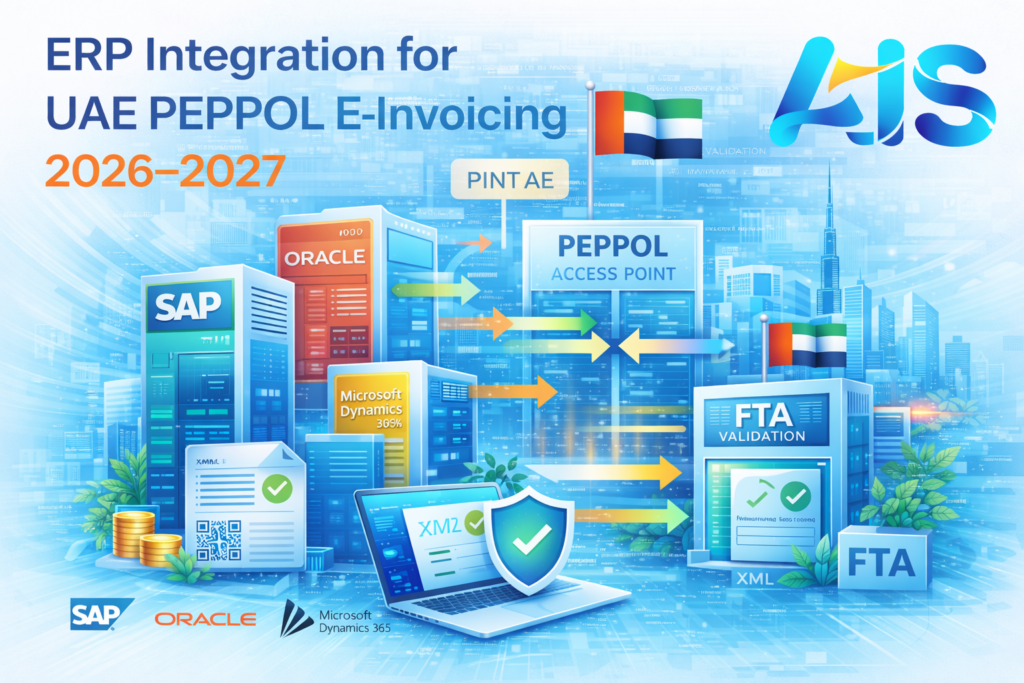
Step-by-Step ERP Integration Roadmap for 2026–2027
Phase 1: ERP Readiness Assessment
- VAT configuration review
- Data quality audit
- Customization mapping
Phase 2: Technical Architecture Selection
- Direct vs Middleware vs Managed
- Security model definition
- Access Point selection
Phase 3: PINT AE Data Mapping
- Field mapping workshop
- Schema validation
- Test XML generation
Phase 4: Sandbox Testing
- Regulatory testing
- Error correction
- Volume simulation
Phase 5: Go-Live & Monitoring
- Production deployment
- Performance monitoring
- Audit documentation
How ERP Integration Improves Business Operations?
Beyond compliance, integration enables:
- Real-time invoice tracking
- Automated reconciliation
- Faster VAT reporting
- Reduced manual errors
- Improved audit readiness
- Digital transformation alignment
ERP Integration & Corporate Tax Synergy
Structured invoice data improves:
- Corporate tax reporting
- Revenue transparency
- Intercompany reconciliation
- Transfer pricing documentation
Cost Factors in ERP PEPPOL Integration
Costs depend on:
- ERP complexity
- Customization level
- Middleware licensing
- Access Point fees
- Implementation partner
Why Early ERP Integration Is Critical?
Waiting until 2027 creates:
- Implementation bottlenecks
- Higher consultant costs
- Operational risk
- Compliance penalties
Early adoption ensures stability and competitive advantage.
How AIS Supports ERP to PEPPOL Integration?
AIS provides:
- ERP readiness assessment
- PINT AE mapping workshops
- Middleware configuration
- Access Point coordination
- Testing & validation support
- Go-live deployment assistance
- Ongoing compliance monitoring
AIS specializes in:
- SAP PEPPOL integration UAE
- Oracle PEPPOL integration UAE
- Microsoft Dynamics compliance automation
- NetSuite e-invoicing configuration
Frequently Asked Questions
What is ERP integration for UAE PEPPOL e-invoicing?
ERP integration for UAE PEPPOL e-invoicing is the technical process of connecting an organization’s ERP system (such as SAP, Oracle, Microsoft Dynamics, or NetSuite) to the PEPPOL network to generate, validate, and transmit structured electronic invoices in PINT AE-compliant XML format through a certified Access Point in accordance with UAE FTA regulations.
Is ERP integration mandatory under the UAE PEPPOL 2026–2027 mandate?
Yes. ERP integration is mandatory for businesses that generate invoices through ERP systems because UAE PEPPOL regulations require invoices to be issued in structured XML format following PINT AE standards and transmitted via certified Access Points. Manual PDF or unstructured invoices will not meet compliance requirements.
What is PINT AE and why is it important for ERP mapping?
PINT AE (PEPPOL International Invoice – UAE Extension) is the structured invoice data model defined for UAE e-invoicing compliance. It specifies mandatory fields such as VAT registration numbers, tax breakdown, invoice type codes, buyer details, and currency precision. ERP systems must map invoice data accurately to PINT AE XML schema to avoid rejection during regulatory validation.
How does SAP integrate with UAE PEPPOL e-invoicing?
SAP integrates with UAE PEPPOL by extracting invoice data from modules like Accounts Receivable, converting it into PINT AE-compliant XML using SAP Document Compliance or middleware, and transmitting it via a certified PEPPOL Access Point. The system also captures validation responses and stores audit logs for compliance.
Can Oracle, Microsoft Dynamics, and NetSuite connect directly to PEPPOL?
Yes, Oracle ERP, Microsoft Dynamics 365, and NetSuite can connect to PEPPOL either through direct API integration or via middleware. However, middleware-based integration is generally recommended because it provides XML transformation, validation checks, error handling, logging, and scalability for regulatory compliance.
What is the difference between direct integration and middleware integration?
Direct integration connects the ERP system directly to a PEPPOL Access Point using APIs. Middleware integration introduces an intermediary platform that performs XML transformation, PINT AE validation, logging, and compliance monitoring before transmitting invoices. Middleware offers better control, security, and scalability compared to direct integration.
What happens if PINT AE mapping is incorrect?
If PINT AE mapping is incorrect, the invoice may fail schema validation or tax rule validation during submission. Rejected invoices must be corrected and resubmitted, which can delay payments, impact VAT reporting accuracy, and increase compliance risk under UAE FTA regulations.
How long does ERP integration for UAE PEPPOL take?
ERP integration typically takes 8 to 16 weeks depending on ERP complexity, customization level, VAT configuration accuracy, testing requirements, and whether middleware is used. Large enterprises with multiple entities may require longer implementation timelines.
What security requirements apply to ERP-PEPPOL integration in the UAE?
ERP integration must comply with secure transmission standards including TLS encryption, digital certificate authentication, secure API communication, audit trail retention, and role-based access control. Proper security implementation protects sensitive invoice and tax data and ensures regulatory compliance.
When should UAE businesses start ERP integration for PEPPOL compliance?
UAE businesses should begin ERP readiness assessment at least 12–18 months before the mandatory phase applicable to their organization size. Early preparation prevents implementation bottlenecks, reduces consultant costs, and ensures smooth regulatory compliance before the 2026–2027 deadlines.
ERP Integration is the Foundation of UAE PEPPOL Compliance
The UAE PEPPOL e-invoicing mandate for 2026–2027 is a technology-driven compliance reform.
Organizations that:
- Modernize ERP architecture
- Implement PINT AE mapping correctly
- Choose scalable connectivity
- Secure validation workflows
Will achieve not just compliance, but operational excellence.
ERP integration is not an IT upgrade.
It is a strategic compliance transformation.
