


The UAE is entering a new era of structured digital tax compliance. With the implementation of mandatory e-invoicing regulations, businesses must align their invoicing systems with the standards issued by the Federal Tax Authority (FTA).
Failure to comply with UAE e-invoicing rules can result in financial penalties, operational disruption, and increased audit risk. This complete 2026 guide explains:
- UAE e-invoicing compliance deadlines
- Applicable penalties and fines
- Risk areas for businesses
- Practical compliance roadmap
- Preventive strategies to avoid FTA violations
Whether you are an SME, large enterprise, Free Zone entity, or multinational operating in the United Arab Emirates, understanding these rules is critical.
Overview of UAE E-Invoicing Framework
The UAE e-invoicing system is designed to:
- Digitize invoice reporting
- Improve VAT transparency
- Reduce tax evasion
- Enable real-time validation
- Strengthen regulatory monitoring
Unlike traditional PDF invoices, UAE e-invoices must follow structured XML formats and comply with technical schema requirements. Invoices are validated electronically and may require digital signatures and secure transmission to accredited platforms.
Is UAE E-Invoicing Mandatory in 2026?
Yes. The UAE is rolling out mandatory e-invoicing in phases beginning 2026, with full compliance expected across VAT-registered businesses.
Businesses subject to VAT under UAE tax laws must:
- Issue structured electronic invoices
- Ensure real-time or near-real-time reporting (as mandated)
- Maintain electronic records
- Comply with approved transmission protocols
Non-compliance may lead to administrative penalties under FTA regulations.
UAE E-Invoicing Compliance Deadlines (2026 Rollout)
While specific enforcement phases may vary by sector and business size, companies should prepare for:
Phase 1 – System Readiness (Preparation Phase)
- ERP upgrades
- XML invoice configuration
- Digital signature setup
- Vendor onboarding
Phase 2 – Mandatory Invoice Issuance
- Structured e-invoice issuance becomes compulsory
- Paper/PDF-only invoices no longer accepted for VAT compliance
Phase 3 – Real-Time Reporting & Validation
- Automated transmission to government-accredited platforms
- Rejection handling workflow
Phase 4 – Full Audit Enforcement
- Automated compliance audits
- Penalty enforcement for non-adherence
Businesses delaying preparation risk missing regulatory deadlines.
UAE E-Invoicing Penalties: What Businesses Must Know?
The FTA enforces administrative penalties for VAT-related violations. Under e-invoicing regulations, potential penalties may include:
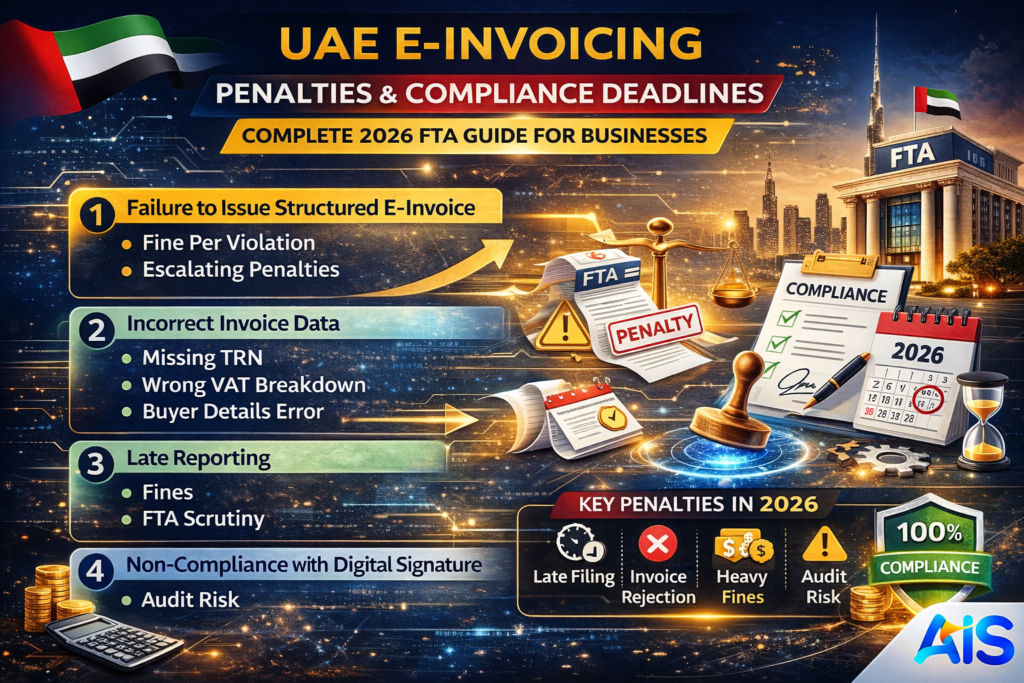
1. Failure to Issue Structured E-Invoice
If a business continues issuing non-compliant invoices:
- Monetary fines per violation
- Escalating penalties for repeated non-compliance
2. Incorrect Invoice Data
Missing mandatory fields such as:
- Tax Registration Number (TRN)
- VAT breakdown
- Buyer details
- Invoice sequence
Can result in rejection and financial penalties.
3. Late Reporting
If real-time reporting is mandated and not adhered to:
- Administrative fines
- Audit scrutiny
4. Digital Signature Non-Compliance
Invoices without proper authentication or encryption may be invalid.
5. Record Retention Violations
Businesses must retain electronic invoices for a minimum of 5 years. Failure can result in compliance penalties.
Estimated Risk Areas That Trigger FTA Audits
Businesses are more likely to face scrutiny if they:
- Frequently submit corrected invoices
- Show mismatch between VAT returns and e-invoice data
- Delay invoice validation
- Use unaccredited service providers
- Fail XML schema validation repeatedly
Proactive compliance reduces audit risk significantly.
UAE EInvoice Compliance Checklist for 2026
Use this readiness checklist:
✔ VAT registration active
✔ TRN correctly mapped
✔ ERP system XML-enabled
✔ Middleware/API integration tested
✔ Digital certificate installed
✔ Invoice sequence control
✔ Secure data storage
✔ Backup & disaster recovery plan
✔ Real-time reporting configuration
✔ Rejection correction workflow
How UAE E-Invoicing Penalties Impact Businesses?
Financial Impact
- Direct fines
- Increased compliance cost
- Cash flow delays
Operational Impact
- Invoice rejection delays
- Payment hold-ups
- Vendor disputes
Reputational Risk
- Government scrutiny
- Audit classification as high-risk taxpayer
How to Avoid UAE E-Invoicing Penalties?
1. Conduct Compliance Gap Analysis
Identify system weaknesses before enforcement.
2. Upgrade ERP Systems
Ensure SAP, Oracle, or accounting software supports structured XML invoices.
3. Use Accredited Service Providers
Partner with certified integration providers.
4. Implement Real-Time Monitoring
Automate rejection alerts and correction workflows.
5. Train Finance Teams
Educate staff on invoice validation rules and regulatory updates.
Role of ERP Systems in Compliance
Modern ERP systems help:
- Auto-generate XML invoices
- Validate VAT calculations
- Maintain invoice logs
- Store digital certificates
- Automate reporting
Without ERP integration, manual invoicing increases compliance risk.
Free Zone vs Mainland: Are Penalties Different?
Free Zone businesses registered for VAT must comply with e-invoicing requirements when issuing taxable supplies.
Corporate structure does not exempt VAT-registered entities from compliance.
UAE E-Invoicing & VAT Reporting Alignment
UAE e-invoicing will directly impact VAT returns. Mismatches between:
- VAT return filings
- E-invoice submissions
- Taxable supply records
May trigger automated compliance alerts.
UAE E-Invoicing Implementation Timeline Strategy
Recommended timeline:
6–12 months before enforcement
- ERP assessment
- Budget allocation
- Vendor selection
3–6 months before enforcement
- Integration development
- XML testing
- User training
1–3 months before enforcement
- Parallel run
- Compliance simulation
- Final audit readiness
Early adoption reduces penalty exposure.
UAE E-Invoicing Common Mistakes That Lead to Penalties
- Treating e-invoicing as only IT responsibility
- Ignoring data accuracy
- Delaying integration testing
- Using outdated digital certificates
- Not monitoring rejected invoices
Compliance requires cross-functional collaboration.
E-Invoice UAE Long-Term Benefits of Compliance
Although penalties drive urgency, benefits include:
- Faster invoice approval
- Improved VAT reconciliation
- Reduced fraud risk
- Better financial transparency
- Stronger audit readiness
Digital compliance strengthens business credibility.
How Aiscorp.ai Helps Businesses Stay Compliant?
AISCorp.ai provides:
- End-to-end e-invoicing readiness assessment
- ERP integration support
- XML mapping and validation
- Compliance monitoring
- Ongoing FTA regulatory updates
- Risk mitigation strategy
Early compliance planning prevents penalties and ensures smooth operations.
FAQs
What are the penalties for non-compliance with UAE e-invoicing?
Penalties may include administrative fines, invoice rejection, VAT audit risk, and escalating financial penalties for repeated violations under FTA regulations.
When does UAE e-invoicing become mandatory?
The UAE is implementing phased mandatory e-invoicing beginning 2026 for VAT-registered businesses.
Is a structured XML invoice mandatory in UAE?
Yes. E-invoices must follow a structured XML format compliant with the government technical schema.
Can businesses still issue PDF invoices?
PDF invoices may not meet structured e-invoicing requirements unless accompanied by compliant XML data.
How long must e-invoices be retained?
Businesses must retain electronic invoices for at least five years under UAE VAT law.
Are Free Zone companies required to comply?
If VAT-registered and issuing taxable supplies, Free Zone entities must comply with e-invoicing rules.
What happens if an invoice is rejected?
Rejected invoices must be corrected and resubmitted according to validation requirements.
Does late submission trigger penalties?
Yes. Failure to meet reporting deadlines may result in administrative fines.
How can businesses avoid e-invoicing penalties?
By upgrading ERP systems, ensuring XML compliance, monitoring submissions, and partnering with certified integration providers.
How can Aiscorp.ai support UAE e-invoicing compliance?
Aiscorp.ai delivers readiness assessment, ERP integration, XML validation, regulatory updates, and full compliance monitoring to prevent penalties.
UAE e-invoicing is not just a regulatory update; it represents a transformation in tax transparency and digital compliance.
Businesses that delay preparation risk financial penalties, operational disruption, and audit exposure.
By proactively aligning systems, upgrading ERP infrastructure, and implementing structured compliance monitoring, organizations can avoid penalties and gain operational advantages.
Preparing today ensures smooth compliance tomorrow.
