


The UAE’s e-invoicing transformation is reshaping how businesses generate, validate, transmit, and archive tax invoices. As part of the national digital tax strategy led by the Ministry of Finance and regulated by the Federal Tax Authority (FTA), businesses will be required to connect to a Government-Approved Accredited Service Provider (ASP) to comply with structured electronic invoicing rules.
Choosing the right Government-Approved ASP in UAE is not just a technical decision, it is a strategic compliance move that affects ERP integration, tax reporting accuracy, operational efficiency, and audit readiness.
This complete guide explains:
- What is a Government-Approved ASP?
- Why is ASP selection critical?
- Technical and regulatory requirements
- Step-by-step ASP evaluation framework
- ERP integration strategy
- Security and compliance standards
- Cost considerations
- Red flags to avoid
- FAQs for decision-makers
If your business operates in the UAE and is VAT registered, selecting the right e-invoicing compliance partner is essential for smooth implementation and long-term regulatory security.
What is a Government-Approved ASP in UAE?
A Government-Approved Accredited Service Provider (ASP) is a certified technology provider authorized to:
- Transmit structured electronic invoices
- Validate invoice data
- Connect businesses to tax authority systems
- Ensure compliance with UAE e-invoicing regulations
- Maintain secure digital archives
- Facilitate real-time or near real-time reporting
In a Continuous Transaction Controls (CTC) model, businesses may not send invoices directly to tax authorities. Instead, they connect through an accredited ASP that:
- Validates the invoice structure
- Applies required digital signatures
- Submits invoice data for clearance or reporting
- Returns confirmation to the business
The ASP acts as the compliance bridge between ERP systems and government platforms.
Why Choosing the Right ASP Matters?
Selecting the wrong provider can lead to:
- Invoice rejections
- VAT reporting errors
- System downtime
- Compliance penalties
- Security risks
- Audit exposure
Choosing the right Government-Approved ASP ensures:
✔ Regulatory compliance
✔ Secure integration
✔ Minimal ERP disruption
✔ Scalable infrastructure
✔ Business continuity
E-invoicing is not a one-time implementation. It is an ongoing compliance requirement. Your ASP must support long-term regulatory updates and system enhancements.
Understanding the UAE E-Invoicing Model
Although detailed specifications may evolve, the UAE is expected to adopt a structured e-invoicing model that includes:
- Machine-readable invoice formats (XML/JSON)
- Mandatory invoice data fields
- Digital validation mechanisms
- Reporting or clearance process
- Secure archiving standards
In such frameworks, ASPs must meet strict government accreditation criteria before serving businesses.
Role of a Government-Approved ASP in UAE
A compliant ASP typically provides:
1. Invoice Validation
Ensures required tax fields are present and accurate.
2. Schema Compliance
Checks XML or structured format adherence.
3. Digital Signature & Authentication
Applies required cryptographic security standards.
4. API Connectivity
Integrates ERP systems with tax authority platforms.
5. Reporting & Clearance
Transmits invoice data in real time.
6. Secure Archiving
Stores invoices as per VAT retention requirements.
Step-by-Step Guide to Choosing the Right Government-Approved ASP in UAE
Step 1: Verify Government Accreditation
Before anything else, confirm the provider is officially approved under the UAE regulatory framework.
Ask for:
- Government accreditation certificate
- Registration ID
- Official listing confirmation
- Compliance audit documentation
Never assume approval; verify directly.
Step 2: Evaluate Technical Capabilities
Your ASP must support:
- Structured invoice formats
- ERP API integration
- Real-time validation
- High transaction volumes
- Error handling workflows
- Reconciliation tools
Ask technical questions such as:
- Do you support SAP, Oracle, Microsoft Dynamics?
- What is the API response time?
- What is your system uptime SLA?
Step 3: Assess ERP Integration Flexibility
The ASP should integrate with:
- SAP
- Oracle
- Microsoft Dynamics
- Custom ERP systems
- Accounting platforms
Look for:
✔ Pre-built connectors
✔ Minimal customization
✔ Scalable integration
✔ Sandbox testing environment
Poor ERP compatibility leads to operational disruption.
Step 4: Check Data Security Standards
Security is critical.
Ensure the ASP provides:
- End-to-end encryption
- ISO 27001 certification
- Secure API authentication
- Data residency compliance
- Backup & disaster recovery
Sensitive tax data requires enterprise-grade protection.
Step 5: Evaluate Scalability
Your business may grow.
The ASP must handle:
- High invoice volumes
- Multi-entity operations
- Cross-border transactions
- Future regulatory changes
Scalability ensures future-proof compliance.
Step 6: Review Compliance Support Services
Does the ASP provide:
- Regulatory updates
- Dedicated compliance team
- Tax advisory support
- Ongoing monitoring
- Error resolution assistance
Technology alone is not enough. Regulatory expertise is essential.
Step 7: Compare Pricing Models
Common ASP pricing structures include:
- Per invoice transaction fee
- Monthly subscription
- Tier-based pricing
- Hybrid models
Consider:
- Implementation cost
- Maintenance cost
- Upgrade cost
- Support charges
Avoid hidden fees.
Step 8: Request a Demo & Pilot Testing
Before signing:
- Conduct a live demo
- Test integration in sandbox
- Simulate invoice rejection scenarios
- Measure validation speed
Testing prevents costly mistakes.
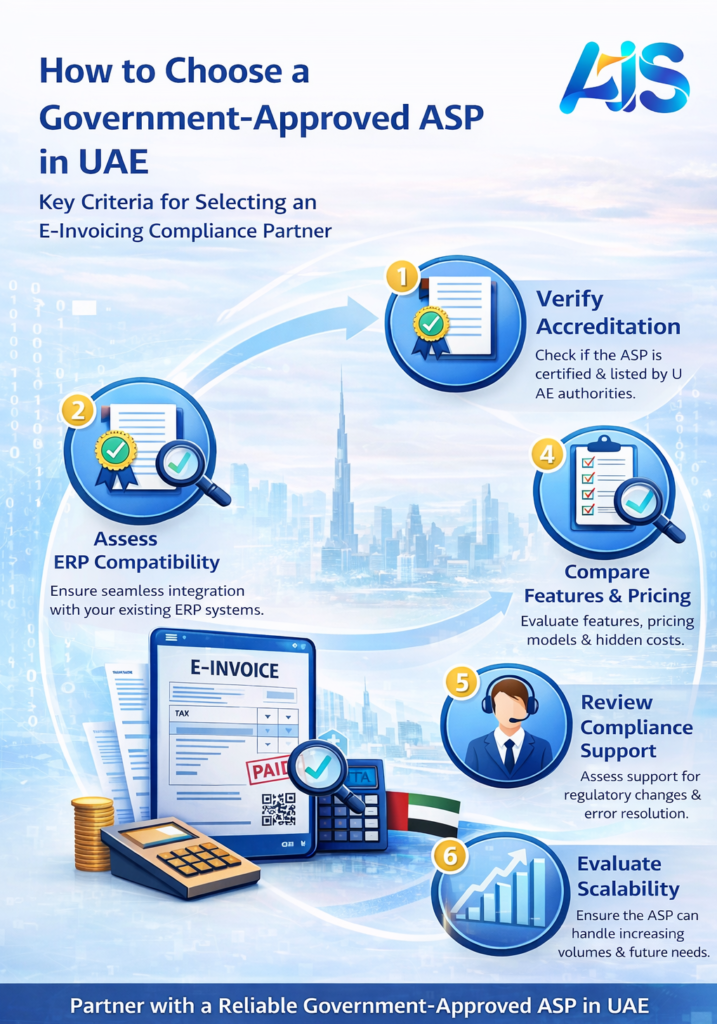
Key Criteria Checklist for ASP Selection
| Criteria | Importance |
| Government Approval | Mandatory |
| ERP Compatibility | Critical |
| Data Security | High |
| SLA & Uptime | High |
| Scalability | High |
| Compliance Expertise | Essential |
| Transparent Pricing | Important |
| Customer Support | Essential |
Red Flags to Avoid
Avoid ASP providers who:
- Cannot show accreditation proof
- Offer unclear pricing
- Lack local UAE expertise
- Have no ERP integration track record?
- Provide no SLA guarantees
- Do not offer sandbox testing
Choosing a non-compliant provider exposes your business to penalties.
Implementation Roadmap with an ASP
After selection, follow this roadmap:
- Contract finalization
- Technical architecture planning
- ERP integration design
- Data mapping
- Testing phase
- User training
- Go-live monitoring
- Ongoing compliance review
Cost of Government-Approved ASP in UAE
Costs vary based on:
- Transaction volume
- ERP complexity
- Customization needs
- Support level
Typical cost elements:
- One-time setup fee
- API integration cost
- Monthly subscription
- Per invoice fee
- Compliance update fees
Low-cost providers may compromise service quality.
Benefits of Choosing the Right ASP for UAE Einvoicing
✔ Smooth compliance transition
✔ Reduced VAT risks
✔ Automated tax validation
✔ Faster invoice approval
✔ Improved cash flow
✔ Strong audit readiness
✔ Long-term regulatory security
A strategic ASP partner becomes part of your compliance ecosystem.
Future of ASP in UAE
As UAE expands digital tax reporting, ASPs may support:
- B2C reporting
- Cross-border invoice validation
- Real-time analytics
- AI-driven fraud detection
- Automated reconciliation
Choosing the right partner ensures adaptability.
Frequently Asked Questions (FAQs)
What is a Government-Approved ASP in UAE?
An accredited service provider authorized to transmit and validate structured e-invoices under UAE regulations.
Is using an ASP mandatory in UAE?
Under structured e-invoicing frameworks, businesses must connect through approved providers.
How can I verify if an ASP is approved?
Request accreditation proof and confirm with official regulatory listings.
Can my ERP connect directly without an ASP?
Most CTC models require accredited intermediaries.
What happens if my ASP fails?
You may face invoice rejection, reporting delays, or compliance penalties.
How much does an ASP cost in UAE?
Costs depend on transaction volume, integration needs, and support level.
Are SMEs required to use ASPs?
If VAT registered and within mandate scope, yes.
What security standards should an ASP meet?
ISO certifications, encryption protocols, and secure authentication frameworks.
How long does ASP implementation take?
Typically 2–6 months depending on ERP complexity.
Can I switch ASP providers later?
Yes, but migration requires careful data handling and re-integration.
The UAE’s digital tax transformation is inevitable. Businesses must prepare by selecting a Government-Approved ASP in UAE that ensures regulatory compliance, secure integration, and long-term scalability.
Rushed decisions lead to compliance risks.
A structured selection process guarantees:
- Smooth implementation
- Reduced penalties
- Operational efficiency
- Sustainable compliance
Evaluate carefully, test thoroughly, and partner strategically.
Prepare Your Business for UAE E-Invoicing with the Right Government-Approved ASP
Don’t wait for the mandate deadline. Ensure seamless compliance, secure ERP integration, and zero invoice rejection risks by partnering with a trusted Government-Approved ASP in UAE.
👉 Book a Free E-Invoicing Readiness Consultation
👉 Get a Compliance Gap Assessment
👉 Speak to Our UAE E-Invoicing Experts Today
Stay compliant. Stay secure. Stay ahead.
