

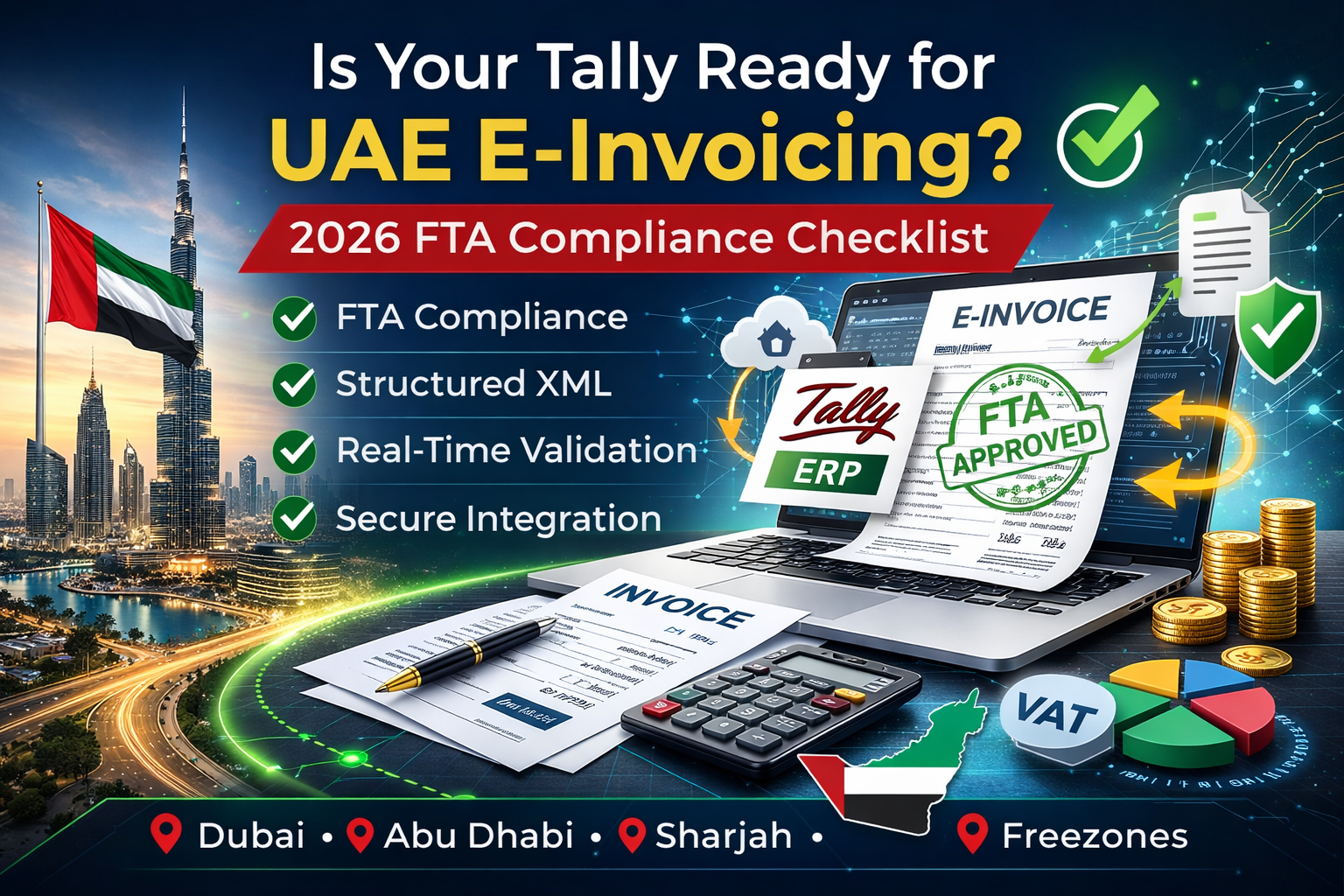
The UAE is moving toward structured electronic invoicing as part of its national tax digitization strategy. If your business uses Tally ERP in Dubai, Abu Dhabi, Sharjah, Ajman, Ras Al Khaimah, Fujairah, Umm Al Quwain, or any UAE freezone, one critical question matters:
Is your Tally system ready for UAE e-invoicing compliance in 2026?
UAE e-invoicing for Tally is not just about generating PDF invoices. It requires structured XML format, validation rules, secure transmission mechanisms, and audit-ready documentation aligned with Federal Tax Authority (FTA) standards.
This compliance checklist will help UAE businesses assess readiness and implement UAE e-invoicing Tally integration before enforcement begins.
What is UAE E-Invoicing and Why It Impacts Tally Users?
UAE e-invoicing refers to a structured electronic invoice system where invoices are:
- Machine-readable (XML format)
- Digitally validated
- Securely transmitted
- Stored with an audit trail
- Compliant with FTA standards
For businesses using Tally, this means configuration and integration are required to ensure invoices are not just generated, but validated and structured correctly.
If you are searching for:
- uae e-invoicing tally
- uae einvoicing tally
- uae e-invoice tally
- uae einvoice tally
- uae e-invoicing for tally
- uae tally e-invoice
You are already in the compliance stage of awareness.
Who Must Implement UAE E-Invoicing in 2026?
Any VAT-registered business operating in:
- Dubai
- Abu Dhabi
- Sharjah
- Ajman
- Ras Al Khaimah
- Fujairah
- Umm Al Quwain
- UAE mainland
- UAE freezones
If you issue taxable invoices, structured e-invoicing will apply.
This includes industries such as:
- Retail
- Wholesale
- Manufacturing
- Construction
- Healthcare
- Logistics
- Professional Services
- Insurance
- FMCG
Tally users in these sectors must prepare for UAE e-invoicing integration now.
UAE E-Invoicing Tally 2026 – Compliance Checklist
Below is a structured readiness checklist for UAE Tally users:
| Compliance Area | Requirement | Status Check |
| VAT Configuration | TRN properly mapped | ✔ / ✘ |
| Invoice Format | Structured XML support | ✔ / ✘ |
| Mandatory Fields | Customer TRN, VAT %, supply type | ✔ / ✘ |
| Validation Rules | Tax calculation accuracy | ✔ / ✘ |
| Digital Transmission | Secure sending mechanism | ✔ / ✘ |
| Audit Trail | Invoice history retention | ✔ / ✘ |
| Error Handling | Rejection correction workflow | ✔ / ✘ |
If your Tally setup fails even one of these, you are not fully compliant with UAE e-invoicing requirements.
How UAE E-Invoicing for Tally Works?
The integration process typically follows these steps:
Step 1: Invoice Creation in Tally
Sales invoice is generated with VAT details.
Step 2: Data Extraction
Invoice data is extracted from:
- Ledger
- Tax configuration
- Customer records
- Item master
Step 3: Structured XML Conversion
Invoice is converted into structured machine-readable format.
Step 4: Validation
System validates:
- VAT calculations
- TRN accuracy
- Invoice numbering sequence
- Mandatory data fields
Step 5: Secure Transmission
Invoice is securely transmitted to the compliance network.
Step 6: Confirmation & Status Update
Acceptance or rejection status is updated inside Tally.
This is how UAE tally e-invoicing becomes fully compliant.

Mainland vs Freezone Compliance
Many businesses assume freezones are exempt. That is incorrect.
| Location | Compliance Required |
| Dubai Mainland | Yes |
| Abu Dhabi | Yes |
| Sharjah | Yes |
| Ajman | Yes |
| Ras Al Khaimah | Yes |
| Fujairah | Yes |
| Umm Al Quwain | Yes |
| UAE Freezones | Yes (if VAT registered) |
If your freezone entity issues taxable invoices, UAE e-invoicing for Tally applies.
Common Mistakes UAE Tally Users Make
- Believing PDF invoices are compliant
- Ignoring structured format requirements
- Not validating VAT calculation logic
- Incorrect TRN formatting
- Manual invoice corrections without audit trail
- No rejection handling workflow
- Delaying implementation until last minute
These mistakes increase compliance risk.
Is Standard Tally Ready for UAE E-Invoicing?
Out-of-the-box Tally installations typically require configuration for:
- Structured XML mapping
- Field validation
- VAT configuration alignment
- Secure integration layer
Both Tally Silver and Tally Gold users must implement compliance updates.
If you are searching for:
- uae e-invoice for tally
- uae einvoicing for tally
- uae tally e-invoicing integration
- tally e-invoicing implementation uae
You likely require system enhancement.
High-Intent Commercial Considerations for UAE Tally Users
Businesses searching for tally e-invoicing services in UAE, tally e-invoice integration in Dubai, tally compliance solutions in Abu Dhabi, or tally e-invoicing partners in Sharjah are typically in the final decision stage. These companies are not exploring e-invoicing; they are evaluating implementation partners and cost structures.
When assessing UAE e-invoicing for Tally, several factors influence implementation cost:
| Component | Cost Driver |
| System Configuration | Complexity of VAT structure and transaction volume |
| Integration Layer | Need for middleware or API-based automation |
| Compliance Testing | Industry-specific validation requirements |
| Training | Staff readiness and onboarding |
| Maintenance | Ongoing compliance updates and support |
Early implementation allows businesses in Dubai, Abu Dhabi, and other UAE emirates to avoid rushed deployments and potential non-compliance penalties.
2026 Implementation Timeline
Preparation Phase – System audit & gap analysis
Configuration Phase – Structured format mapping
Testing Phase – Validation simulation
Deployment Phase – Go-live
Monitoring Phase – Ongoing compliance review
Waiting until enforcement increases operational risk.
Why Businesses in Dubai & Abu Dhabi Must Prioritize Compliance?
Dubai and Abu Dhabi host high volumes of VAT-registered SMEs and enterprise businesses. Early adoption ensures:
- Smooth invoice processing
- Faster payment cycles
- Reduced VAT audit risk
- Stronger compliance posture
- Digital transformation readiness
Sharjah, Ajman, Ras Al Khaimah, Fujairah, and Umm Al Quwain businesses must not assume delay in enforcement.
Benefits of UAE E-Invoicing Tally Integration
- Automated compliance validation
- Reduced manual errors
- Improved financial transparency
- Faster audit readiness
- Stronger data security
- Better VAT reporting accuracy
- Future-ready digital infrastructure
Frequently Asked Questions
Is UAE e-invoicing mandatory for Tally users?
Yes, VAT-registered businesses must comply once phased implementation begins.
Does Tally support UAE structured e-invoice format?
Tally requires configuration and structured XML mapping for compliance.
What is UAE einvoicing tally?
It refers to generating and validating structured electronic invoices using Tally ERP in compliance with UAE FTA standards.
Are UAE freezones required to implement e-invoicing?
Yes, if the entity is VAT registered and issues taxable invoices.
What format is required for UAE e-invoice?
Structured machine-readable XML format.
Can small businesses delay UAE tally e-invoicing?
Delay increases compliance and penalty risk.
How long does tally e-invoicing implementation take?
Typically 2–6 weeks depending on business complexity.
Does tally silver require upgrade for UAE e-invoicing?
Configuration and integration setup are required.
What happens if an invoice fails validation?
It must be corrected and resubmitted.
Is UAE e-invoicing tally different from VAT filing?
Yes. VAT filing is reporting; e-invoicing is structured invoice validation and transmission.
UAE e-invoicing Tally implementation is not optional preparation; it is strategic compliance readiness.
Businesses in Dubai, Abu Dhabi, Sharjah, Ajman, Ras Al Khaimah, Fujairah, Umm Al Quwain, and UAE freezones must ensure:
- Structured invoice format
- VAT validation accuracy
- Secure transmission
- Audit-ready documentation
- Integration preparedness
The question is no longer whether UAE e-invoicing will apply.
The real question is:
Is your Tally ready before enforcement begins?
