


The UAE is entering a new era of digital tax transformation. With the introduction of mandatory electronic invoicing regulations, businesses must ensure their invoicing systems align with the requirements set by the Federal Tax Authority (FTA).
An FTA-compliant e-invoicing solution in UAE is no longer optional; it is a strategic necessity for VAT-registered businesses, ERP users, SMEs, enterprises, healthcare providers, retailers, logistics companies, and service providers operating in the region.
This complete 2026 implementation guide explains:
- What FTA-compliant e-invoicing means?
- Technical and legal requirements
- Compliance structure and validation process
- ERP integration (including SAP)
- Implementation roadmap
- Risk mitigation strategies
- How to choose the right solution provider?
What Is an FTA-Compliant E-Invoicing Solution in UAE?
An FTA-compliant e-invoicing solution is a digital system that generates, validates, transmits, and stores structured electronic invoices in accordance with UAE tax regulations.
Unlike traditional PDF invoices, compliant e-invoices:
- Are issued in structured XML or approved digital formats
- Include mandatory VAT data fields
- Follow FTA validation standards
- Ensure invoice authenticity and integrity
- Are securely transmitted and archived?
An FTA-compliant e-invoicing solution in UAE is a certified digital invoicing system that generates structured electronic invoices aligned with Federal Tax Authority regulations, ensuring VAT accuracy, real-time validation, secure transmission, and audit-ready documentation for 2026 compliance.
Why UAE Businesses Must Prepare for 2026?
The UAE government is implementing e-invoicing to:
- Increase tax transparency
- Reduce VAT fraud
- Improve audit efficiency
- Digitize tax reporting
- Align with global e-invoicing standards
Businesses that fail to comply may face:
- Financial penalties
- VAT audit risks
- Invoice rejection
- Operational disruption
- Reputational damage
Compliance is not just about avoiding penalties; it is about future-proofing your tax and ERP ecosystem.
Core Requirements of FTA-Compliant E-Invoicing
To meet compliance standards, your system must support:
Structured Invoice Format
Invoices must be generated in structured digital format (XML or government-approved schema).
Mandatory Data Fields
- Supplier TRN
- Buyer TRN (where applicable)
- VAT breakdown
- Invoice issue date
- Unique invoice number
- Tax amount and currency
- Supply type
Invoice Validation
Invoices must pass compliance checks before submission or reporting.
Secure Transmission
Invoices must be transmitted securely to authorized platforms or intermediaries.
Digital Archiving
Invoices must be stored electronically for audit and legal requirements.
Types of E-Invoicing Models in UAE
The UAE is expected to implement a structured framework that may resemble global models such as:
- Clearance model (real-time validation before issuance)
- Reporting model (post-issuance reporting to authority)
- Hybrid model
Businesses must prepare for:
Industries Most Impacted
While all VAT-registered entities will eventually adopt e-invoicing, the following sectors face higher compliance complexity:
- Healthcare
- Retail & eCommerce
- Manufacturing
- Logistics & supply chain
- Construction
- Professional services
- F&B chains
Large enterprises using ERP systems require integration-level compliance, not manual invoicing tools.
ERP Integration: The Smart Way to Achieve Compliance
Businesses using ERP systems must integrate their invoicing module with e-invoicing requirements.
SAP ERP Integration Example
Companies using SAP Business One or SAP S/4HANA must:
- Enable structured invoice output
- Map VAT codes properly
- Implement API connectors
- Ensure TRN validation logic
- Automate compliance checks
Manual invoice upload tools are not scalable for medium and large businesses.
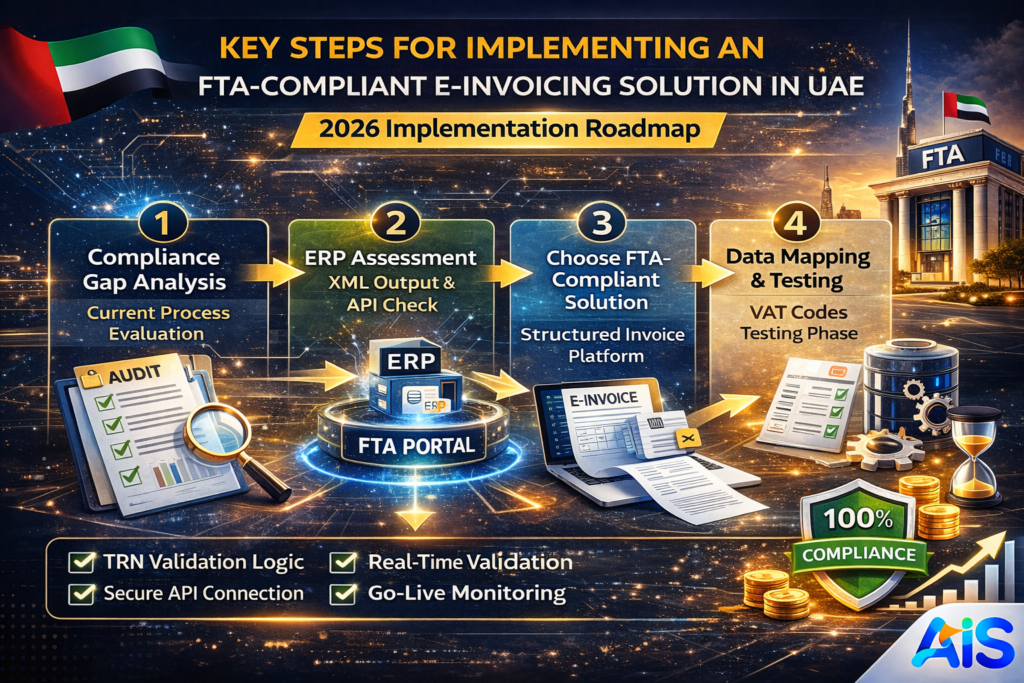
Step-by-Step Implementation Roadmap (2026 Ready)
Step 1: Compliance Gap Analysis
Evaluate current invoicing process.
Step 2: ERP Assessment
Check whether your ERP supports:
- XML output
- API connectivity
- VAT rule automation
Step 3: Choose an FTA-Compliant Solution
Select a provider that offers:
- Structured invoice generation
- Real-time validation
- Secure data transmission
- Cloud-based audit storage
Step 4: Data Mapping & Testing
Map:
- VAT codes
- Customer master data
- Product tax categories
Conduct sandbox testing before live deployment.
Step 5: Go-Live & Monitoring
Launch the system and monitor:
- Invoice rejection rate
- VAT mismatch errors
- Compliance dashboard reports
Common Compliance Mistakes to Avoid
- Missing TRN details
- Incorrect VAT calculation
- Duplicate invoice numbers
- Manual editing after validation
- Failure to archive properly
- Delayed reporting
- Not upgrading ERP version
Avoiding these errors reduces penalty risk.
How to Choose the Right E-Invoicing Solution Provider in UAE?
When selecting a partner, evaluate:
🔹 Technical Expertise
Do they understand ERP integration?
🔹 Regulatory Knowledge
Do they follow FTA framework updates?
🔹 Industry Experience
Have they implemented similar projects?
🔹 Data Security Standards
Is the platform secure and encrypted?
🔹 Scalability
Can the solution handle business growth?
Benefits of Early Adoption
- Reduced compliance stress
- Competitive advantage
- Better cash flow visibility
- Automated VAT reporting
- Strong audit preparedness
- Improved data accuracy
Compliance Checklist for UAE Businesses
✔ Structured XML invoice generation
✔ VAT data validation rules
✔ TRN auto-verification
✔ Secure transmission system
✔ Digital archive retention
✔ ERP integration capability
✔ User training completed
✔ Compliance monitoring dashboard
Future of E-Invoicing in UAE
E-invoicing is part of a broader digital transformation strategy. Over time, we may see:
- Real-time VAT reporting
- AI-driven tax audits
- Automated compliance scoring
- Cross-border digital tax alignment
Businesses that modernize now will benefit long-term.
Frequently Asked Questions (FAQ)
What is an FTA-compliant e-invoicing solution in UAE?
It is a digital system that generates and transmits structured electronic invoices aligned with Federal Tax Authority regulations.
Is e-invoicing mandatory in UAE for 2026?
Yes, VAT-registered businesses must prepare for mandatory electronic invoicing compliance.
What format is required for UAE e-invoices?
Structured digital format such as XML aligned with FTA schema requirements.
Can SAP ERP be integrated with UAE e-invoicing?
Yes, SAP systems can be configured and integrated to meet compliance requirements.
What happens if a business fails to comply?
Businesses may face penalties, audit risks, and invoice rejection.
Do SMEs need an ERP system for compliance?
Not necessarily, but structured digital invoicing software is required.
How long should e-invoices be stored?
As per VAT record retention regulations, invoices must be archived digitally for audit purposes.
What are the key compliance fields in UAE e-invoicing?
Supplier TRN, buyer TRN, VAT breakdown, invoice number, issue date, tax amount, and currency.
Is real-time reporting required in UAE?
The final implementation model will define whether real-time or periodic reporting is required.
How can businesses prepare early?
Conduct a compliance audit, upgrade ERP systems, and implement a certified e-invoicing solution provider.
An FTA-compliant e-invoicing solution in UAE is not simply a regulatory requirement; it is a strategic upgrade to your finance ecosystem.
Preparing for 2026 means:
- Upgrading ERP systems
- Automating VAT compliance
- Implementing structured invoice formats
- Choosing experienced integration partners
The sooner businesses act, the smoother the transition will be.
Prepare for UAE 2026 E-Invoicing Compliance Today
Don’t wait for penalties or last-minute compliance stress. Ensure your business is fully aligned with FTA regulations with a secure, scalable, and ERP-integrated e-invoicing solution.
👉 Book a Free Compliance Assessment with AIS Business Corp Today

