


The UAE E-Invoicing Mandate 2026–2027 marks one of the most significant digital tax transformations in the history of the United Arab Emirates. Following the success of VAT implementation in 2018 and Corporate Tax introduction in 2023, the government is now moving toward a PEPPOL-based electronic invoicing framework to enhance transparency, reduce VAT fraud, and enable real-time tax reporting.
If you are a VAT-registered business operating in the UAE, this guide will help you understand:
- What the UAE e-invoicing mandate means
- Regulatory requirements and compliance obligations
- The PEPPOL PINT AE framework
- The DCTCE 5-Corner Model
- ERP integration strategy (SAP, Oracle, NetSuite, Dynamics)
- Implementation timeline and roadmap
- Penalties and deadlines
- How to prepare your organization
This is your complete compliance blueprint.
1. What Is the UAE E-Invoicing Mandate?
The UAE e-invoicing mandate is a regulatory framework introduced by the Federal Tax Authority (FTA) requiring VAT-registered businesses to issue, transmit, and receive invoices electronically in a structured digital format through an accredited service provider.
Unlike traditional PDF invoices, UAE e-invoices must:
- Be generated in structured XML/UBL format
- Follow PEPPOL PINT AE standards
- Be transmitted through an accredited Access Point
- Be validated and reported digitally
This ensures authenticity, integrity, and real-time compliance.
2. Why is UAE Implementing E-Invoicing?
The UAE’s objectives include:
1️⃣ Combat VAT Fraud
Digital traceability reduces fake invoicing and tax evasion.
2️⃣ Improve Tax Collection Efficiency
Automated reporting enhances revenue monitoring.
3️⃣ Accelerate Digital Transformation
Supports UAE’s digital economy vision.
4️⃣ Enable Real-Time Reporting
Moves from periodic reporting to near real-time invoice validation.
3. UAE PEPPOL-Based E-Invoicing Framework
The UAE has adopted the PEPPOL 5-Corner Model, customized for local regulations.
What Is PEPPOL?
PEPPOL (Pan-European Public Procurement Online) is an international e-invoicing network standard enabling secure cross-border electronic document exchange.
The UAE adaptation ensures:
- Standardized invoice format (UBL)
- Interoperability between systems
- Secure transmission via certified providers
4. Understanding the DCTCE 5-Corner Model
The UAE follows the DCTCE 5-Corner architecture:
- Supplier
- Supplier Access Point
- Central Platform (FTA Oversight)
- Buyer Access Point
- Buyer
This model ensures:
- Authentication
- Digital signatures
- Secure exchange
- Compliance validation
5. Who Must Comply?
The mandate applies to:
- VAT-registered businesses in UAE
- B2B transactions
- B2G transactions
- Eventually B2C (in later phases)
This includes:
- SMEs
- Enterprises
- Freezone companies
- Mainland companies
6. UAE E-Invoicing 2026-2027 Timeline
Although official phased rollout details may evolve, expected stages include:
Phase 1 – Preparation (2025-2026)
- Framework finalization
- Accreditation of service providers
- Sandbox testing
Phase 2 – Mandatory B2B (2026)
- Large enterprises first
- VAT-registered entities onboarded
Phase 3 – Full Enforcement (2027)
- SMEs
- Wider transaction coverage
Businesses should prepare at least 12–18 months before enforcement.
7. The 14-Day Submission Rule
One major compliance element is structured reporting within a defined timeframe (commonly referenced as the 14-day rule under digital reporting models).
Failure to transmit invoices within the defined timeframe may lead to:
- Administrative penalties
- VAT return mismatches
- Audit risks
8. Invoice Format Requirements
UAE e-invoices must follow:
- XML structured format
- UBL (Universal Business Language)
- PINT AE compliance
- Mandatory tax data fields
Mandatory Data Fields May Include:
- VAT registration numbers
- TRN details
- Invoice ID
- Timestamp
- Tax breakdown
- Line item classification
- Digital signature
PDF-only invoices will not be compliant.
9. ERP Integration Strategy
E-invoicing compliance depends heavily on ERP readiness.
A. SAP Integration
Businesses using:
- SAP S/4HANA
- SAP Business One
Must configure:
- XML mapping
- Digital signature integration
- Middleware connectivity
- PEPPOL access point integration
B. Oracle Integration
Oracle ERP users must:
- Enable structured invoice generation
- Integrate via certified middleware
C. NetSuite & Dynamics
Cloud ERP platforms require:
- API-based invoice transmission
- Real-time validation logic
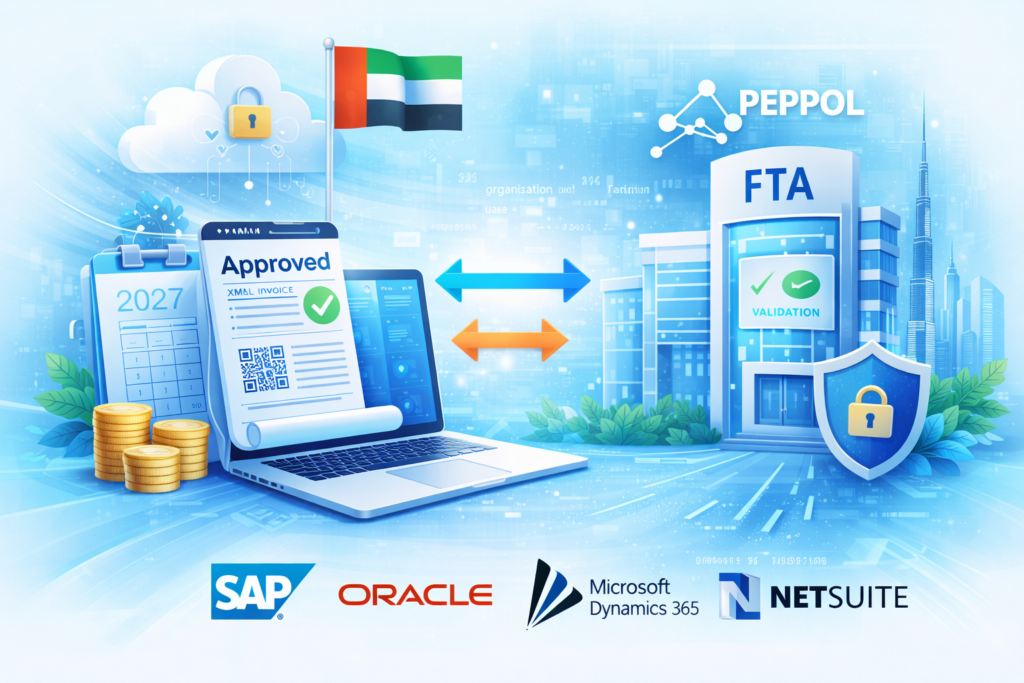
10. ERP to FTA Integration Architecture
Typical integration flow:
ERP → Middleware → PEPPOL Access Point → FTA Validation → Buyer
A compliant architecture includes:
- API connectors
- Error validation engine
- Audit logs
- Compliance dashboard
11. Role of Accredited Service Providers (ASP)
Businesses cannot directly connect to the central network.
They must use:
Choosing the right provider is critical for:
- Data security
- Regulatory updates
- SLA compliance
- Audit support
12. Freezone & Mainland Implications
The mandate applies across:
- DMCC
- JAFZA
- Abu Dhabi Freezones
- Sharjah Freezones
- Ras Al Khaimah
- Ajman
- Mainland UAE
Freezone status does not exempt VAT-registered businesses.
13. Penalties for Non-Compliance
Although official penalty schedules may evolve, risks include:
- Administrative fines
- Invoice rejection
- VAT recovery disallowance
- Audit investigations
- Suspension of tax privileges
Early preparation avoids last-minute compliance stress.
14. Corporate Tax & E-Invoicing Connection
With Corporate Tax now active in the UAE, e-invoicing enhances:
- Revenue tracking
- Expense validation
- Transfer pricing documentation
- Tax audit readiness
Digital invoices create reliable audit trails.
15. Implementation Roadmap for Businesses
Here’s a recommended roadmap:
Step 1 – Compliance Gap Assessment
Review ERP, invoicing workflows, VAT setup.
Step 2 – Technical Readiness
Enable:
Step 3 – Choose ASP
Select accredited provider.
Step 4 – Sandbox Testing
Test invoice flows.
Step 5 – Staff Training
Train finance & IT teams.
Step 6 – Go Live Before Mandate
16. How to Prepare Now (2025 Action Plan)?
- Conduct ERP audit
- Map invoice data fields
- Clean master data
- Evaluate middleware
- Monitor FTA announcements
- Budget for implementation
Early movers gain competitive advantage.
17. Benefits Beyond Compliance
E-invoicing is not just regulatory.
It improves:
- Cash flow speed
- Invoice accuracy
- Automation
- Reduced manual work
- Fraud prevention
- Data-driven insights
18. Data Security & Residency
Businesses must ensure:
- UAE data residency compliance
- Encrypted transmission
- Secure API endpoints
- Backup & disaster recovery
Cybersecurity readiness is essential.
19. Real-Time Reporting & Audit Readiness
Digital reporting enables:
- Faster audits
- Reduced compliance burden
- Transparent tax environment
- Lower dispute risk
Organizations that automate compliance reduce long-term tax exposure.
Frequently Asked Questions
Is UAE e-invoicing mandatory in 2026?
Yes, phased mandatory implementation is expected starting 2026.
Does it apply to SMEs?
Yes, VAT-registered SMEs will be covered.
Are PDFs allowed?
No, structured XML format is required.
Is PEPPOL mandatory?
Yes, UAE framework is PEPPOL-based.
Do Freezone companies need compliance?
Yes, if VAT registered.
What ERP systems are supported?
SAP, Oracle, NetSuite, Dynamics and others.
What happens if invoices are rejected?
They must be corrected and retransmitted.
Will B2C be included?
Possibly in later phases.
Do we need middleware?
Most ERP systems require middleware integration.
When should we start preparation?
Immediately.
The UAE E-Invoicing Mandate 2026–2027 is more than a compliance obligation; it represents a structural transformation of tax reporting in the United Arab Emirates.
VAT-registered businesses must:
- Understand PEPPOL standards
- Upgrade ERP systems
- Integrate accredited service providers
- Align finance and IT departments
- Prepare before enforcement deadlines
Organizations that act early will avoid penalties, reduce compliance risks, and gain operational efficiency.
The transition to digital VAT reporting is inevitable. The question is not whether to comply – but how strategically you implement it.

