


Why UAE Businesses Must Act Now?
The United Arab Emirates is moving toward structured electronic invoicing as part of its broader digital tax transformation agenda. Under the supervision of the Federal Tax Authority (FTA), businesses operating in the UAE will need to implement compliant e-invoicing frameworks aligned with global standards.
For companies using Cloud ERP systems, this is not just a compliance upgrade. It is a strategic opportunity to:
- Automate VAT reporting
- Improve invoice accuracy
- Strengthen audit readiness
- Enable real-time tax transparency
- Future-proof financial operations
This comprehensive guide provides a step-by-step roadmap for implementing UAE e-invoicing for enterprises, SMEs, finance leaders, CIOs, and ERP administrators.
Understanding UAE E-Invoicing Framework
UAE e-invoicing is expected to follow a structured data model similar to Peppol-based frameworks adopted globally. It is anticipated to include:
- Structured XML invoices
- Real-time or near real-time reporting
- Accredited Service Provider (ASP) model
- Secure digital signatures
- Data validation before submission
Unlike PDF invoicing, structured e-invoicing ensures:
- Machine-readable formats
- Automated compliance checks
- Secure government validation
- Fraud prevention
For Cloud ERP users, this means integration at both application and data architecture levels.
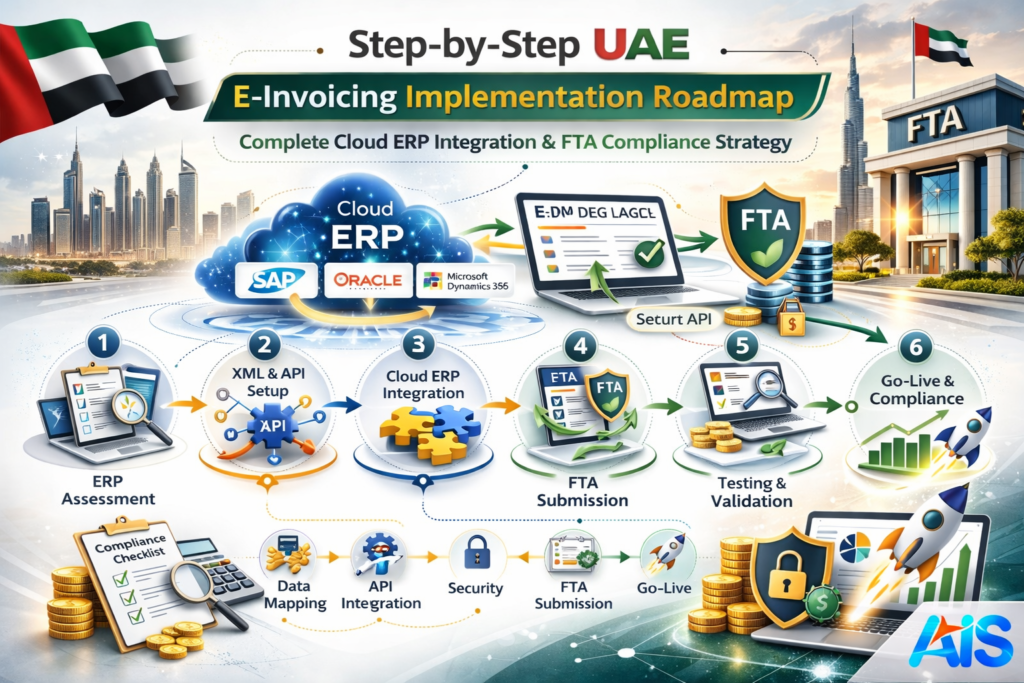
Phase 1: Regulatory & Compliance Assessment
Before touching technology, businesses must understand compliance obligations.
Key Actions:
- Study FTA guidelines
- Identify transaction types (B2B, B2G, B2C)
- Review VAT registration details
- Map reporting frequency
- Understand invoice data fields required
Why This Step Matters?
Incorrect configuration at this stage leads to:
- Rejected invoices
- VAT penalties
- System redesign costs
- Operational delays
Compliance must drive architecture, not the other way around.
Phase 2: ERP Readiness Assessment
Not all ERP systems are natively ready for structured e-invoicing.
Evaluate:
- ERP version compatibility
- Cloud deployment model
- API capability
- XML generation support
- Digital signature integration
- Data validation tools
If you are using:
- SAP
- Oracle
- Microsoft Dynamics
- Custom ERP
You must assess whether native connectors exist or middleware is required.
Output of This Phase:
✔ ERP Gap Analysis Report
✔ Integration Architecture Blueprint
✔ Risk Assessment Matrix
Phase 3: Data Mapping & Invoice Standardization
This is one of the most critical stages.
Tasks Include:
- Mapping ERP fields to UAE structured XML schema
- Standardizing VAT codes
- Validating TRN details
- Configuring invoice numbering logic
- Structuring line-item level tax data
Poor data mapping is the #1 reason for e-invoice rejection globally.
Pro Tip:
Implement automated validation rules inside ERP before submission.
Phase 4: Selecting Integration Model (Direct vs ASP)
Businesses generally choose between:
1️⃣ Direct API Integration with FTA
- Real-time submission
- Higher control
- Requires internal IT capability
2️⃣ Accredited Service Provider (ASP) Model
- Third-party validation layer
- Reduced compliance burden
- Faster implementation
Decision Factors:
- Transaction volume
- Internal IT strength
- Budget
- Compliance complexity
- Industry sector
Phase 5: Middleware & API Configuration
Integration requires secure API-based communication.
Technical Requirements:
- RESTful APIs
- OAuth authentication
- Encryption standards
- Digital certificate management
- Secure token validation
Security Layer Must Include:
- End-to-end encryption
- Role-based access
- Audit logging
- Data retention compliance
This phase ensures secure transmission between:
ERP → Middleware → FTA Platform
Phase 6: Testing & Sandbox Validation
Never go live without sandbox testing.
Test Scenarios:
- Invoice creation
- Credit notes
- Debit notes
- Invoice cancellation
- VAT adjustments
- Cross-border transactions
Validate:
- XML format accuracy
- TRN verification
- Tax calculation
- Digital signature compliance
- Rejection handling
A strong UAT phase prevents compliance disruption.
Phase 7: Change Management & Team Training
Technology alone does not ensure success.
Train:
- Finance teams
- IT teams
- Compliance officers
- Accounts receivable staff
- Internal auditors
Focus Areas:
- Invoice lifecycle
- Error handling
- Rejection workflows
- Compliance monitoring
- Reporting dashboards
Organizational readiness reduces resistance and improves adoption.
Phase 8: Go-Live & Monitoring
Before go-live, verify:
✔ Production API access
✔ Digital certificates
✔ Backup procedures
✔ Monitoring dashboard
✔ Escalation matrix
Post Go-Live Monitoring:
- Rejection rate tracking
- API response time
- Tax reporting accuracy
- Audit trail verification
- Compliance logs
Continuous monitoring ensures regulatory alignment.
Phase 9: Audit Readiness & Documentation
FTA audits may require:
- Invoice logs
- Submission timestamps
- Error reports
- Correction workflows
- VAT reconciliation reports
Maintain:
- Digital archive
- Secure document storage
- Automated reconciliation
- Version-controlled compliance records
Audit readiness reduces penalty risks.
Phase 10: Future-Proofing Your E-Invoicing Strategy
UAE e-invoicing will evolve.
Businesses should prepare for:
- Real-time clearance model
- Cross-border digital trade
- AI-based tax validation
- Automated fraud detection
- Expanded B2C reporting
Future-proof strategies include:
- Scalable cloud ERP
- Modular API design
- Continuous compliance updates
- Digital transformation roadmap
Common UAE E-Invoicing Implementation Mistakes
- Treating it as an IT-only project
- Ignoring VAT reconciliation
- Poor XML mapping
- Skipping sandbox testing
- Not training finance staff
- Underestimating change management
- Choosing the wrong ASP
- Delaying implementation
- Weak cybersecurity layer
- Not planning for scalability
Avoiding these ensures smooth compliance.
Benefits of Proper UAE E-Invoicing Implementation
- Reduced VAT errors
- Faster invoice processing
- Improved cash flow
- Stronger compliance posture
- Automated tax reporting
- Lower audit risk
- Enhanced data transparency
- Reduced fraud
- Improved operational efficiency
- Competitive advantage
E-invoicing is not just regulation; it is transformation.
How Aiscorp.ai helps Businesses Implement UAE E-Invoicing?
AISCorp.ai specializes in:
- Cloud ERP implementation
- UAE e-invoicing integration
- FTA compliance architecture
- Middleware API development
- ERP upgrade & migration
- Secure digital tax transformation
With structured deployment methodology and regulatory expertise, AISCorp.ai enables businesses to:
- Achieve seamless ERP-to-FTA connectivity
- Reduce implementation risks
- Accelerate go-live timelines
- Maintain long-term compliance
FAQs on UAE E-Invoicing Implementation
What is UAE e-invoicing?
UAE e-invoicing is a structured electronic invoicing system requiring businesses to generate and submit tax-compliant invoices in a standardized XML format integrated with government systems.
Who must comply with UAE e-invoicing regulations?
VAT-registered businesses operating in the UAE will be required to comply once the mandate becomes effective.
Is PDF invoicing allowed under UAE e-invoicing?
No. Structured XML or machine-readable formats are expected to replace traditional PDFs for compliance reporting.
Does UAE e-invoicing require real-time reporting?
The framework is expected to move toward near real-time validation and submission via API integration.
How does Cloud ERP integrate with UAE e-invoicing?
Cloud ERP integrates via secure APIs or accredited service providers, mapping structured invoice data to government systems.
What happens if an invoice is rejected?
Rejected invoices must be corrected and resubmitted after resolving validation errors.
Is middleware mandatory?
Not always. It depends on ERP capability and integration model selected.
How long does implementation take?
Typically 8–16 weeks depending on ERP complexity, transaction volume, and readiness.
What are penalties for non-compliance?
Penalties may include financial fines, VAT disallowance, and compliance audits.
Why choose Aiscorp.ai for UAE e-invoicing integration?
Aiscorp.ai provides end-to-end strategy, ERP integration, API security, compliance monitoring, and audit-ready architecture designed for UAE regulatory standards.
UAE e-invoicing implementation is not merely a regulatory upgrade; it is a strategic digital transformation initiative.
Businesses that adopt a structured, step-by-step roadmap will gain:
- Compliance confidence
- Operational automation
- Financial transparency
- Scalable cloud architecture
- Competitive readiness
The time to prepare is now.
If your organization is planning Cloud ERP integration for UAE e-invoicing, a structured roadmap combined with expert guidance ensures compliance, efficiency, and long-term success.
