


The UAE e-invoicing mandate is reshaping how businesses issue, validate, and report invoices. For companies running Oracle NetSuite ERP, this is not a minor update; it is a structural compliance shift.
If your organization operates in Dubai, Abu Dhabi, Sharjah, Ajman, Ras Al Khaimah, Fujairah, Umm Al Quwain, or any UAE freezone, and you are searching for:
- UAE e-invoicing Oracle NetSuite
- UAE einvoicing Oracle NetSuite
- UAE e-invoice Oracle NetSuite
- UAE Oracle NetSuite e-invoicing
- UAE e-invoicing for Oracle NetSuite
- Oracle NetSuite UAE e-invoice integration
This blueprint gives you the clarity and execution strategy required for 2026–2027 compliance.
Why UAE E-Invoicing Matters for Oracle NetSuite Users?
The UAE Federal Tax Authority (FTA) is introducing structured electronic invoicing using the Peppol framework and PINT-AE format. Traditional invoice formats such as PDF attachments or manually generated documents will not qualify as compliant electronic invoices.
Instead, invoices must:
- Be generated in structured XML format
- Follow PINT-AE data standards
- Be validated automatically
- Be transmitted in real time via a certified Peppol Accredited Service Provider (ASP)
- Receive acknowledgment from the FTA
Oracle NetSuite does not natively transmit invoices through Peppol or generate UAE PINT-AE structured XML automatically.
That means integration is mandatory.
UAE E-Invoicing Timeline (2026-2027)
The rollout is phased to ensure smooth adoption across sectors.
| Phase | Category | Expected Timeline |
| Pilot | Selected voluntary businesses | July 2026 |
| Phase 1 | Large enterprises | January 2027 |
| Phase 2 | SMEs & remaining VAT-registered businesses | July 2027 |
This applies to mainland and freezone entities alike.
What UAE E-Invoicing Means for Oracle NetSuite?
Oracle NetSuite is a powerful cloud ERP for finance, billing, multi-entity accounting, and VAT reporting. However, UAE e-invoicing introduces new requirements beyond standard ERP functionality.
NetSuite must now:
- Extract structured invoice data
- Convert invoice into PINT-AE compliant XML
- Transmit invoice via Peppol-certified ASP
- Receive FTA validation status
- Update invoice records automatically
- Maintain digital audit trail
Without this structured workflow, invoices may be rejected or non-compliant.
How UAE Oracle NetSuite E-Invoicing Integration Works?
Below is the standard integration architecture for UAE e-invoicing Oracle NetSuite environments.
Step 1: Invoice Data Extraction
Data is retrieved from NetSuite AR module:
- Seller TRN
- Buyer TRN
- Invoice number
- Line items
- VAT percentage
- Taxable amount
- Currency
- Payment terms
Step 2: Data Mapping to PINT-AE Format
Invoice data is transformed into structured XML format compliant with UAE specifications.
This stage ensures:
- Mandatory field validation
- VAT structure accuracy
- Invoice numbering consistency
- Duplicate prevention
Step 3: Peppol Transmission
The structured XML invoice is transmitted through a certified Peppol Accredited Service Provider.
Step 4: Real-Time FTA Validation
FTA performs:
- Schema validation
- Tax registration verification
- Field accuracy checks
- Duplicate invoice review
Step 5: Status Update in NetSuite
The ERP automatically receives:
- Accepted confirmation
- Rejected status
- Error details (if applicable)
This closes the compliance loop.
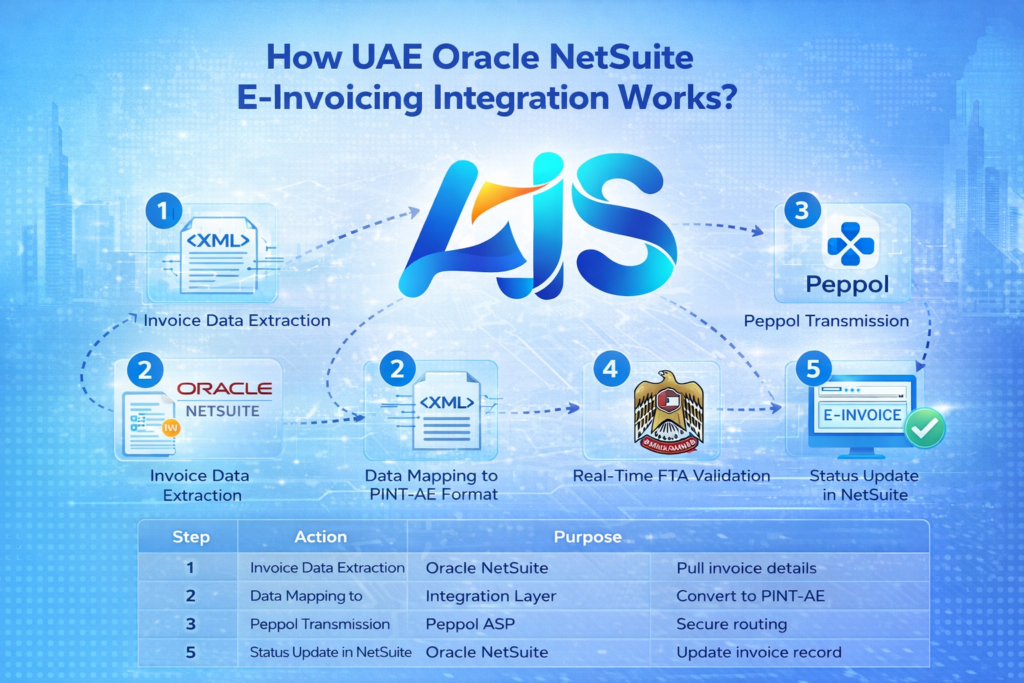
Technical Flow Summary
| Stage | System Involved | Purpose |
| Data Extraction | Oracle NetSuite | Pull invoice details |
| XML Mapping | Integration Layer | Convert to PINT-AE |
| Transmission | Peppol ASP | Secure routing |
| Validation | FTA | Compliance verification |
| Status Return | NetSuite | Update invoice record |
High-Intent Commercial Relevance
Businesses searching for the following terms are actively preparing for implementation:
- Oracle NetSuite e-invoicing solution UAE
- NetSuite e-invoice integration Dubai
- FTA compliant Oracle NetSuite integration
- Peppol ASP for Oracle NetSuite UAE
- Oracle NetSuite e-invoicing implementation partner
This is not educational curiosity.
It is execution intent.
Industry-Specific Impact
Insurance Sector
Insurance companies face heightened compliance requirements due to:
- Policy-based billing structures
- High transaction volume
- Audit-sensitive financial reporting
UAE insurance e-invoicing Oracle NetSuite integration must handle structured tagging and multi-branch validation.
Retail & E-Commerce
Retail companies require:
- High-volume real-time validation
- Fast invoice generation
- Automated correction workflows
Construction & Manufacturing
These sectors need:
- Project-based billing integration
- Contract-linked invoice references
- VAT breakdown compliance
All industries are included under the mandate.
UAE Freezones and Multi-Entity NetSuite Compliance
Companies operating subsidiaries across:
- DMCC
- JAFZA
- DIFC
- ADGM
- Sharjah Airport Freezone
- RAK Freezone
must ensure each VAT-registered entity complies individually.
Multi-entity NetSuite environments require:
- Entity-specific TRN validation
- Separate Peppol routing
- Centralized compliance dashboard
- Structured reporting per entity
Common Mistakes Businesses Make
- Assuming PDF invoices are sufficient
- Delaying integration until enforcement
- Using non-certified API gateways
- Ignoring structured XML validation
- Failing to test rejection workflows
- Not training finance teams
Proactive preparation avoids disruption.
Financial & Operational Risks of Non-Compliance
Non-compliance may result in:
- Administrative penalties
- VAT claim rejection
- Invoice disputes
- Audit triggers
- Business interruption
- Delayed receivables
The larger risk is operational breakdown – not just fines.
Implementation Timeline for Oracle NetSuite UAE E-Invoicing
A typical implementation timeline:
| Phase | Duration |
| Assessment | 1 week |
| Integration Design | 1 week |
| Development & XML Mapping | 2–3 weeks |
| Peppol Testing | 1–2 weeks |
| Go-Live & Monitoring | 1 week |
Average total duration: 4–8 weeks.
Why Early Implementation is a Strategic Advantage?
Businesses that implement before enforcement:
- Avoid last-minute vendor rush
- Reduce technical stress
- Ensure smooth VAT reporting
- Maintain uninterrupted billing
- Gain audit confidence
Digital tax compliance is moving toward continuous reporting.
Early movers are future-ready.
Why Aiscorp.ai is Positioned to Support UAE Oracle NetSuite E-Invoicing?
Aiscorp specializes in:
- Oracle ERP ecosystems
- Peppol-based integrations
- UAE FTA regulatory alignment
- Structured XML mapping
- Real-time API automation
- Multi-entity freezone compliance
Our approach is engineering-led, not template-based.
We design compliance architecture, not shortcuts.
Frequently Asked Questions
Is UAE e-invoicing mandatory for Oracle NetSuite users?
Yes. All VAT-registered businesses must comply based on the phased rollout schedule.
Does Oracle NetSuite support UAE e-invoicing natively?
No. Integration with a Peppol-certified solution is required.
What format is required for UAE e-invoices?
Invoices must be structured in PINT-AE compliant XML format.
Is Peppol mandatory for UAE e-invoicing?
Yes. Transmission must occur through a certified Accredited Service Provider connected to Peppol.
Are freezone companies required to comply?
Yes, if they are VAT-registered entities.
When does enforcement begin?
Pilot begins July 2026, with phased enforcement into 2027.
What happens if an invoice is rejected?
It must be corrected and resubmitted after reviewing the FTA error code.
Does UAE insurance sector require NetSuite integration?
Yes. Insurance companies must comply like all other sectors.
How long does NetSuite e-invoicing implementation take?
Typically between 4 and 8 weeks depending on complexity.
What are the risks of non-compliance?
Administrative penalties, VAT rejection, operational disruption, and audit exposure.
The UAE e-invoicing mandate is not optional, temporary, or limited to specific industries.
It affects every VAT-registered Oracle NetSuite business across:
- Dubai
- Abu Dhabi
- Sharjah
- Ajman
- Ras Al Khaimah
- Fujairah
- Umm Al Quwain
- All UAE freezones
Structured digital compliance is now the standard.
Businesses that act early secure operational continuity and regulatory confidence.
Oracle NetSuite must evolve with the mandate, and integration is the bridge.
If your organization is preparing for UAE e-invoicing Oracle NetSuite compliance, now is the time to design, integrate, test, and deploy with precision.
