

As the UAE moves toward mandatory structured electronic invoicing, enterprises must rethink their financial systems architecture. Traditional ERP configurations are no longer sufficient to meet upcoming regulatory expectations. Businesses operating in the UAE need a clear, secure, and scalable Cloud ERP UAE e-invoicing integration strategy aligned with 2026 compliance requirements.
Cloud-based ERP systems provide flexibility, automation, and real-time reporting capabilities, making them the ideal foundation for UAE’s digital tax transformation. However, successful integration requires more than system upgrades. It demands architectural planning, regulatory alignment, API connectivity, digital signature implementation, and audit trail management.
This comprehensive guide explains how enterprises can design and implement a compliant cloud ERP integration framework for UAE e-invoicing.
Understanding UAE E-Invoicing Compliance Requirements
Before building an integration strategy, enterprises must understand what compliance involves.
The UAE e-invoicing system is expected to include:
- Structured XML invoice format
- Real-time or near-real-time reporting
- Secure digital signatures
- Accredited Service Provider (ASP) connectivity
- Audit trail retention
- Standardized data schema
The objective is to create transparency, reduce VAT fraud, and automate tax reporting processes.
For cloud ERP users, this means invoice data must be generated, validated, transmitted, and archived in a structured digital format, without manual intervention.
Why Cloud ERP is Critical for UAE E-Invoicing?
Cloud ERP platforms offer advantages that traditional on-premise systems cannot easily match:
1. Scalability
Handle large transaction volumes without infrastructure upgrades.
2. Real-Time Processing
Support instant invoice validation and reporting.
3. Automatic Updates
Stay aligned with regulatory changes.
4. API Connectivity
Enable seamless communication with government portals and service providers.
5. Security Infrastructure
Built-in encryption and access controls.
Enterprises using SAP S/4HANA Cloud, Oracle Cloud ERP, Microsoft Dynamics 365, or other cloud systems are already positioned for digital compliance; if integration is properly configured.
Core Components of a Cloud ERP E-Invoicing Integration Strategy
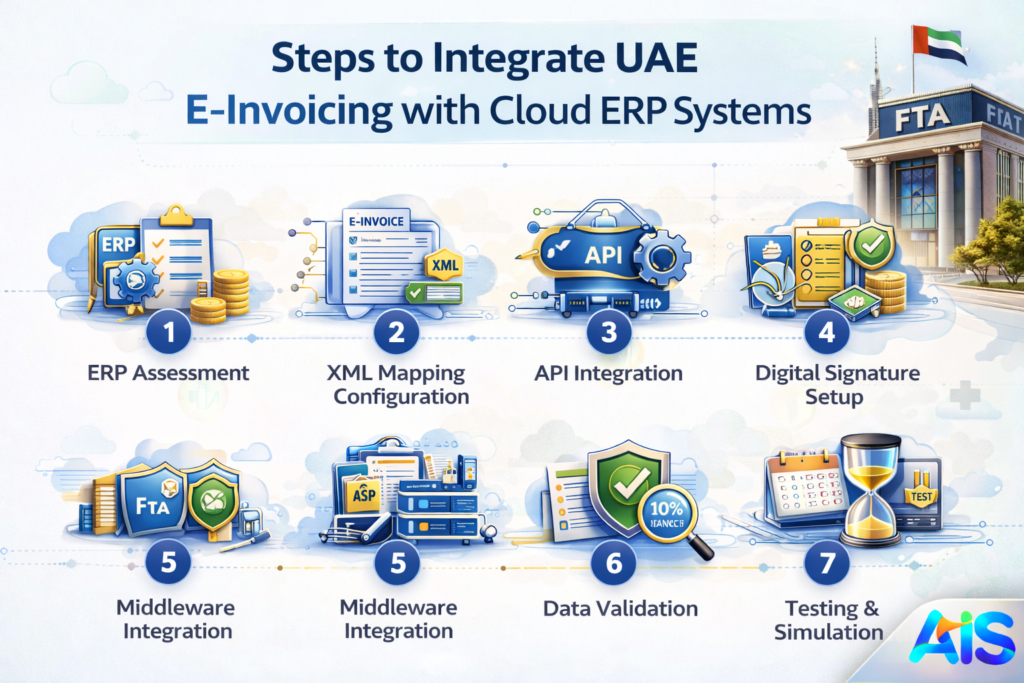
A successful strategy includes five essential pillars:
Pillar 1: Compliance Architecture Design
Enterprises must design a compliance architecture that includes:
- Invoice data extraction layer
- XML transformation engine
- Validation module
- Digital signature component
- API transmission gateway
- Secure archiving system
This architecture ensures that invoice data flows securely from ERP to regulatory platforms.
Pillar 2: API & Middleware Integration
There are two integration approaches:
Direct API Integration
ERP connects directly with regulatory platform or ASP.
Advantages:
- Faster processing
- Fewer components
- Lower middleware cost
Challenges:
- ERP customization required
- Maintenance complexity
Middleware-Based Integration
ERP sends data to middleware, which handles transformation and transmission.
Advantages:
- Flexibility
- Easier upgrades
- Centralized monitoring
Challenges:
- Additional cost
- Requires governance structure
Enterprises with high transaction volumes often prefer middleware for scalability.
Pillar 3: Digital Signature & Security Framework
Security is non-negotiable.
Integration strategy must include:
- Public key infrastructure (PKI)
- Digital certificates
- Data encryption (in transit & at rest)
- Role-based access control
- Two-factor authentication
Security gaps may result in compliance violations.
Pillar 4: Data Governance & Validation Controls
E-invoicing requires accurate, structured data.
Enterprises must implement:
- Mandatory field validation
- Tax code accuracy checks
- Master data cleansing
- Error handling workflows
- Automated reconciliation
Incorrect VAT codes or missing fields may lead to rejection.
Pillar 5: Archiving & Audit Trail Management
UAE regulations require long-term retention of digital invoices.
Cloud ERP strategy must ensure:
- Secure document storage
- Timestamped audit logs
- Immutable record retention
- Retrieval capability during audits
Audit readiness should be built into system design.
ERP-Specific Considerations
SAP S/4HANA Cloud
- Use SAP Document Compliance module
- Configure tax determination logic
- Enable XML output generation
- Integrate with SAP Integration Suite
Oracle Cloud ERP
- Configure E-Business Tax engine
- Set up Oracle Integration Cloud
- Automate validation checks
Microsoft Dynamics 365
- Configure electronic reporting module
- Enable API connectors
- Validate tax mapping
Each ERP requires specific customization for UAE e-invoicing.
Cloud UAE E-Invoicing Implementation Roadmap for 2024–2026
Phase 1: Assessment (2024)
- Conduct ERP gap analysis
- Review invoice generation logic
- Identify master data inconsistencies
- Develop compliance blueprint
Phase 2: Development & Testing (2025)
- Configure XML mapping
- Integrate APIs
- Implement digital signature module
- Run sandbox test cases
- Conduct user acceptance testing
Phase 3: Go-Live & Monitoring (2026)
- Activate live transmission
- Monitor rejection reports
- Conduct compliance audit simulation
- Optimize performance
Cloud Einvoice UAE Common Integration Challenges
- Legacy customizations
- Data inconsistency
- Incorrect VAT mapping
- API downtime
- Resistance from finance teams
- Budget allocation delays
Proactive planning eliminates most obstacles.
Cloud UAE E-Invoicing Risk Mitigation Strategy
Enterprises must manage:
- Regulatory risk
- Operational risk
- Data security risk
- Reputational risk
Mitigation steps:
- Quarterly compliance review
- Automated reconciliation
- Internal audit testing
- Backup transmission systems
- Governance committee oversight
Cloud UAE Einvoicing Cost-Benefit Analysis
Costs Include:
- ERP customization
- Middleware licensing
- Digital certificates
- Implementation consulting
- Training
Benefits Include:
- Reduced penalties
- Automated VAT reporting
- Faster invoice processing
- Audit readiness
- Improved financial visibility
- Competitive advantage
Long-term ROI outweighs short-term costs.
Enterprise Best Practices
- Start early
- Align IT and finance teams
- Choose experienced integration partners
- Document compliance processes
- Test thoroughly before go-live
- Monitor continuously
Integration should be treated as a strategic project, not just an IT upgrade.
Future-Proofing Your Cloud ERP Strategy
The UAE may expand digital tax reporting beyond invoicing.
Enterprises should:
- Adopt scalable architecture
- Ensure modular integration
- Prepare for cross-border reporting
- Implement AI-driven anomaly detection
- Strengthen cybersecurity posture
Digital tax compliance will continue evolving.
Benefits of a Structured Cloud ERP Integration
Enterprises that implement structured integration gain:
- 100% invoice traceability
- Faster VAT reconciliation
- Improved working capital visibility
- Stronger corporate governance
- Enhanced investor confidence
Compliance becomes automated rather than reactive.
Frequently Asked Questions
What is a cloud ERP e-invoicing integration strategy?
It is a structured framework that connects cloud ERP systems with UAE regulatory platforms to generate, validate, transmit, and archive compliant electronic invoices.
Is cloud ERP mandatory for UAE e-invoicing?
Not mandatory, but highly recommended for automation, scalability, and compliance accuracy.
What format will UAE e-invoices use?
Structured XML format aligned with international standards.
Can SAP integrate with UAE e-invoicing?
Yes, through SAP Document Compliance and API integration modules.
What is middleware in e-invoicing integration?
Middleware acts as an intermediary layer that transforms and transmits invoice data securely.
How secure is cloud ERP integration?
With encryption, digital signatures, and PKI infrastructure, it is highly secure when properly configured.
What happens if an invoice is rejected?
The system must allow error correction and resubmission workflows.
How long must invoices be stored?
Minimum five years in secure digital format.
When should enterprises start integration?
Ideally during 2024–2025 preparation phase.
What are the risks of delaying integration?
Higher costs, compliance penalties, system overload, and operational disruption.
The transition to structured e-invoicing in the UAE is inevitable. Enterprises must develop a comprehensive Cloud ERP UAE e-invoicing integration strategy aligned with 2026 compliance requirements.
Cloud ERP platforms provide the scalability, automation, and security necessary for digital tax transformation. However, success depends on careful planning, strong governance, API integration, data validation, and continuous monitoring.
Organizations that begin integration early will minimize risk, reduce compliance costs, and position themselves for long-term digital success.

