

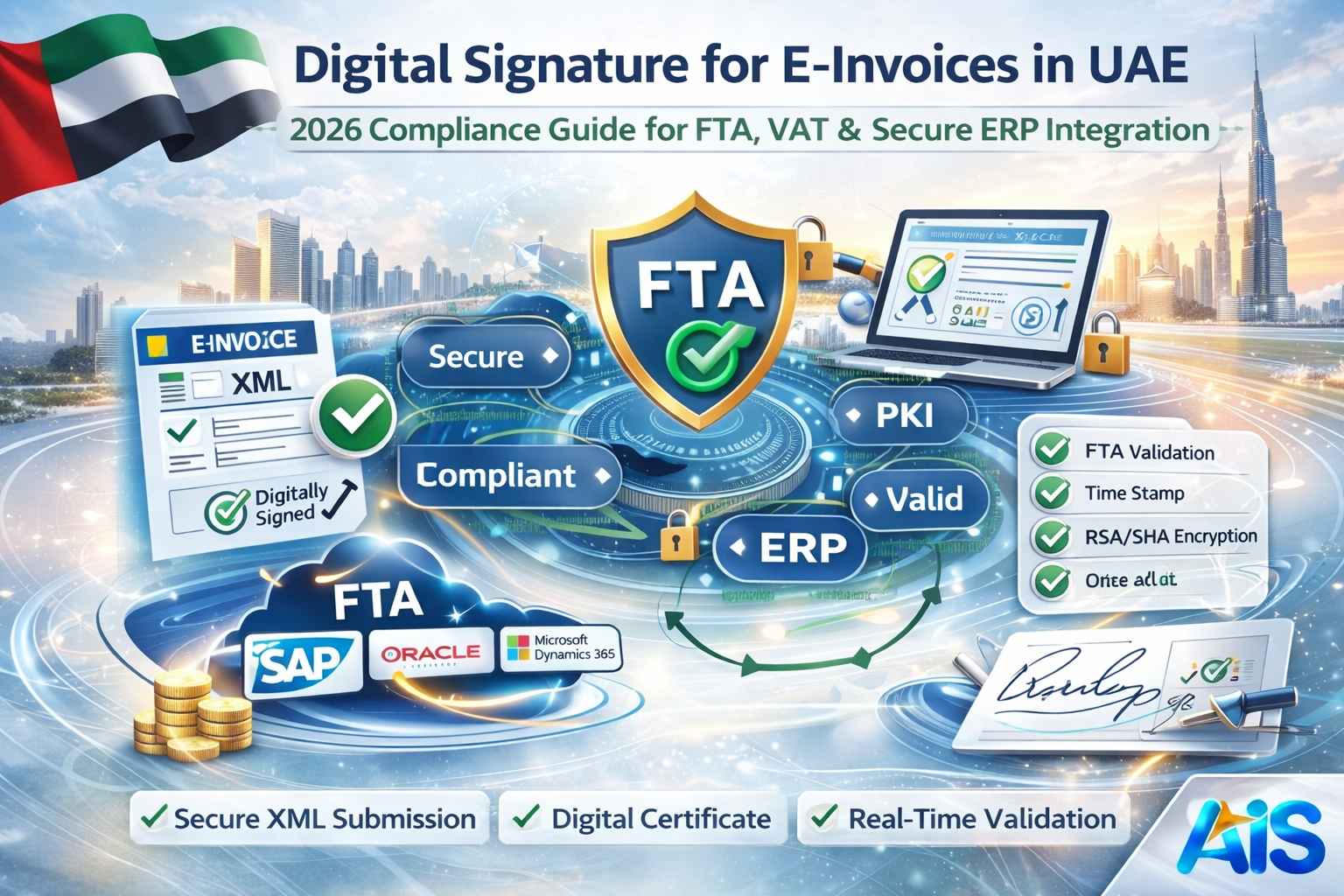
The UAE is rapidly transforming into one of the most digitally advanced tax ecosystems in the Middle East. With the introduction of structured e-invoicing frameworks and real-time reporting mechanisms, businesses must now move beyond traditional invoice generation methods and adopt secure, compliant digital processes.
One of the most critical components of UAE e-invoicing compliance is the digital signature for e-invoices.
A digital signature ensures:
- Invoice authenticity
- Data integrity
- Non-repudiation
- Secure transmission to tax authorities
- Legal validity under UAE regulations
As the UAE e-invoicing mandate evolves toward 2026, companies operating in Dubai, Abu Dhabi, Sharjah, and across the Emirates must understand how digital signatures work, when they are required, and how to implement them properly within their ERP systems.
This comprehensive guide explains everything businesses need to know about digital signatures for e-invoices in the UAE from compliance rules to technical implementation.
What is a Digital Signature in E-Invoicing?
A digital signature is a cryptographic mechanism used to validate the authenticity and integrity of an electronic document.
Unlike a scanned handwritten signature, a digital signature:
- Uses public key infrastructure (PKI)
- Applies cryptographic encryption
- Verifies that invoice data has not been altered
- Confirms the identity of the issuing entity
In the context of UAE e-invoicing, digital signatures play a vital role in ensuring secure tax reporting and compliance with VAT regulations.
Why Digital Signatures Are Critical for UAE E-Invoicing?
The UAE’s shift toward structured e-invoicing and real-time invoice validation increases the importance of secure data exchange between businesses and tax authorities.
Digital signatures provide:
1. Legal Validity
Ensures invoices meet regulatory requirements under UAE VAT laws.
2. Data Integrity
Prevents tampering or modification after invoice generation.
3. Identity Verification
Confirms the issuing entity’s authenticity.
4. Secure Transmission
Protects invoice data during API-based submissions.
5. Audit Readiness
Maintains verifiable documentation for inspections.
Without proper digital signature implementation, invoices may face rejection during compliance validation.
UAE Regulatory Framework and Digital Signatures
The UAE tax system is governed by the:
- Federal Tax Authority
- Ministry of Finance
The Federal Tax Authority (FTA) oversees VAT compliance and structured reporting requirements.
As the UAE aligns with global best practices in e-invoicing:
- Structured XML invoice formats
- Real-time validation systems
- API-based transmission
- Digital authentication mechanisms
are becoming core compliance components.
Businesses must ensure digital signatures meet UAE-approved security standards and cryptographic requirements.
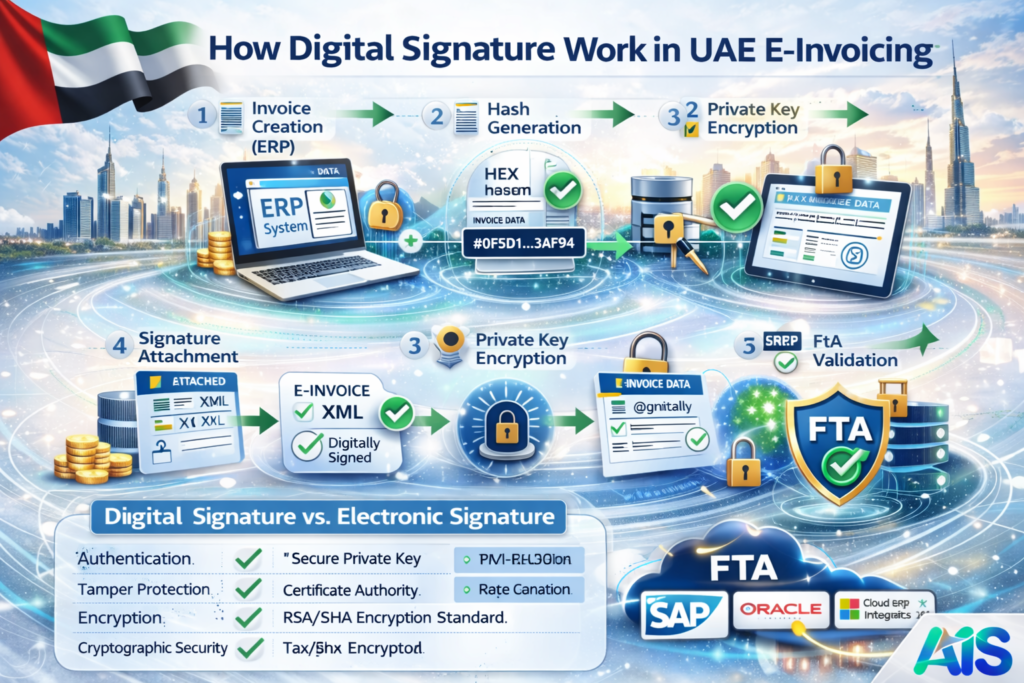
How Digital Signature Works in UAE E-Invoicing?
Here’s the simplified process:
Step 1: Invoice Creation
ERP system generates structured invoice data in XML format.
Step 2: Hash Generation
A cryptographic hash of invoice data is created.
Step 3: Private Key Encryption
The hash is encrypted using the company’s private key.
Step 4: Signature Attachment
The encrypted signature is attached to the invoice file.
Step 5: Verification
Tax authorities or recipients verify using the public key.
If any invoice data is modified after signing, the signature becomes invalid.
Types of Digital Signatures Used in UAE
Simple Electronic Signature
Basic authentication; limited compliance value.
Advanced Electronic Signature
Cryptographically secure; linked uniquely to the signer.
Qualified Digital Signature
Highest level of compliance and legal validity.
For structured tax reporting environments, advanced or qualified digital signatures are typically required.
Digital Signature vs Electronic Signature
| Feature | Electronic Signature | Digital Signature |
| Security Level | Basic | High (cryptographic) |
| Legal Strength | Moderate | Strong |
| Tamper Detection | Limited | Strong |
| Encryption | Not mandatory | Mandatory |
| Compliance Use | General | Tax & regulatory |
For UAE e-invoicing compliance, digital signatures provide stronger validation and audit security.
Digital Signature Integration with ERP Systems
Modern ERP platforms allow built-in digital signature integration, including:
- SAP S/4HANA
- SAP Business One
- Oracle ERP Cloud
- Microsoft Dynamics 365
Integration typically involves:
- PKI certificate installation
- API connector configuration
- XML schema validation
- Automated signature application
- Real-time reporting linkage
A properly integrated system ensures seamless invoice generation and compliant submission.
Technical Requirements for UAE Digital Signatures
Businesses must ensure:
- Secure private key storage
- Certificate authority approval
- SHA-256 or higher hashing algorithms
- RSA encryption standards
- Timestamp validation
- Secure API communication (HTTPS/TLS)
Failure to meet cryptographic standards can result in invoice rejection.
Benefits of Digital Signature for UAE Businesses
Reduced Fraud Risk
Protects against invoice manipulation.
Faster Tax Approval
Speeds up automated validation processes.
Improved Customer Trust
Demonstrates compliance and security.
Audit Transparency
Creates traceable compliance history.
Competitive Advantage
Positions company as digitally mature and compliant.
Common Challenges in Implementation
Many companies face:
- Legacy ERP compatibility issues
- Lack of PKI knowledge
- Certificate renewal management
- API integration complexity
- Employee training gaps
Partnering with an experienced ERP and compliance consultant reduces risks.
UAE 2026 E-Invoicing Readiness Strategy
To prepare for digital signature requirements:
Phase 1: Compliance Assessment
Evaluate ERP readiness and invoice formats.
Phase 2: Technical Setup
Install PKI certificates and integrate signature modules.
Phase 3: Testing & Validation
Run sandbox testing before live deployment.
Phase 4: Go Live
Activate real-time submission and monitoring dashboards.
How AIS Business Corp Supports UAE Compliance?
AIS Business Corp (aiscorp.ai) specializes in:
- SAP ERP implementation
- API integration
- E-invoicing automation
- Digital signature integration
- VAT compliance frameworks
- Cloud transformation
With strong expertise in structured reporting and ERP integration, AIS Business Corp helps UAE businesses prepare for 2026 compliance mandates confidently and securely.
Frequently Asked Questions
Is digital signature mandatory for e-invoices in UAE?
Digital authentication mechanisms are increasingly becoming essential in structured reporting frameworks and may be required depending on implementation phase.
What encryption standard is used for UAE e-invoices?
SHA-256 hashing and RSA encryption are commonly used in compliant systems.
Can I use a scanned signature for UAE e-invoicing?
No. A scanned signature does not provide cryptographic validation.
Does UAE FTA verify digital signatures?
Yes, structured validation mechanisms check invoice integrity.
Which ERP systems support digital signatures?
Major ERP systems such as SAP, Oracle, and Microsoft Dynamics support integration.
What happens if digital signature fails validation?
The invoice may be rejected or flagged for correction.
How long are digital certificates valid?
Typically 1–3 years, depending on certificate authority.
Is digital signature required for B2B and B2C?
Requirements may vary based on reporting model and transaction type.
Can cloud ERP systems support digital signatures?
Yes, modern cloud ERP platforms support API-based digital signing.
How can businesses prepare for 2026 compliance?
Conduct system audits, integrate digital signature modules, and partner with compliance experts.
Digital signatures are no longer optional enhancements; they are becoming fundamental components of UAE’s digital tax ecosystem.
As the UAE advances toward structured e-invoicing and real-time reporting, businesses must:
- Upgrade ERP systems
- Implement secure digital signatures
- Align with FTA requirements
- Prepare for 2026 compliance mandates
Organizations that act early will gain compliance stability, operational efficiency, and competitive advantage.
If your business operates in the UAE and needs structured guidance on digital signature integration for e-invoices, now is the right time to prepare.

