


The UAE e-invoicing implementation timeline marks one of the most significant tax digitalization reforms introduced by the UAE government. Following global trends toward real-time tax reporting and digital compliance, the UAE Federal Tax Authority (FTA) is preparing to implement a structured, phased rollout of mandatory e-invoicing across all VAT-registered businesses.
For companies operating in Dubai, Abu Dhabi, Sharjah, and across the Emirates, understanding the 2024–2026 e-invoicing compliance roadmap is critical. Businesses that prepare early will avoid penalties, reduce operational risk, and gain a competitive advantage.
This comprehensive guide explains:
- The official UAE e-invoicing rollout phases
- Key compliance milestones (2024–2026)
- FTA expectations and regulatory framework
- ERP and SAP system readiness timelines
- Industry-specific impact
- Risk and penalty exposure
- Business preparation checklist
- 10 strategic FAQs for decision-makers
Overview of UAE E-Invoicing Reform
The UAE is transitioning from traditional PDF/printed invoices to a structured electronic invoicing system that enables:
- Real-time invoice exchange
- Standardized data format (likely XML/Peppol-based model)
- Secure government validation
- Automated VAT reporting
The UAE’s approach aligns with global frameworks adopted in countries such as Italy, Saudi Arabia, and India.
Why the UAE Is Implementing E-Invoicing?
The primary objectives include:
- Enhancing VAT transparency
- Reducing tax fraud and evasion
- Automating tax audits
- Improving business digitization
- Strengthening cross-border trade compliance
The system is expected to operate under a decentralized continuous transaction control (CTC) model, allowing invoice exchange between buyer and seller while reporting data to the FTA.
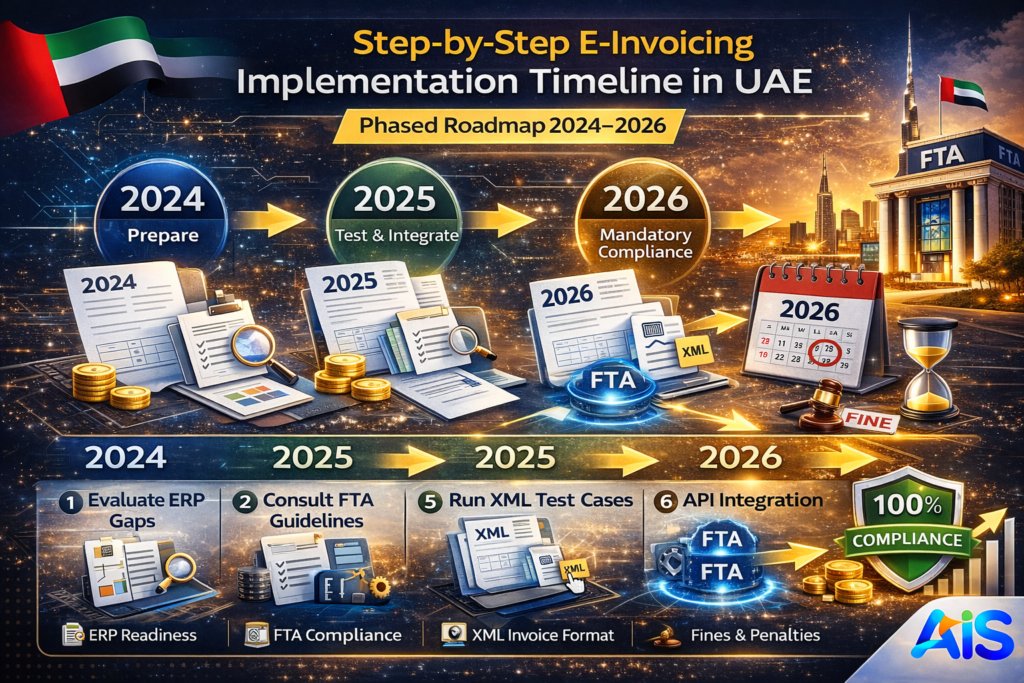
UAE E-Invoicing Implementation Timeline (2024–2026)
Below is the structured roadmap businesses must understand.
Phase 1: Framework Development & Consultation (2024)
Key Activities:
- Regulatory framework drafting
- Industry consultation sessions
- Technology architecture definition
- Accreditation model for service providers
- Data schema and invoice standardization
What Businesses Should Do in 2024:
- Assess ERP readiness
- Identify system gaps
- Engage with implementation partners
- Begin internal digital transformation planning
This phase focuses on awareness and groundwork, not mandatory compliance yet.
Phase 2: Technical Rollout & Pilot Testing (2025)
2025 is expected to be a transition year.
Expected Developments:
- Release of technical specifications
- Accredited Service Provider (ASP) registration
- Pilot testing with selected businesses
- Sandbox environment launch
- Integration guidelines for ERP systems
What Businesses Must Do in 2025:
- Upgrade ERP systems
- Configure invoice formats
- Integrate APIs for real-time reporting
- Train finance and IT teams
- Conduct test submissions
Businesses delaying preparation during this phase may struggle in 2026.
Phase 3: Mandatory Implementation (2026)
This is the critical compliance phase.
Expected Enforcement:
- Mandatory structured e-invoice issuance
- Real-time or near-real-time submission to FTA
- Digital signature validation
- Centralized audit trail maintenance
- Strict penalty enforcement
Companies failing to comply may face:
- Administrative fines
- VAT reporting penalties
- Business disruption
- Reputational risk
Who Will Be Affected?
The mandate will likely apply to:
- All VAT-registered businesses
- B2B transactions
- B2G transactions
- Potentially B2C sectors in later phases
Industries most impacted:
- Retail & eCommerce
- Manufacturing
- Construction
- Healthcare
- Logistics
- Financial services
SMEs are not exempt; early compliance is critical.
Understanding the UAE E-Invoicing Model
While final specifications are expected from the FTA, the system will likely include:
1. Structured Invoice Format
Invoices must follow standardized XML schema.
2. Real-Time Validation
Invoices may require validation through an accredited platform.
3. Secure Digital Signature
Authenticity and integrity checks.
4. Archival Requirements
Digital record retention for 5+ years.
5. Interoperability
System compatibility across ERP and accounting software.
ERP & SAP Readiness Timeline
For enterprises using SAP, Oracle, Microsoft Dynamics, or custom ERPs:
2024:
- Gap analysis
- Data structure review
- Tax code validation
2025:
- API integration
- Middleware implementation
- Digital signature configuration
- Testing and certification
2026:
- Go-live deployment
- Continuous compliance monitoring
- Audit simulation
Organizations without ERP systems must adopt compliant accounting software.
Risk of Delayed Compliance
Businesses that ignore the timeline face:
- Increased integration costs
- Last-minute system overload
- Limited service provider availability
- Regulatory fines
- Operational downtime
Early adoption reduces risk significantly.
UAE E-Invoicing Penalties (Expected Framework)
Although detailed penalties are pending confirmation, based on VAT law:
- Failure to issue compliant invoice: Administrative fine
- Failure to maintain digital records: Penalty
- Incorrect VAT reporting: Financial penalty
- System manipulation: Severe regulatory action
Preparation is not optional.
Industry-Specific Impact
Retail
High invoice volumes require automation.
Construction
Milestone-based billing must align with structured reporting.
Healthcare
Insurance claims integration required.
Logistics
Cross-border VAT treatment becomes more visible.
Step-by-Step Business Preparation Plan
Step 1: Internal Assessment
Evaluate current invoicing process.
Step 2: ERP Capability Review
Determine technical gaps.
Step 3: Compliance Strategy
Align finance, IT, and legal teams.
Step 4: Vendor Selection
Choose accredited solution providers.
Step 5: Integration & Testing
Pilot with real scenarios.
Step 6: Staff Training
Ensure operational readiness.
Step 7: Go-Live Monitoring
Track performance and reporting accuracy.
Benefits of Early Compliance
Businesses that adopt early gain:
- Faster VAT reconciliation
- Improved cash flow visibility
- Reduced audit risk
- Automated reporting
- Competitive advantage
Compliance is not just regulatory; it is strategic.
Common Challenges in Implementation
- Legacy ERP limitations
- Data inconsistency
- API connectivity issues
- Staff resistance to change
- Budget allocation delays
Planning early resolves most challenges.
UAE E-Invoicing Readiness Checklist (Quick View)
✔ ERP system compatible
✔ XML format generation enabled
✔ Digital signature integrated
✔ FTA reporting API connected
✔ Staff trained
✔ Audit simulation conducted
✔ Archiving system compliant
Frequently Asked Questions
When will e-invoicing become mandatory in UAE?
Mandatory implementation is expected in 2026, following phased preparation in 2024 and 2025.
Is e-invoicing required for all businesses?
It will likely apply to all VAT-registered businesses across the UAE.
What format will UAE e-invoices use?
Structured electronic format such as XML aligned with international standards.
Will small businesses be exempt?
No formal exemption has been confirmed; SMEs should prepare.
What happens if a business does not comply?
Penalties, VAT fines, and operational disruptions may occur.
Do SAP users need system upgrades?
Yes, SAP systems will require configuration and integration updates.
Will e-invoicing replace VAT returns?
No, but it will automate VAT data collection and reporting.
Can invoices be issued in PDF?
PDF may not be sufficient unless structured data is embedded.
How long must invoices be stored?
Minimum five years in secure digital format.
How can businesses prepare now?
Conduct ERP assessment and begin integration planning in 2024.
The UAE E-Invoicing Implementation Timeline (2024–2026) is more than a regulatory update; it is a transformation of financial reporting infrastructure.
Businesses that treat 2024 as a strategic preparation year and 2025 as an implementation year will transition smoothly into 2026 mandatory compliance.
Waiting until enforcement begins may result in financial and operational risks.
Start your readiness assessment now. Align your ERP systems, finance teams, and compliance strategy before the mandate becomes enforceable.
The future of invoicing in the UAE is digital, structured, and real-time.
Preparation today ensures compliance tomorrow.
