

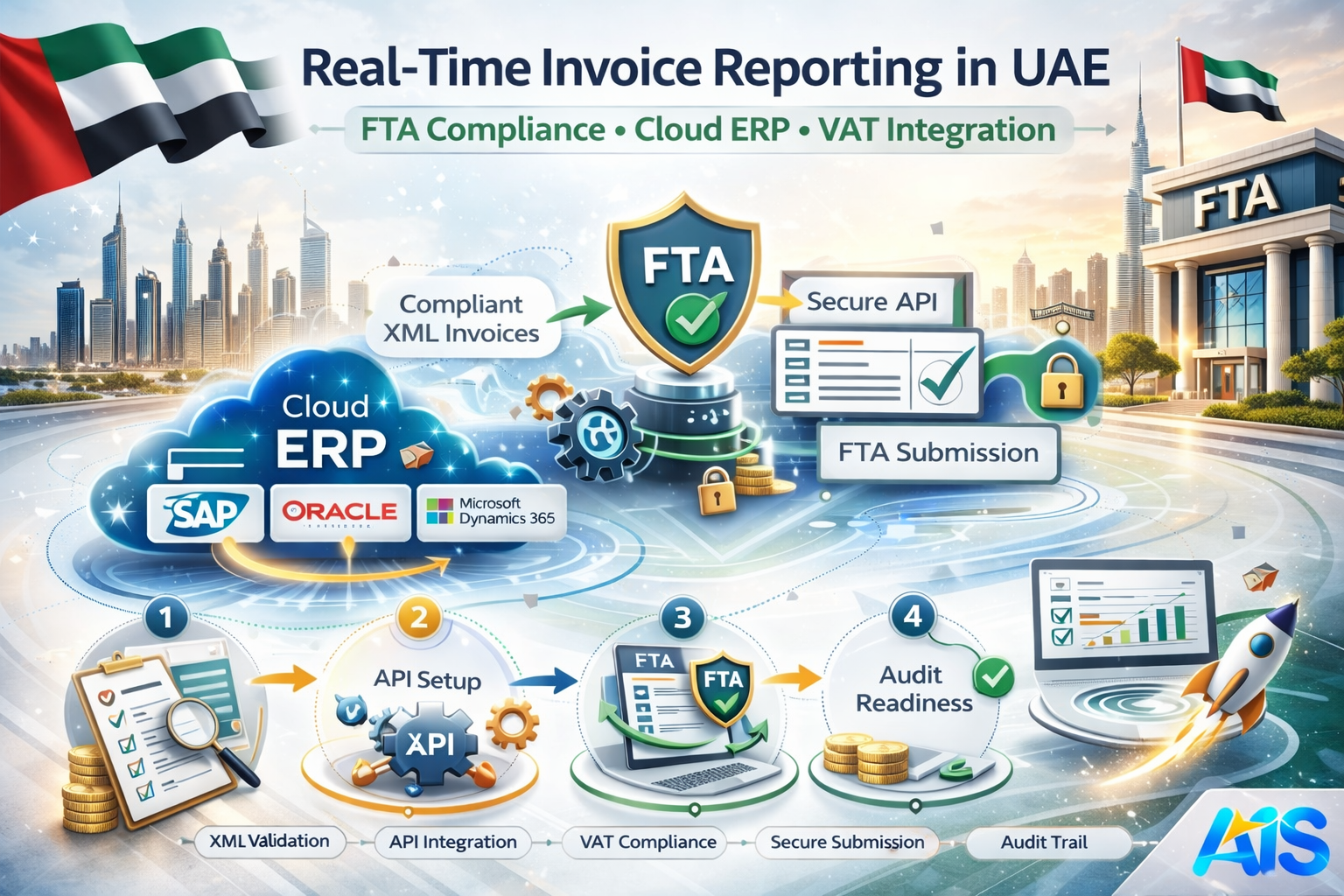
The UAE is rapidly transforming its tax and digital compliance ecosystem. With the evolution of VAT regulations and structured digital reporting, Real-Time Invoice Reporting in UAE is becoming a critical requirement for businesses operating across the Emirates.
The introduction of structured e-invoicing frameworks under the supervision of the Federal Tax Authority (FTA) signals a move toward greater transparency, automation, and fraud prevention. Businesses must now prepare for automated invoice submission, validation, and reporting through secure digital systems integrated with their ERP platforms.
This comprehensive guide explains:
- What real-time invoice reporting means in the UAE?
- How it differs from traditional VAT reporting?
- FTA compliance requirements
- ERP integration roadmap
- Implementation challenges and solutions
- Best practices for 2026 readiness
What is Real-Time Invoice Reporting?
Real-Time Invoice Reporting (RTIR) refers to the automated electronic submission of invoice data to tax authorities immediately or shortly after issuance.
Instead of reporting VAT periodically (monthly or quarterly), invoice data is transmitted digitally to the FTA through:
- Structured XML format
- Secure APIs
- Accredited service providers
- ERP-integrated reporting systems
This ensures:
- Instant validation
- Reduced tax evasion
- Accurate VAT reconciliation
- Faster audits
Why UAE is Implementing Real-Time Reporting?
The UAE government aims to:
✔ Increase VAT Transparency
✔ Prevent Fraud & Invoice Manipulation
✔ Enable Digital Tax Audits
✔ Align with Global E-Invoicing Standards
✔ Improve Business Automation
Countries such as Italy, Saudi Arabia, and Brazil have already implemented clearance or reporting models. The UAE is aligning with global best practices to strengthen compliance infrastructure.
Traditional VAT Filing vs Real-Time Reporting
| Feature | Traditional VAT Filing | Real-Time Invoice Reporting |
| Submission Frequency | Monthly/Quarterly | Immediate or near real-time |
| Format | Manual/Excel/ERP reports | Structured XML |
| Validation | After filing | Instant |
| Audit Risk | High | Reduced |
| Compliance Automation | Limited | Fully Automated |
Real-time reporting shifts compliance from retrospective to proactive.
UAE Real-Time Invoice Reporting Framework
Although implementation phases may roll out gradually, the UAE model is expected to include:
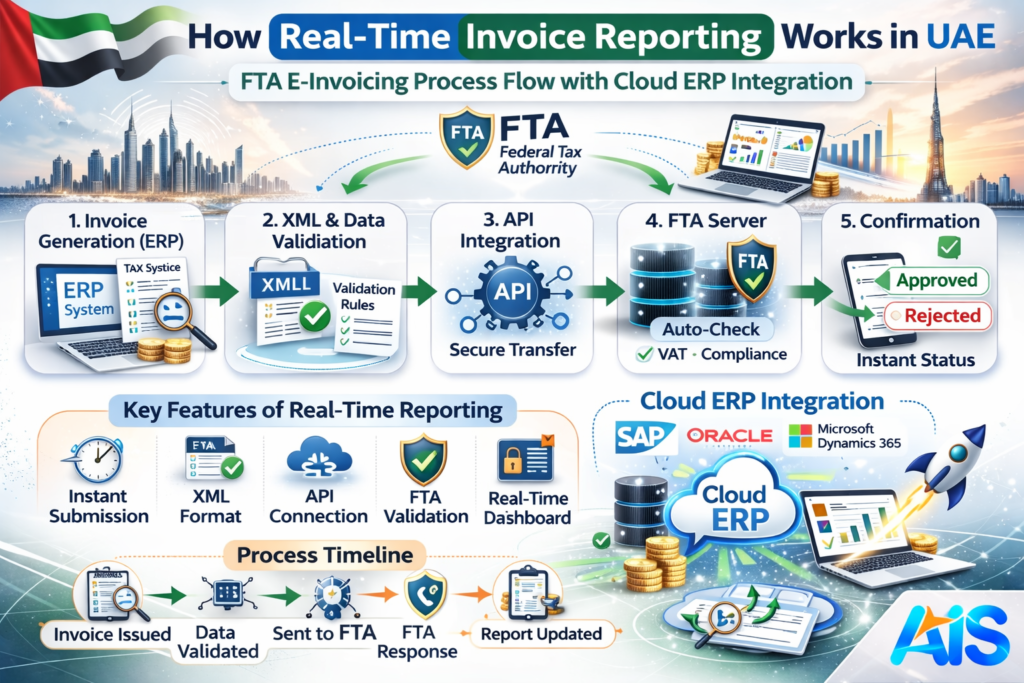
Invoice Generation
ERP generates invoice in structured format.
Data Validation
Invoice validated against VAT rules.
Secure API Transmission
Invoice transmitted securely to FTA.
FTA Confirmation
Invoice approved, rejected, or flagged.
Storage & Audit Trail
Digital archive maintained for compliance.
This process requires ERP systems to be technically upgraded.
Role of Cloud ERP in Real-Time Reporting
Modern ERP platforms such as:
- SAP
- Oracle
- Microsoft Dynamics 365
allow seamless integration via APIs and structured invoice mapping.
Key ERP requirements include:
- XML invoice generation
- Tax code mapping
- API connectivity
- Digital signature capability
- Secure storage
Without ERP modernization, compliance becomes complex and risky.
Technical Components of Real-Time Reporting
A. Structured Invoice Format
Invoices must follow XML schema standards.
B. API Integration
Secure real-time communication between ERP and FTA.
C. Encryption & Security
TLS encryption and digital certificates required.
D. Validation Engine
Automated VAT rule validation.
E. Archiving
Secure digital storage for audit compliance.
Implementation Roadmap for UAE Businesses
Step 1: ERP Assessment
- Evaluate current ERP readiness
- Check API capabilities
- Review tax configuration
Step 2: Compliance Gap Analysis
- Identify missing fields
- Validate VAT mapping
- Review invoice templates
Step 3: XML & API Configuration
- Develop structured invoice format
- Enable secure API integration
Step 4: Sandbox Testing
- Submit test invoices
- Validate approval cycles
Step 5: Staff Training
- Train finance and IT teams
Step 6: Go-Live & Monitoring
- Activate real-time reporting
- Monitor error logs
Benefits of Real-Time Invoice Reporting
- Faster VAT Reconciliation
- Improved Compliance Security
- Better Financial Transparency
- Reduced Audit Risks
- Automated Reporting
Businesses that implement early gain operational advantage.
Challenges Businesses May Face
❌ Legacy ERP Limitations
❌ API Integration Complexity
❌ Data Mapping Errors
❌ Security Compliance Gaps
❌ Change Management Resistance
Proactive planning reduces disruption.
Impact on SMEs vs Large Enterprises
| SME | Large Enterprise |
| Lower transaction volume | High invoice volume |
| May need ERP upgrade | Complex multi-ERP integration |
| Budget-sensitive | Requires enterprise security compliance |
| Faster implementation | Longer testing cycles |
Both segments must prepare early.
Compliance Risks of Non-Adoption
Failure to comply may result in:
- Financial penalties
- VAT filing rejection
- Increased audits
- Business disruption
- Reputational damage
Best Practices for 2026 Readiness
✔ Start ERP audit in advance
✔ Choose experienced implementation partner
✔ Implement secure API infrastructure
✔ Train internal compliance team
✔ Maintain structured documentation
✔ Monitor FTA updates
Future of Digital Taxation in UAE
The UAE is moving toward:
- Fully automated tax ecosystem
- AI-driven audit analytics
- Cross-border digital reporting
- Integrated customs and VAT platforms
Businesses that digitize early will remain competitive.
Frequently Asked Questions
What is real-time invoice reporting in UAE?
It is the automated electronic submission of invoice data to the FTA immediately after issuance.
Is real-time reporting mandatory in UAE?
Phased implementation is expected under evolving FTA regulations.
Do SMEs need ERP upgrades?
Yes, if current systems cannot generate XML structured invoices.
What format is required?
Structured XML format compliant with UAE tax schema.
How does it affect VAT filing?
It automates VAT reconciliation and reduces reporting errors.
Is API integration compulsory?
Yes, secure API communication enables automated submission.
What happens if invoices are rejected?
They must be corrected and resubmitted.
Does real-time reporting reduce audits?
It significantly lowers compliance risks and audit frequency.
How secure is invoice transmission?
It uses encrypted protocols and digital certificates.
When should businesses start preparing?
Immediately, to avoid compliance delays.
Real-Time Invoice Reporting in UAE represents a significant transformation in tax compliance and financial reporting. Businesses must modernize their ERP systems, integrate secure APIs, and align with FTA regulations to ensure seamless compliance.
Early adoption not only reduces regulatory risk but also enhances operational efficiency and financial transparency.
Organizations that act today will be fully prepared for the UAE’s digital tax future in 2026 and beyond.
