


UAE e-invoicing connector, UAE einvoicing connector, UAE e-invoice connector, and UAE e-invoicing connector services are becoming essential for businesses that need seamless integration between ERP systems and the upcoming UAE digital tax invoicing framework.
As the Federal Tax Authority prepares to implement nationwide electronic invoicing, organizations across Dubai, Abu Dhabi, Sharjah, Ajman, Ras Al Khaimah, Fujairah, Umm Al Quwain, and UAE freezones are actively searching for reliable UAE e-invoicing connector providers to automate invoice exchange, ensure tax compliance, and streamline financial operations.
A powerful UAE e-invoice connector bridges the gap between your ERP, billing platform, or accounting software and the UAE’s future digital invoicing ecosystem. Businesses that adopt the right connector early gain advantages in automation, compliance readiness, and operational efficiency.
This article explains why UAE e-invoicing connector services are becoming a critical infrastructure component for modern businesses.
What is a UAE E-Invoicing Connector?
A UAE e-invoicing connector is a middleware integration layer that connects business systems such as ERP platforms with the government-approved electronic invoicing network.
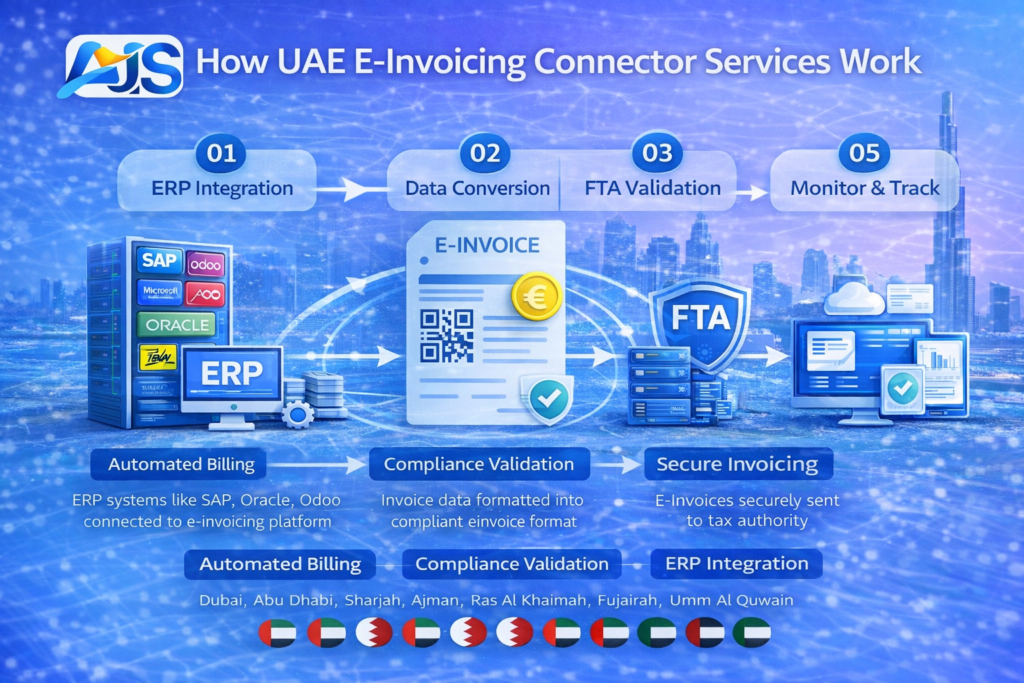
Instead of manually generating invoices and sending them to customers, a connector automatically:
• Extracts invoice data from ERP
• Converts it into compliant digital format
• Validates tax information
• Sends invoices to the UAE e-invoicing network
• Receives confirmations and status updates
The result is fully automated digital invoicing that aligns with regulatory requirements.
Companies across the UAE are implementing e-invoice connectors to prepare for the national e-invoicing rollout and maintain smooth invoice processing.
Why UAE Businesses Need an E-Invoice Connector?
Businesses today operate on multiple digital systems – ERP platforms, accounting software, procurement tools, and billing solutions.
Without a connector, integrating these systems with e-invoicing infrastructure can be complex.
A UAE einvoice connector solves this challenge by acting as the communication bridge between business software and tax reporting systems.
Key benefits include:
1. Automated Invoice Transmission
Invoices are automatically transmitted to the network without manual intervention.
2. Real-Time Tax Compliance
Connectors validate invoices against tax rules before submission.
3. ERP Integration
Systems like SAP, Oracle, Microsoft Dynamics, and Odoo can easily connect.
4. Faster Invoice Processing
Automation reduces delays in invoice generation and approval.
5. Secure Data Exchange
Connectors ensure encrypted data transmission.
Businesses in Dubai, Abu Dhabi, and Sharjah are already adopting these solutions to stay ahead of regulatory changes.
UAE E-Invoicing Framework: What Businesses Should Know?
The UAE government is implementing a structured electronic invoicing system that will digitize invoice exchange between businesses and authorities.
This initiative aims to:
• Improve tax transparency
• Reduce fraud
• Increase reporting accuracy
• Enhance financial automation
The UAE model is expected to follow international standards similar to PEPPOL-based frameworks, enabling standardized digital invoice exchange across organizations.
Companies that implement a UAE e-invoice connector provider solution early will experience a smoother transition when e-invoicing becomes mandatory.
Key Components of UAE E-Invoicing Connector Architecture
A modern UAE e-invoicing connector service includes several essential components.
ERP Integration Layer
Extracts invoice data directly from enterprise systems.
Data Transformation Engine
Converts invoice data into a compliant digital structure.
Validation Module
Ensures all invoices meet regulatory requirements.
Secure Transmission Gateway
Sends invoices to the electronic invoicing network.
Monitoring Dashboard
Allows businesses to track invoice status and approvals.
This architecture ensures seamless communication between ERP systems and government platforms.
Industries That Require UAE E-Invoicing Connectors
Nearly every industry in the UAE will benefit from adopting an e-invoicing connector.
Key sectors include:
Retail & E-Commerce
Automated invoicing for high transaction volumes.
Logistics & Supply Chain
Digital invoice exchange across partners.
Construction & Contracting
Structured billing for project-based payments.
Manufacturing
Automated supplier and distributor invoicing.
Equipment Rental & Leasing
Recurring billing automation.
Professional Services
Accurate client invoicing and reporting.
Companies in UAE freezones and mainland jurisdictions will increasingly depend on connectors to streamline financial workflows.
ERP Systems That Require E-Invoice Connectors
Most enterprise businesses use ERP systems to manage finance and operations.
Popular ERP systems in the UAE include:
• SAP
• Oracle ERP
• Microsoft Dynamics
• Odoo
• Tally
• Zoho Books
A UAE e-invoicing connector provider enables these platforms to exchange invoices with the national e-invoicing network automatically.
Without connectors, businesses would need costly manual integrations.
Why Businesses in UAE Cities Are Adopting E-Invoice Connectors?
Organizations across the UAE are accelerating digital transformation.
Dubai
Large enterprises are investing in invoice automation for global operations.
Abu Dhabi
Government-linked companies are prioritizing regulatory compliance.
Sharjah
Manufacturing and logistics companies require invoice standardization.
Ajman
SMEs are adopting digital invoicing for efficiency.
Ras Al Khaimah
Industrial companies need automated supplier invoicing.
Fujairah
Logistics and shipping firms require real-time invoice exchange.
Umm Al Quwain
Small businesses are shifting toward digital tax reporting.
Across these regions, e-invoicing connector services help companies reduce complexity and ensure compliance.
High-Intent Commercial Use Cases for UAE E-Invoicing Connector Services
Businesses searching for UAE e-invoicing connector provider solutions usually have immediate implementation needs.
Common commercial use cases include:
• ERP integration with e-invoicing systems
• Automated invoice validation
• Tax-compliant digital invoice generation
• Invoice exchange with suppliers and buyers
• Secure invoice archiving
• Invoice status monitoring
These services significantly reduce manual work in finance departments.
How AIS Corp Delivers Advanced UAE E-Invoicing Connector Services?
Organizations looking for a reliable UAE e-invoicing connector provider require scalable and compliant technology.
AIS Corp solutions provide:
Seamless ERP Integration
Connectors compatible with major ERP systems.
Automated Compliance Validation
Ensures invoices meet regulatory standards.
Real-Time Invoice Exchange
Instant communication with invoicing networks.
Scalable Architecture
Supports growing transaction volumes.
Secure Cloud Infrastructure
Enterprise-grade security for financial data.
Businesses across Dubai, Abu Dhabi, Sharjah, and UAE freezones rely on advanced integration solutions to streamline invoicing workflows.
Future of E-Invoicing Connectors in the UAE
The demand for UAE einvoicing connector services will increase as digital tax infrastructure expands.
Future developments may include:
• Real-time tax reporting
• AI-powered invoice validation
• Automated financial analytics
• Cross-border invoice exchange
• Lockchain-based invoice authentication
Companies that implement connector technology early will gain a strong operational advantage.
The rise of UAE e-invoicing connector, UAE einvoicing connector services, and UAE e-invoice connector providers marks a major shift in how businesses manage financial transactions.
Instead of relying on manual invoice processes, companies across Dubai, Abu Dhabi, Sharjah, Ajman, Ras Al Khaimah, Fujairah, Umm Al Quwain, and UAE freezones are adopting connectors to automate compliance, integrate ERP systems, and streamline digital invoicing.
Businesses that deploy robust e-invoicing connectors today will be best prepared for the UAE’s rapidly evolving digital tax environment.
FAQ – UAE E-Invoicing Connector
What is a UAE e-invoicing connector?
A UAE e-invoicing connector is integration software that connects ERP systems with the national electronic invoicing network to automate invoice exchange.
Why do businesses need e-invoice connectors?
They automate invoice submission, ensure compliance, and reduce manual processes.
Is e-invoicing mandatory in the UAE?
The UAE is implementing a national e-invoicing framework that will require businesses to adopt compliant systems.
What systems can connect to e-invoicing platforms?
ERP systems like SAP, Oracle, Microsoft Dynamics, Odoo, and other accounting platforms can connect using connectors.
Are e-invoice connectors secure?
Yes, most connectors use encrypted communication and secure authentication protocols.
Can SMEs use e-invoice connectors?
Yes. Small and medium businesses can integrate their accounting systems through lightweight connectors.
Do UAE freezone companies require e-invoicing connectors?
Freezone companies involved in taxable transactions may need connectors to comply with invoicing regulations.
What industries benefit the most from e-invoice connectors?
Retail, logistics, manufacturing, construction, and service companies benefit the most.
How long does connector implementation take?
Depending on system complexity, implementation can take a few weeks.
How can businesses choose the best e-invoicing connector provider?
Businesses should evaluate integration capability, compliance support, security, scalability, and implementation expertise.

